

 Truth is stranger than fiction, right? Case in point: at last night’s screening of Wildcat at Boston’s Coolidge Corner Theatre, presented by Ethan Hawke and co-writer Shelby Gaines, a pair of nuns sat in the row next to us. It was a beautiful juxtaposition, the two prim devotees politely awaiting the film’s start as the college kids packing the rest of the house shouted at their friends to get them another beer. You can’t make this up — but if anyone could, it’d be Flannery O’Connor.
Wildcat stars Maya Hawke as the Southern Gothic writer, centered mostly on the tumultuous period of her mid-twenties in which she struggled to publish her first novel Wise Blood. During this time O’Connor is diagnosed with lupus, the disease that would eventually kill her, and she returns to her childhood home in rural Georgia to live with her mother Regina (Laura Linney). O’Connor’s life for the next twelve years was hardly cinematic — her daily routine consisted of going to mass and writing in the morning and then recuperating in the afternoon — and so it’s to Wildcat‘s benefit that writer/director Ethan Hawke and co-writer Shelby Gaines make two bold choices in structuring the film.
The first is to hang the film on her relationship with her mother, essentially the only real relationship O’Connor had throughout her life. This is underscored with the second structural swing: a program of O’Connor’s short stories — including “The Comforts of Home,” “The Life You Save May Be Your Own,” “Revelation,” “Parker’s Back,” “Everything That Rises Must Converge” and “A Good Man is Hard to Find” — are depicted throughout the film, with Maya Hawke and Laura Linney appearing as one of the characters in each. It’s an admittedly inspired choice for this biopic about an author who, in spite of a hard existence, led an interior life of vibrancy and excitement.
These episodic stories inform the larger framing device of O’Connor at home with Regina, often bringing to the fore the vastly different ways in which the two women view the world. Somewhat sneakily, there’s a great bit of her story “The Enduring Chill” in the framing device, too, which adds an extra layer of mystique. “Chill” is about a sickly author coming home to his stuck-in-the-past mother, detailing his helpless frustration as his mother insists that the useless town physician will fix him right up and allow the author back to his “cute stories.” But the author knows that the local doctor can’t fix what’s wrong with him, nor can any doctor, and in the context of O’Connor’s relationship with Regina it rings all the truer.
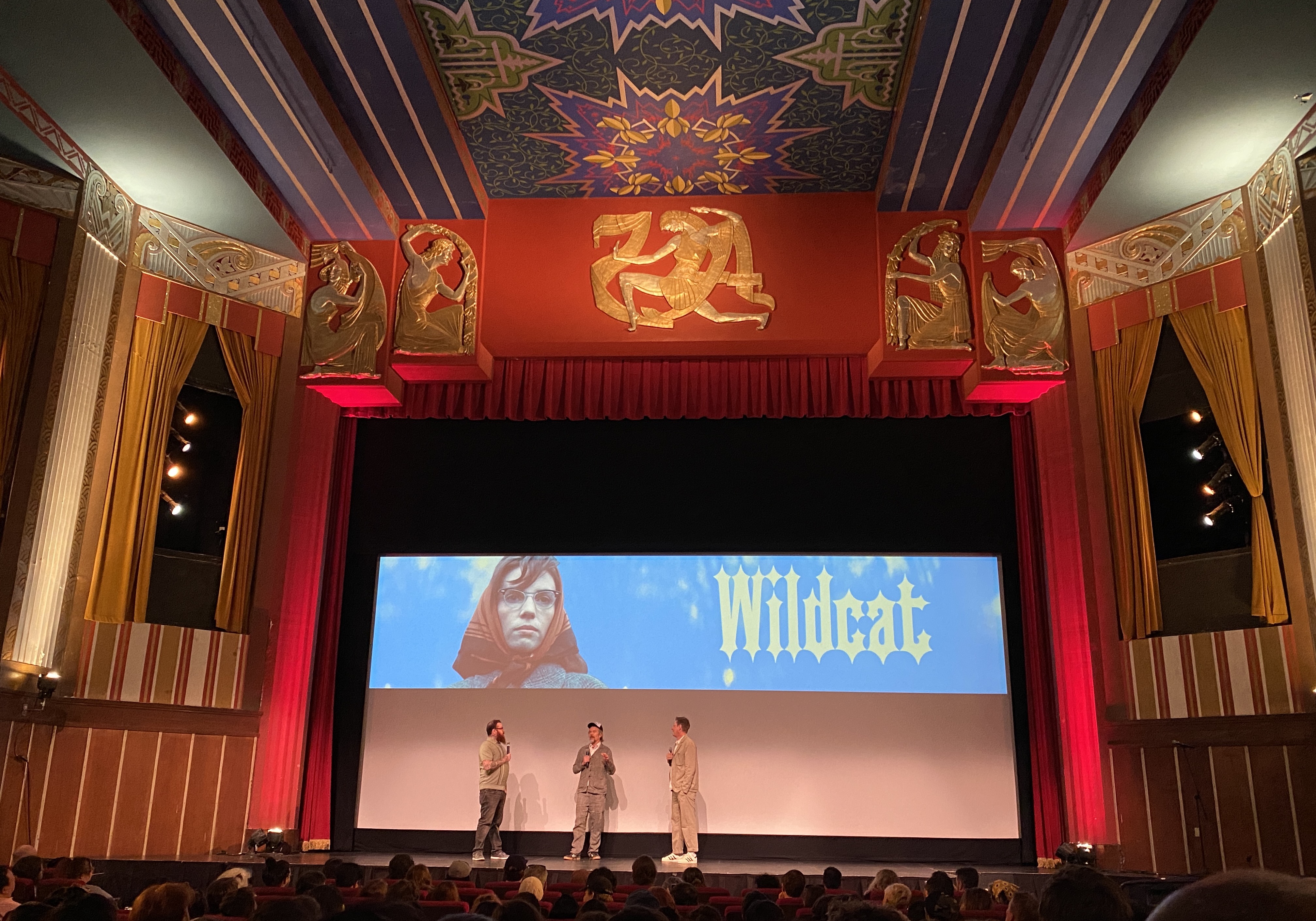
Co-writers Hawke and Gaines spoke about a number of things in the post-screening Q&A, including an interesting rundown of Hawke’s directorial influences on this project. He mentioned Peter Weir’s gothic Picnic at Hanging Rock and highlighted Weir’s ability to make an everyday setting like the classroom of Dead Poets Society feel mysterious and wondrous. The gloomy, foggy train station in which we meet the young author at the beginning of Wildcat certainly plays like something Weir would have filmed. Honing in on O’Connor’s deeply religious life, Hawke also admitted that he “wouldn’t have made this film without Paul Schrader’s First Reformed” (a film we listed as our favorite of 2018). In another humorous anecdote Hawke recalled a woman on a plane succinctly giving her review of O’Connor’s Wise Blood: “It’s fucked up!” Much to my delight, this made the nuns in the row next to us chortle.
But the most interesting comments were about choosing the stories that appear throughout the film, with the co-writers knowing that they wanted to “write to the Flannery-Regina relationship” and have their stars Maya Hawke and Laura Linney take on multiple additional roles. In a sense this works, especially when Linney gets the chance to play a character like Ruby Turpin from “Revelation” or Julian’s mother from “Everything That Rises Must Converge.” These women are the outward picture of Southern Nice, with pleated skirts and frilly hats and a “good disposition”…but they’re also women unable (or unwilling) to emerge from a racist worldview, which O’Connor clearly and gleefully presents as a grotesque conundrum in her writing. Linney absolutely nails this complexity, perfectly cast as the prototypical Southern White Socialite blissfully in denial of the blemishes on her own heart.
And yet O’Connor herself can be accused of racism throughout her life, with a whole slew of letters and correspondence containing ideas that betray the author’s prejudices. In Wildcat, while Linney often carries the load of racism in her various characters, Maya Hawke — and by extension Flannery O’Connor herself — is consistently cast as the comparatively righteous one, rolling her eyes as another person entirely exudes bigotry and intolerance. She’s the one who angrily chucks a book at Ruby Turpin in “Revelation,” and the one who bemoans her mother’s discrimination in “Everything That Rises,” and the implication is a disappointing one. Wildcat purports to confront the racism of its subject in a way that so many other biopics skip over entirely, but in a way it’s much worse to pretend that O’Connor was some sort of anti-racist. One is forced to wonder if the roles should be reversed, the author herself in the polished shoes of her most racist characters.
So maybe the truth isn’t stranger than fiction after all. Wildcat is a uniquely-told tale, and refreshing in the context of those dime-a-dozen biopics about famous artists. The structure is inspired and the performance from Linney is especially pitch-perfect, but the twisting of the truth still makes for an uncomfortable and contradictory experience. The film’s version of Flannery O’Connor even chides one of her fellow writers at one point for trying to soften her language: “The truth doesn’t change according to your ability to stomach it.” Stylistic prowess and performances aside, the team behind Wildcat might have taken that lesson to heart. The truth may not be stranger than fiction, but it’s a definitely lot harder.
 Motion State Review