

 No matter how closely a film adaptation hews to its source material, the experience will always be uniquely different from page to screen. Nickel Boys, adapted from Colson Whitehead’s 2019 novel by documentarian RaMell Ross, underscored that fact as it opened the 62nd New York Film Festival on Saturday night. Even the decision to drop The from the film’s title, for example, seemingly one of the more minor changes made by Ross and his crew, is a crucial one for a story about the broad nature of identity. Nickel Boys may center around two distinct characters, but the intersection between them and the other boys at Nickel Academy is the real heart of both novel and film.
When Elwood Curtis (Ethan Herisse) happens to hop into the wrong car, he’s arrested and brought to the sadistic juvenile reform school Nickel Academy. There he meets Turner (Brandon Wilson), a young man with a very different outlook on their similar circumstances. While Elwood sees a world ripe for change, spurred by the ideals of Martin Luther King Jr., his friend largely opts for survival by keeping his head down. As Elwood seeks the beauty in the world, he and Turner are forced to reckon with the abuse of Nickel for the rest of their lives.
Ross’s adaptation is a highly stylish one, shot entirely in POV through the eyes of the main characters. The most immediate result is probably the best cinematography in an American debut in the past decade, with Ross and DP Jomo Fray doing Elwood’s outlook justice by capturing beauty even in a horrific place like Nickel. Ross brings the same eye he brought to his documentary feature Hale County This Morning, This Evening, finding wonder in the simplicity of a reflective surface or a dancing shadow. Most importantly, this commitment to perspective befits the story in a number of ways, seeking purchase in Whitehead’s effortlessly declarative writing:
“Elwood saw that he was always simultaneously at home in whatever scene he found himself and also seemed like he shouldn’t have been there; inside and above at the same time; a part and apart. Like a tree trunk that falls across a creek—it doesn’t belong and then it’s never not been there.”
There is a realization regarding identity at the end of Nickel Boys (which I will not spoil here), and in Whitehead’s novel this realization both upends and underscores the themes of the rest of the book. “Who was he?” one of the characters asks himself as he looks back on having barely escaped Nickel decades ago. “He was him, the man he had always been.” Whitehead’s language is reminiscent of a similarly-ambiguous sentence from Philip Roth’s The Human Stain, another novel centered on an African American bereft of his own identity: “Could it be because who he really was was entirely his secret?” The dual ways to read these seem to be at war with one another: identity as secret, secret as identity. In Nickel Boys the line is completely blurred, and yet Whitehead’s delivery of this story is so clear and direct that the ramifications of the concluding revelation are absolutely inescapable.
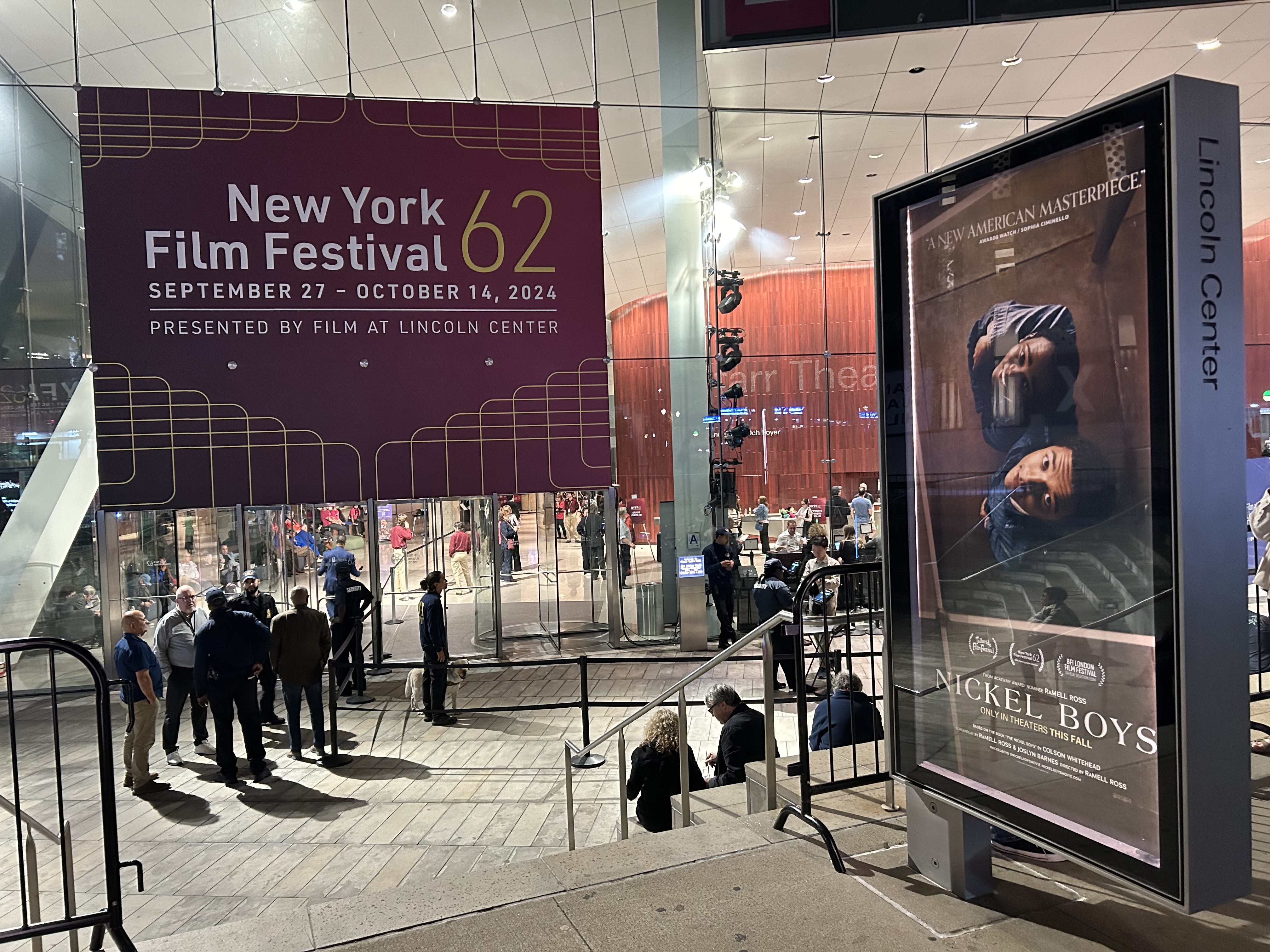
The film adaptation from Ross is clear in the sense that it is honest, fully borne of his style and vision, and yet as the events of the story play out on screen they become more muddled than their counterparts on the page. There is something crucial in the conciseness of Whitehead’s work, laying out in a matter-of-fact way an unblinking, brutal history (for Nickel Academy is indeed based on the very real Dozier School). While Ross’s film finds beauty in simplicity again and again, the uniqueness of the POV approach begins to overwhelm the story at hand by the midpoint. By the time the revelatory ending of Nickel Boys comes about, the film’s style almost seems to be more important than its subject.
Granted, a viewer experiencing the film without the touchpoint of the novel will have a completely different experience. Given the alternative adaptation we might have seen instead — a Hollywoodized, Oscar-season release full of famous faces, a heartbreaking string section playing over a movie you swear you’ve seen before — Ross’s adaptation is a revelation in and of itself. This is not a movie you have seen before. Regardless of form, Nickel Boys is an incredible story of identity and resilience, willing and able to seek beauty in an ugly world.
 Motion State Review