Category Archives: Film Review

Batman Returns (1992)

‘Tis the season! ‘Tis a time for merriment, gaiety, festivity, and a bunch of other synonyms! ‘Tis also a time in which box-office turnouts for fifth and sixth installments of Saw or Fast and Furious vastly outweigh those for fresh, original film — a time in which the popularity of one kind of movie seems almost contingent on the failure of the other. ‘Tis a good time for cynicism, evidently.

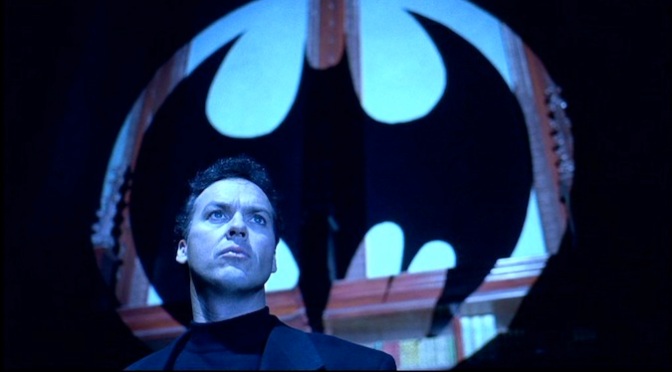
Batman Returns is a superhero sequel, obviously, but it’s not the kind of assembly-line movie that phrase conjures up today (it’s also a Christmas movie, hence my yuletide cheer). This isn’t an instantly forgettable Marvel sequel like Iron Man 2 or Thor: The Dark World, seemingly intent only on filling the space between Avengers team-ups. Returns, like Burton’s first Batman film, takes pride in originality even in the face of decades of established Bat-lore, flipping things upside down and ignoring long character histories and comic book arcs in favor of new things, for better or worse. So in Batman we discover that the Joker is the one who killed Thomas and Martha Wayne, not some nobody named Joe Chill; here in Returns, Penguin isn’t a respected sophisticate but instead a literal man-bird. Returns basically says f*ck you to so much of the Batman canon that it’s difficult to imagine it being released today without causing fanboydom to implode.

Continue reading Batman Returns (1992)

Inherent Vice (2014)

Doc Sportello ain’t a do-gooder, as one of the trailer lines for Inherent Vice sings, but he’s done good. Paul Thomas Anderson’s seventh movie doesn’t seem to match up with anything else he’s done, tempting though it may be to shove it in the same category with Boogie Nights simply because they’re both comedies. There’s a little Boogie in there, for sure – there’s also mid-’80s Leslie Nielsen zaniness, a bit of Robert Altman, a bit of early Guy Ritchie, a bit of everything. Joaquin Phoenix plays Doc, a sofa-riding P.I. suddenly embroiled in a kidnapping/murder case that’s way, way over his head. The moving parts of the case are as perplexing to Doc as those of the film proper might be to us, and when Doc gives up trying to make sense of it all is about the time we do the same.

So, yeah: Inherent Vice has Jewish real estate moguls, ex-convicts, flat-topped cops, Japanese drug cartels, the Aryan Brotherhood, doped-up dentists, maritime lawyers and an increasingly large cross-section of people known from San Fran to San Diego with clear disdain or clear indifference as hippies. There are loan sharks, FBI agents, tenor sax players. There’s a big boat which might be called The Golden Fang, might not. How could these disparate agencies possibly be connected?

Continue reading Inherent Vice (2014)

The Hustler (1961)

There’s a long legacy of sports films where the heroes are the starry-eyed, passionate lovers of the game, the athletes who play from the heart and, despite a lack of technique or formal training, still come out on top. Even Rocky emerges from his loss against Apollo Creed with the blood, sweat, tears and girlfriend to prove that, in the end, he’s the real winner. Robert Rossen’s The Hustler is not one of these movies. If you asked George C. Scott’s character, Bert, what those other heroes had in common, he’d tell you it was “character.” Paul Newman’s Fast Eddie, on the other hand, has none. The Hustler tells the story of how Eddie (our hero, if you can call him that) earned his character.

The opening scene introduces Fast Eddie, a drifting pool shark, as he executes his latest con in a small town billiards hall. Just as he’s about to put away the eight ball in a finishing move and claim all the bets, the camera decides to stay on his face, completely ignoring the action on the table. We know Eddie wins because of the sound of the ball landing in the pocket, but that’s not the sound Eddie lives for. He’s there for the shit-eating grin he gets to wear the moment he wins. For the groans of gamblers that have lost money on a rigged bet. For the wad of cash he gets to shove in his breast pocket. He’s good at pool, sure. Hell, he’s the best anyone’s seen. But there’s no indication yet that he plays pool for any other reason than that it’s a game that attracts the greasy, betting types with loose wallets. For Eddie, pool’s a means to an end of fame and glory. And this, somehow, is the protagonist we’re supposed to fall in love with.

Continue reading The Hustler (1961)

American History X (1998)

Director Tony Kaye has certainly not been afraid of being too graphic in his limited body of work. In his 1998 movie American History X, starring Edward Norton and Edward Furlong, Kaye doesn’t shy away from explicit detail in showing both the past and present of Derek Vinyard (Norton), a young founder of the white supremacist group D.O.C. and his influence on his younger brother (Furlong). The graphic depiction in this movie, despite making it difficult to watch at times, is what makes it so great, along with the performances by Norton and Furlong. Through these two important aspects of the film, the viewer gets a real look at racism in this country; but more than that, the viewer is confronted with the immense influence — either positive or negative — that either a father or an older brother can have on a young boy.

The movie takes place between two time periods. The present day spans a mere 24 hours with flashbacks to the past that show several years. Each of the flashbacks is presented in black and white, a nice directorial touch to not only make it evident that what is occurring is in fact the past but also to show the ignorance and narrow-mindedness in Derek’s views. Once Derek is released from prison, marking the present day, the scene shifts from black and white to color. At that moment, we find that Derek no longer sees the world in black and white. During his time in prison, due to the help of his unlikely friend Lamont (Guy Torry) and former teacher Dr. Sweeney, as well as a falling out with the Aryan Brotherhood in jail (which culminates in a graphic rape scene), Derek is able to see the world in all its colors and look beyond race and bigotry.

Continue reading American History X (1998)

The Wolf of Wall Street (2013)

This is certainly one of those films that you either absolutely love or downright hate, and I can understand why. Martin Scorsese’s latest work, The Wolf of Wall Street, really isn’t that much different from many of his other pictures except for the intensity of the vulgarity -the literal sex, drugs and rock n’ roll – which turns certain people off from the film. The use of 569 F-words, numerous sex scenes including a gay orgy, the consumption of copious amounts of Vitamin B (posing as cocaine) and Quaalude’s, as well as speeding cars, helicopters and yachts, all add to the excessive feeling and tone that the movie captures so well, love it or hate it. Whether or not you enjoyed this film, you cannot deny how energized it is and that watching it was probably the quickest 180 minutes of your life.

It is easy for someone watching The Wolf of Wall Street to miss many of the film’s truly great aspects due to this vulgarity. The endless bare breasts and drunken and/or high (usually and) benders that the majority of the characters go on may serve as a kind of invisibility cloak for the less well-trained moviegoer. First off, the wittiness, intelligence, and authenticity of the dialogue is likely the most impressive thing about The Wolf of Wall Street. The script, penned by the Sopranos genius Terry Winter, is undeniably phenomenal; see “the McConaughey lunch scene,” “the Jean Dujardin negotiating scene,” “the epic f@#king DiCaprio speech scenes.” At the same time, however, Scorsese encourages his muses to improvise, delve deeply into their characters and bring that necessary authenticity to their performances and the film. It is this combination of impeccable writing and spontaneous inspiration that makes the dialogue in this film so good.

Continue reading The Wolf of Wall Street (2013)

Nightcrawler (2014)

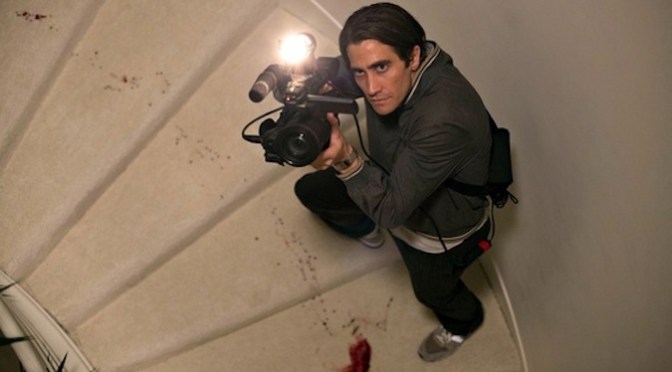
When we first meet the scavenging Lou Bloom, it’s clear that he’s an opportunist. He steals anything – copper tubing, swaths of aluminum fence, manhole covers (“the nice thick ones”) – and sells what he’s stolen to a construction foreman. Then he fights the foreman over the price, and then he asks the foreman for a job. So Lou’s mentality isn’t so much “when life gives you lemons, make lemonade”, but more “I have no lemons, so I’ll take yours”. This is the strongest aspect of Lou Bloom’s character, and indeed at times it’s overwhelmingly strong. Jake Gyllenhaal and writer/director Dan Gilroy don’t nail everything in Nightcrawler, but they nail that.

There’s a definite stylishness to Nightcrawler that aims to capture the seedy neon after-hours of downtown Los Angeles and the surrounding, more affluent suburbs. Lou graduates from scavenging to a real (ahem, “real”) job when he happens upon a highway car accident one evening: crime scene photography, he learns, can be a lucrative business. “If it bleeds, it leads,” says Bill Paxton’s mentor-photographer in a very trailer-suitable explanatory monologue. So Lou buys a camcorder and a police scanner and begins working. He’s all about opportunity, so when it knocks Lou answers. Opportunity, of course, keeps knocking, and Lou keeps answering. Soon he’s creating his own opportunities, which means everyone except Lou is about to get their lemons jacked.

Continue reading Nightcrawler (2014)

Raiders of the Lost Ark (1981)

This article first appeared as a part of the Brattle Theatre Film Notes commentary series, presented by the Brattle Theatre in Boston, MA, for a special screening of Raiders of the Lost Ark. Slight edits have been made from the original posting.

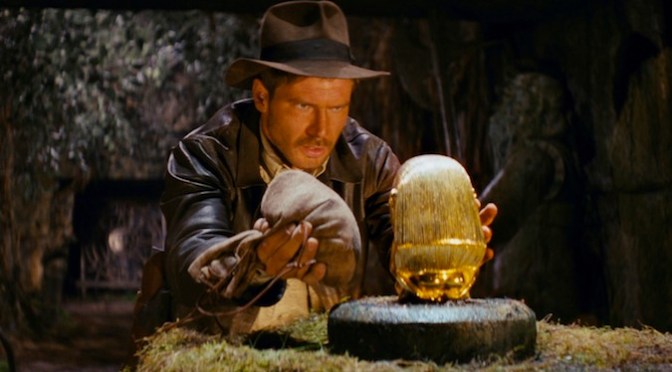
Not long ago Steven Soderbergh removed all of the color and sound from Raiders of the Lost Ark in an attempt to better study the visual staging of Steven Spielberg’s massively influential adventure film. The theory – according to Soderbergh – is that “a movie should work with the sound off”, that the coordination and arrangement of the visual elements of the story should, essentially, tell the same story that the dialogue tells. With Raiders, the theory certainly holds water: from the thick rainforest and cobwebbed tunnels of the opening action sequence to the quiet Archaeology classroom of the very next scene, from the snake-infested underground temple to the desert chase, the staging and pacing of the film is continuously surefooted. “No matter how fast the cuts come, you always know exactly where you are,” Soderbergh writes – and the attention he calls to the visual aspect of Raiders proves that Spielberg’s dedication to a strong sense of story isn’t compromised by a black-and-white color palette or a bass-laden electronica soundtrack.

To put it another way: Indiana Jones, even with these major elements stripped away, is still Indiana Jones. The color is one thing, but you’d think the absence of the iconic “Raiders March” would really shake things up for the worse. The John Williams score is inextricable from Indy, arguably as much a part of the adventurer as his hat or his bullwhip. You wouldn’t take the Bond theme away from James Bond any more than you’d take away his tux or his martini, for fear that the character before you wouldn’t seem like the same familiar spy anymore. Indy seems the same way, seems like a character so reliant on these iconic elements – but while Soderbergh’s exercise proved its point with regards to scene staging, it also pointed out what sets Indy apart.

Continue reading Raiders of the Lost Ark (1981)

The One I Love (2014)

It might just be because of the scenes in the pool, but John Cheever’s short story “The Swimmer” was never far removed from my viewing of The One I Love. The obsession with suburban America that Cheever shared with the likes of John Updike also seems applicable here, but it’s probably more the hazy blur of realism and surrealism that brings the late writer’s most famous story to mind throughout the film. Granted The One I Love is more lighthearted than anything Cheever ever wrote, but there’s still a sustained  feeling of dread and discomfort here. That’s coincidentally what sets the movie apart from most others, pulling it safely out of rom-com zaniness territory while managing to maintain a humorous mood.

Mark Duplass and Elisabeth Moss are Ethan and Sophie, troubled young couple who find their marriage in jeopardy. Their counselor (who, for some reason, is played by Ted Danson) suggests a getaway at a picturesque hillside home designed specifically, it seems, for troubled young couples. They go. They have a great first night. After that, though, things go a little haywire. There’s something off about the little guest house in back. What was all the confusion about that first night? Could this be a dangerous place? Should they leave? Stay? Was this Ted Danson’s intention?

Continue reading The One I Love (2014)

Murder by Decree (1979)

It can be a strange thing these days: some actors either play a role so many times or play it so effectively once that it becomes nearly impossible to fill the shoes, impossible to recast the role or to even imagine recasting the role. The former scenario – where an actor owns a role by performing it over multiple films – is more and more common now that the shared universe and neverending saga models are actually viable. Robert Downey Jr. and Hugh Jackman had the advantage of being the first to play Tony Stark and Wolverine in their respective franchises, but it’s still damn difficult to imagine what those cinema characters will look like ten years from now once Messrs. Downey and Jackman age out of the parts.

The latter camp – those who own a role after only a single performance – is more interesting, at least when the role we’re considering is that of Sherlock Holmes. The great deerstalker-capped detective has been played by hundreds of actors onscreen, notably by the likes of Basil Rathbone, Christopher Lee, Roger Moore (in Sherlock Holmes in New York), and the aforementioned Downey Jr. in the most recent feature adaptations. Peter O’Toole voiced the character in a series of animated shorts in the early ’80s, Ian McKellen will portray him in 2015’s Mr. Holmes, and Benedict Cumberbatch plays Sexy Holmes in the BBC show Sherlock. Jeremy Brett’s decade in the role spanning four separate series is certainly one of the most interesting turns – Brett’s health declined noticeably as each series progressed, and his time in the role ended up charting a tragic bearing through his final years.

Continue reading Murder by Decree (1979)

The Intouchables (2011)

Netflix has beefed up their foreign language film offerings lately, adding within the past few months a new cache of hundreds of popular films from around the globe. One such movie is The Intouchables (no, not the French re-make of The Untouchables starring a French Kevin Costner) a 2011 French film directed by Olivier Nakache and Eric Toledano. In fact, by sheer numbers The Intouchables is the Mona Lisa of foreign language films, grossing $281 million worldwide, more than any other non-English movie in history.

The movie’s worldwide success raises the question: how did this film about the true story of wealthy quadriplegic Philippe Pozzo di Borgo and his underqualified, rough around the edges, ex-con caretaker Abdel Sellou shine above the rest? For starters, the original story itself is fascinating. An old wealthy man taking a chance on a young criminal as the man responsible for his own wellbeing is intriguing, but, in most cases, would seem too far-fetched. In the case of The Intouchables, the story is practically completely true, even when it seems overblown.

Continue reading The Intouchables (2011)