A Few Good Men (1992)

Aaron Sorkin’s A Few Good Men first appeared as a play in 1989, three years before it would be adapted into a feature film from a major studio. Removing All Doubt and the one-act Hidden in This Picture, Sorkin’s first plays, would boost his reputation in the New York theatre scene prior to any associations with Hollywood, but it was A Few Good Men that would garner greater praise and sell as film rights before the play even premiered. Sorkin’s theatre experience would certainly inform his style of writing in his film and television scripts going forward, and the adapted script for A Few Good Men is a prime example of that influence.

Loosely based on a real-life series of events, A Few Good Men concerns itself with a murder at a Guantanamo Bay Marine base. Lieutenant and Army lawyer Daniel Kaffee, played by Tom Cruise, is ultimately assigned to the case along with Demi Moore’s JoAnne Galloway and Kevin Pollak’s Sam Weinberg. Resistance meets the defense team largely in the form of Jack Nicholson’s Colonel Nathan Jessup, who tends to pop up only every now and then throughout A Few Good Men in order to steal scenes from under Cruise’s nose in typical Nicholson fashion. Cruise was at the time on a tear of Nicole Kidman collaborations (following Days of Thunder and Far and Away), so the military courtroom drama was likely a welcome change of pace.

Continue reading A Few Good Men (1992)

Young Ones (2014)

These days future-set postapocalyptic fables are so common that anything such a movie can do to make the idea fresh and original is more than welcome. Cormac McCarthy’s popular The Road and John Hillcoat’s ensuing adaptation with Viggo Mortensen helped to cement the profitability of the genre after a distinct lag since the Mad Max/Blade Runner heyday, and now dystopias seem to be coming through the woodwork. The fact that both Mad Max and Blade Runner will be getting new treatments soon should attest to that desire to recapture the glory days of the genre.

One of the latest entries is Jake Paltrow’s Young Ones, set in a world where water has finally become a scarce and precious commodity. The film is divided into sections focusing on different characters, starting with Michael Shannon’s Ernest Holm, continuing with Nicholas Hoult’s rogueish Flem, and ending with Kodi Smit-McPhee’s son-of-Ernest Jerome Holm. They’re all changed irrevocably by the drought, guarding what little they have with violence and ruthlessness, and most shades of innocence are gone by the time Young Ones takes place. As in most dystopias, it’s the state of things that causes this darker and more animalistic aspect of humanity to come to the surface.

Continue reading Young Ones (2014)

The Mosquito Coast (1986)

In many ways our Director Series on Peter Weir can be seen as an excuse to write about The Mosquito Coast, which is the logical culmination of the “early stage” of the director’s career and gateway to those brilliant films that would follow (though calling that Weir’s “later stage” makes it sound like his directing career is a slowly advancing disease). Coast would follow Gallipoli and The Year of Living Dangerously – two well-received Australian films that helped launch Mel Gibson into superstardom – and Witness, which would prove to be Weir’s first American film. The greatness of Dead Poets Society would follow. It’s The Mosquito Coast, though, that’s arguably the most ambitious of any of these films.

And that’s fitting, because although Gibson’s Guy Hamilton and Harrison Ford’s John Book and Robin Williams’s John Keating could conceivably all be described as “ambitious” in one way or another, it’s Ford’s Allie Fox that allows his ambition to get the better of him. Fed up with just about every aspect of America, inventor Fox uproots everything and takes his family deep into the South American jungle. They make a new home – “home” a term used liberally here – on the Mosquito Coast, where Allie’s latest creation provides something magical for the local population: ice. Helen Mirren and River Phoenix appear as Allie’s wife and eldest son, who essentially allow themselves to be dragged into the jungle by this iceman simply because they love him.

Continue reading The Mosquito Coast (1986)

Chef (2014)

Sometimes, a movie like Chef is just exactly what you need. Jon Favreau’s latest directorial effort seems a far cry from his Iron Man days and is just about as different as it gets from a fall blockbuster, although Robert Downey Jr. does pop up. The closest you get to an action sequence in Chef is a skillful wielding of a carving knife going to town on a smoked pork loin, which itself certainly isn’t an ascetic display. It’s simple, but that’s not to say it’s ever dull.

The casting for Chef caused an early stir – “the dude who kicked off the Marvel Cinematic Universe directing and starring in a film also starring Iron Man himself, Black Widow herself, and Sid from Ice Age himself?! Chef is going to be so badass!!” – but the fact of the matter is that Chef isn’t the type of movie that has hype or sequels or post-credit cameos by other superpowered chefs from the same franchise. Chef is a tiny, unassuming, been-there-done-that flick about a guy who really just wants to cook some delicious food. Somehow, that’s supposed to be a compliment.

Continue reading Chef (2014)

MASH (1970)

Among plenty of other achievements, MASH is (allegedly) the first major studio film to make use of the word “fuck”. While not necessarily a proven fact depending on your definition of “major studio”, the employment of the word is the perfect illustration of the important and innovative way MASH used dialogue. A large portion of Robert Altman’s filmography is made up of movies that are filled to the brim with sharp wit and fast banter, and MASH is arguably the finest example.

Donald Sutherland stars as Hawkeye Pierce, surgeon in the U.S. Army during the Korean War, prankster and goofball extraordinaire. Hawkeye, along with cohorts that include characters played by Tom Skerritt and Elliot Gould, is a lover of all things mischievous and manages to cause trouble even when he is blissfully unaware of doing so. This is war, of course, so people lose good friends and die themselves during the endless futilities of battle – in a Catch-22 sort of way, MASH uses its relentless humor as a way to illustrate this futility in highly satirical fashion, with Hawkeye and Co. essentially laughing in the face of meaningless death because what else can you do? In a Catch-22 sort of way, it works like a charm.

Continue reading MASH (1970)

The Big Sleep (1946)

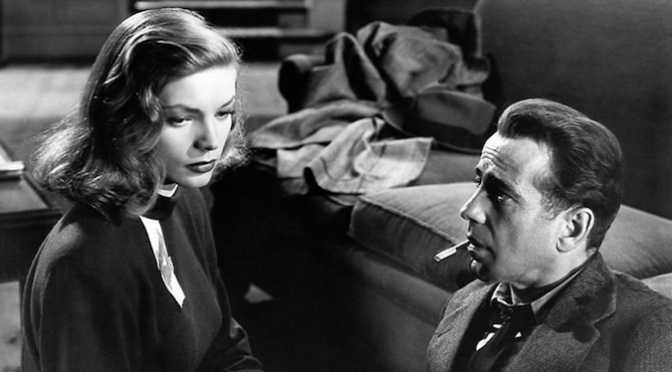
Our Director Series on Robert Altman is partially responsible for a look at The Big Sleep, as the overlapping rapid-fire back-and-forth dialogue characteristic of Altman’s films was first characteristic of the films of Howard Hawks. Toss in the fact that the source material is by Raymond Chandler and the fact that William Faulkner himself helped write the screenplay, and The Big Sleep is still one of the finest American film scripts ever committed to celluloid.

Private eye Philip Marlowe has appeared in a few films – notably portrayed by Elliott Gould in 1973’s The Long Goodbye (also Altman) and then by Robert Mitchum in both 1975 and 1978 – but Humphrey Bogart’s time in the role is the most valuable. He’s Marlowe in the way that Sean Connery is Bond: it’s not the only portrayal of the character…but yeah, it’s the only portrayal of the character. Marlowe’s investigation into a whole host of strange occurrences rolled out one after another, starting with the disappearance of one Sean Regan, provides the drive for the film. But one solution inevitably leads to two more problems in The Big Sleep, and there’s little hope of piecing everything together into a neat little answer to “so what actually happened?”

Continue reading The Big Sleep (1946)

Witness (1985)

Peter Weir’s first American film was the Harrison Ford vehicle Witness, released to commercial and critical acclaim in 1985. The Australian director was originally set to make his stateside debut with The Mosquito Coast, but a last-minute loss of financing would leave time for Weir to make a very different kind of picture first.

As a “Harrison Ford movie” — a label which immediately evokes Raiders and Blade Runner — Witness probably falls flat. John Book ain’t an adventurer, an action hero, or a possible cyborg (or is he?) and Witness ain’t a popcorn blockbuster. You can imagine the studio executives wincing as they reluctantly finance something that, frankly, looks excruciatingly boring as an abstract. Man goes to Amish country. Protects small boy. Woohoo.

Continue reading Witness (1985)

Automata (2014)

Just by virtue of being a smaller, lesser-known project with a scrappy underdog mentality, Automata has an instant advantage over similar sci-fi dystopias of recent memory like Elysium, the Dredd remake, Oblivion and the godawful In Time. The comparison to Neill Blomkamp’s Elysium and his earlier District 9 is especially unavoidable, as the world-building employed here is every bit as important and every bit as impressive. This is a distinct Earth that’s very unlike our own, but it doesn’t take a second to get used to.

The credits sequence says it all, really: our ecosystem has crumbled and our atmosphere has become unbearable, and so the future humankind invents a whole host of technological solutions: mechanical “clouds” that produce fake rain and shield our planet, massive walls that keep the desert from encroaching upon our cities, and most importantly a vast array of “automata” – robot slaves who weld our machines, cook our food, wash our dishes and wipe our asses when we get old. The credits sequence already pulls a 180 on us, though, by depicting this future as the past. By the time the events of Automata take place, humankind is jaded to the wonders of these technological advances, and the automata themselves seem to have become a bit jaded too.

Continue reading Automata (2014)

Countdown (1968)

James Caan and Robert Duvall starred in quite a few films together in their early careers. In 1969 Francis Ford Coppola would cast them both in The Rain People, and the director would go on to give them each one of their finest roles as Sonny Corleone and Tom Hagen in The Godfather and The Godfather Part II. The pair would reunite in 1975 for Sam Peckinpah’s The Killer Elite, and the fact of that film failing shouldn’t be faulted to either actor. But their first collaboration was on one of the earliest feature films of the great Robert Altman: the man-on-the-moon drama Countdown.

Altman had years of television and film experience prior to Countdown. His first feature The Delinquents appeared in 1957, around the same time as his James Dean documentary The James Dean Story, both of which led to television gigs on the likes of Bonanza and Alfred Hitchcock Presents. It was Countdown, though, that seemed to herald Altman’s career as a film director – he would basically direct a film every single year for the next two decades, which is pretty unheard of in this day and age.

Continue reading Countdown (1968)

The Judge (2014)

The Judge looks like your typical ’90s courtroom drama, playing in the vein of The Rainmaker or The Firm, and looks aren’t deceiving in this particular instance. Starring Robert Downey Jr. and Robert Duvall as estranged family brought together to face a potential injustice, the film ticks all the expected boxes on the checklist and rarely surprises. Still, The Judge survives on the strength of the performances of the two leads and manages to be a largely enjoyable family drama.

Downey Jr.’s Hank Palmer is a bigshot city lawyer who returns to his minuscule hometown when his mother passes away. Contact with his father, the county judge, has been minimal at best over the past years. But Hank is forced to stay when a murder investigation targets the judge and an implacable prosecutor (played by Billy Bob Thornton) arrives to put Judge Palmer behind bars for the rest of his life. Only Hank can defend his father and his the legacy of his family.

If you’ve seen the trailer for The Judge, the actual movie will probably just feel like an elongated version. Downey Jr. is absolutely perfect for the role, but I don’t mean that as a full compliment. This is a character he’s played over and over again: immoral, arrogant, power-hungry, never home to see his daughter, aces in the workplace at the expense of his real-world relationships, bound to see the error in his ways through the events of the film. He’s basically Tony Stark without the Iron Man suit (so The Judge is Iron Man 3, basically), and it just would have given the film a much-needed edge if the protagonist wasn’t exactly who we imagined him to be.

Continue reading The Judge (2014)

Never judge a book by its movie