

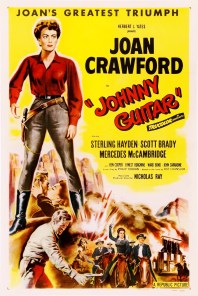
 Strong female character is a phrase that gets thrown around a lot in woke film crit, and it’s probable that the arbiter of this particular criteria should maybe be someone other than weak male film critic — but here we are. Watching a movie as fantastic as Johnny Guitar, it’s hard not to wonder if the phrase is in fact more often applied to female characters who basically act like male characters, resorting easily to physical and verbal violence. The leads in Captain Marvel and Atomic Blonde and Red Sparrow are handy in a fight, sure, but they also lack flaws, for the most part, and therefore lack real complexity. Holding those characters up as the gold standard for strong females in film has always rung hollow.
The fact that all of those modern action films are directed by men is not inconsequential (and is its own problem), but then again so is Johnny Guitar, helmed by the great Nicholas Ray, which still manages to feature a lead character who — in addition to being handy in a fight — has complex relationships with the men and women around her, has self-doubt in tandem with self-confidence, has flaws and imperfections and weaknesses, all of which paradoxically contribute to the strength of this character. This character is Vienna (Joan Crawford), a saloonkeeper on the outskirts of an Arizona cattle town, a brash and opinionated woman frequently at odds with the town’s cattlemen. The arrival of the mysterious Johnny Guitar (Sterling Hayden) complicates Vienna’s already-contentious relationship with the other townsfolk, particularly her sworn enemy Emma Small (Mercedes McCambridge).

 What’s the worst thing that can happen in sports? That’s the question voiced by the title character as the curtain goes up on Molly’s Game, Aaron Sorkin’s directorial debut and latest produced screenplay since 2015’s
 The Black Stallion is very much a film of two halves. You could enter the film at the midpoint and still enjoy the back 50% as a self-contained story. Similarly, you could just watch the first chunk and then turn it off feeling surprisingly satisfied. Viewed as a whole, though, Stallion serves as a personality quiz centered around whichever half you ultimately prefer. Think Full Metal Jacket or King Kong, which not only bring characters through two vastly different settings but seemingly bring them through different genres of film as well. It’s possible to enjoy the whole film in each of these instances, but by design one segment probably connects with you more powerfully than the other.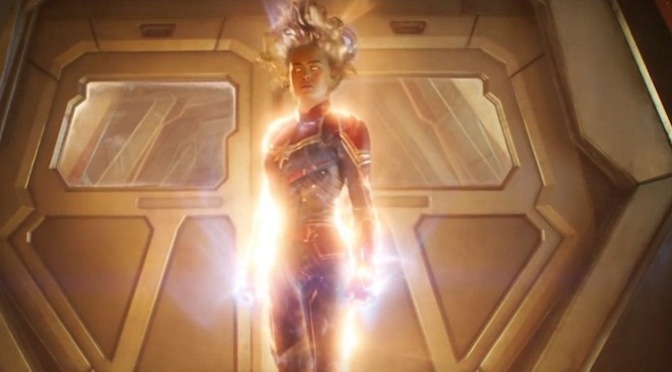
 In 2017 The Last Jedi ignited a culture war between lovers of Star Wars on the one side and…well, lovers of Star Wars on the other side. This war was ostensibly borne of debate over the film, praise versus criticism, and there certainly is a battlefront of this war that does engage in genuine discourse over Jedi. There’s another front, of course, comprised mostly of warriors fighting with a willing blindness to the merits or pitfalls of the film as a film; some people just despise Jedi for puerile personal reasons, some just defend it simply because it’s Star Wars. This is the Ultimate First World Problem, such hatred and ire thrown about over the seventh sequel to a space fantasy from 1977. But intentionally or not, a particular faction of “critics” revealed themselves during this war. We’ll call them the Shitboys, because they’re mostly boys and they mostly shit on everything.

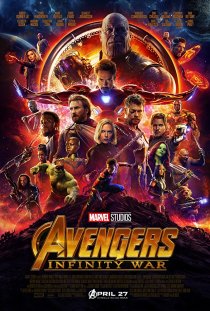 One of the things that soured
  Motion State Review