

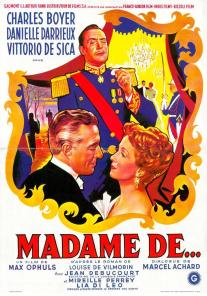
 The Earrings of Madame de… is the English-language title for Madame de…, as it was released in France, which heralds the heart-shaped diamond jewelry — not its owner — as the star of the film. The earrings do indeed play a major role, significantly altering the lives of those who possess them, seemingly propelled by their own willpower from one owner to another and back again. With a pinch more malice this would be The Lord of the (Ear)rings, a fantasy tale about tempting jewelry that instills a deadly pride in those who dare purport to wield such power. But the passionately humanist Max Ophüls ensures that this is always really the story of Madame de…, not simply of her diamonds, and the themes of pride and ownership don’t necessarily involve the earrings at all.
That sleight-of-hand is one of the many reasons Madame de… stands as the most highly-praised work by Ophüls, whose career as a filmmaker was constantly capsized by the onset of World War II. A German-born Jew, Ophüls fled and became a French citizen in 1938, only to have to flee further to the U.S. There he failed to break into Hollywood until an admirer of his work recommended him to Howard Hughes; it helped that the admirer was none other than Preston Sturges. Ophüls directed five Hollywood productions before returning to Europe in 1950, where a new stage of his filmmaking career blossomed. Each of his final films — La ronde (1950), Le plaisir (1952), Madame de… and Lola Montes (1955) — is a masterful achievement in its own right, championed thereafter by the likes of Samuel Fuller, Stanley Kubrick and Paul Thomas Anderson.

 Of the nine Best Picture nominees at this year’s Academy Awards, four of them — that’s a healthy 44% — address predatory love. Okay, maybe only three if you don’t include The Shape of Water, though, technically, yes, the protagonist is in love with a literal predator. Down to 33%, which is still a higher percentage than you’d expect from American awards season. Though I suppose Three Billboards Outside Ebbing, Missouri is never really about rape, only using that (as it used a number of other social issues) as a springboard for dramatic explorations of entirely different social issues. So, okay, fine: 22%.
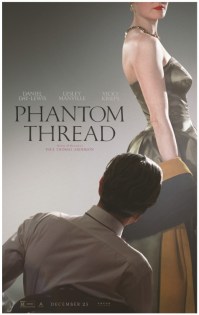 Early on in Phantom Thread I started thinking about the miniaturized nature of certain segments in the cinema of Paul Thomas Anderson. At the top of this latest film we see Reynolds Woodcock’s morning routine, clearly practiced to the point of automation, nearly mechanical, though the whole scene lasts less than thirty seconds. He shaves, he slicks his hair, he pulls on his big winecolored socks, his pants. And that’s it. The dressmaker is dressed. One might expect a little more extravagance from a film that’s ostensibly about high-end style and tailored beauty, no?
 Motion State Review