

 There were a number of factors that prevented me from rushing out to see You Were Never Really Here on opening night. First was the weather, which is not really an excuse at all if you’re a New Englander like me. The second factor was the review snippet plastered on the poster that referred to the film as “Taxi Driver for a new century.” Do I enjoy Taxi Driver? I do. Do I enjoy “modern updates” to ’70s classics like Westworld, for example? Occasionally, yes, I do. But this kind of explicit tailcoat-riding is either lazy marketing or inadequate criticism or, likely, both. I don’t think I saw Interstellar because people said “it’s 2001 for a new generation!” and I didn’t see Annihilation because people said “it’s 2001 for a new generation!“, but I do know that I enjoyed those movies primarily for how not-2001 they both were.
But this, too, is a weak excuse. Two big preventatives: firstly, in a move most unforgivable and piteously ironic for someone who purports to point out “inadequate criticism” in the first paragraph of this very review, I had never before seen anything directed by Lynne Ramsay. People had gently suggested this oversight as something I should reconcile tout suite. “Start with Ratcatcher,” they said, recommending Ramsay’s feature debut. “Start with We Need to Talk About Kevin,” they said, recommending her 2011 effort. I’m a bit of a completist in this regard, watching one movie by the Coen Brothers and then suddenly finding myself rewatching them all. Maybe my appreciation of You Were Never Really Here would be heightened if I first paid my dues to Ramsay’s previous films, no?
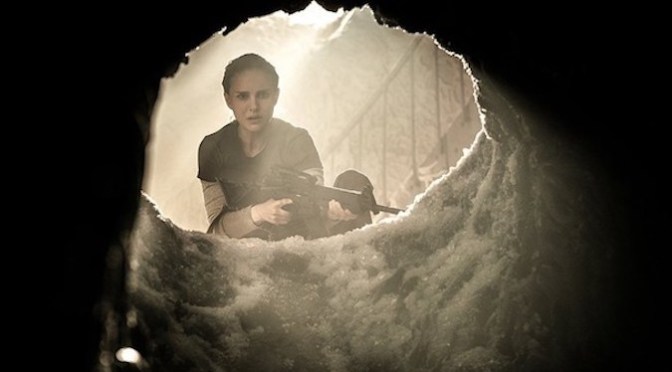
 In the climactic finale of Annihilation, there is a moment in which a shape-shifting alien bioclone with burning arms lovingly embraces a charred corpse in a lighthouse that has been struck by a meteor and overtaken by a mutated blight that threatens all life as we know it. Go ahead and read that sentence again if you have to. I dare you to try to come up with something so outlandish, so unsettling, so straight-up weird, much less deploy it at a crucial moment in a multimillion-dollar motion picture production. We live in a time where pretty much every sci-fi film with a budget this size (about $40 million) ends one way: explosions. The scripts all contain the same line: Big CGI Thing bursts into CGI flame. Heck, explosions probably typify the finale of most Hollywood films, sci-fi or otherwise, and the scripts for their inevitable sequels all contain the same line: Bigger CGI Thing bursts into bigger CGI flame.
 Motion State Review