

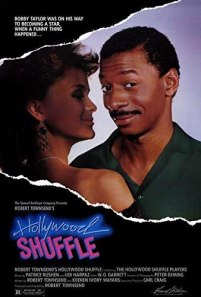
 One of the best collections available on the Criterion Channel is one called Film Plays Itself, a self-reflexive assemblage of movies about movies. Here you’ve got your classics, like Sunset Boulevard and 8½. You’ve got your “out-there” stuff, like the experimental Symbiopsychotaxiplasm or Godard’s New-Wave Contempt. And you’ve got some modern triumphs like The Player and Adaptation. Each of these sort of screams CINEMA! in a not-so-subtle way, which is not a knock against them so much as a bit of a prerequisite for inclusion on the Criterion Channel in the first place. But the highbrow reek of such an overly-academic, carefully-cultivated program of thinkfilms threatens to become overbearing without any deviance — or at least it would, if not for Hollywood Shuffle.
In the mid-1980s, Robert Townsend saw the same problem that every black actor saw in Tinseltown: you either play a criminal, a convict, a slave or some combination of the three. Moreover, depictions of those figures were by and large stereotyped approximations rather than actual characters. Shuffle sparked when a white casting director turned Townsend down for a role because he “wasn’t black enough,” and Townsend recognized this as a brand of systematic racism baked into Hollywood itself. He only had to look to the local cinema at the time for evidence: the sole major studio production with black leads in the 1985-’86 movie season was The Color Purple, written and directed and produced by white men and a clear-cut case of overly-sentimental, stereotypical depictions of black men and women on the silver screen.

 We’re always experiencing history now. Few grasp this concept like Alex Cox, who frequently eschews the traditional idea of “historical accuracy” in favor of something we might pretentiously refer to as historical truth. In 1986’s
  Motion State Review