All posts by hangmantitan

The Walk (2015)

The Walk is being compared to Gravity in a recent spate of fairly misleading TV spots, intense Inception-esque music set to critic quotes that swoop in to say things like DOES WHAT GRAVITY DID FOR SPACE! It’s clear what they’re trying to say: this is more an experience than a movie. It’s partially true, and certainly the most affecting parts of the film are those which purport to be more than film. Lots of movies try to push for that as a selling point, and the floating and swooping superlatives in the Walk trailers recall all of those other movies that are GUARANTEED TO BLOW. YOUR. MIND.

Robert Zemeckis handles the majority of the story of Phillippe Petit, the eccentric and restless French high-wire artist, with much the same eccentricity and restlessness as characterizes his subject. There’s voiceover narration hosted by a Statue of Liberty-bound Petit (get it? France!), there’s a black-and-white sequence, a few flashbacks, a few time lapses, a few time jumps. The Walk, like Petit’s mind, is all over the place. At times the quick pace is paradoxically dragging, but I suppose such is the case for Petit as well. He’s bored by ropes strung between lampposts and trees. He wants a true high wire. He wants to see New York, to see the towers. He wants to see mountains again, Gandalf, mountains.
Continue reading The Walk (2015)

O Brother, Where Art Thou? (2000)

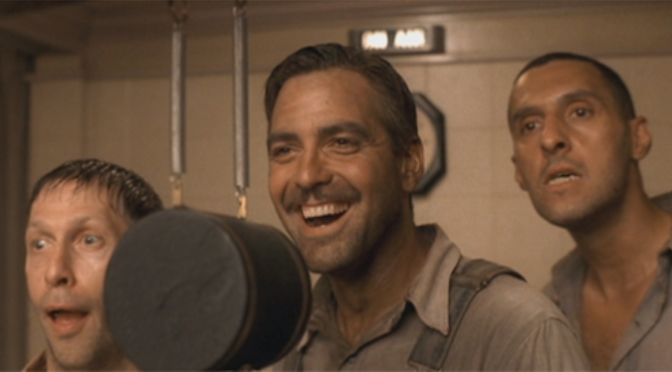
This year’s New York Film Festival played host to a 15th Anniversary screening of O Brother, Where Art Thou?, the Coens’ Dirty Thirties road movie, though it hardly seems like that much time has passed. I might have described O Brother differently — say, the Coens’ Dust Bowl love letter or the Coens’ Homer homage or the period highbrow escapee buddy whatever — except that the directing duo melted all of that babble away in the post-screening “discussion” of their writing process. “We just started with ‘three guys on the road'” said Joel; Ethan added, “then we tarted it up with Homer.” That was that. Next question. The Coens are experts at both of those things: interpretive film direction and film interpretation deflection.

But they were no less the storytellers on stage, despite their succinctness, and they were joined by O Brother stars George Clooney, John Turturro and Tim Blake Nelson as well as legendary cinematographer Roger Deakins. The latter was a pleasant surprise, and though the Coens have recently worked with the likes of Emmanuel Lubezki and Bruno Delbonnel it’s endlessly exciting that Deakins will return to the fold (as will Clooney) for the next Coen film Hail, Caesar!; if it’s at all the blend of O Brother and Barton Fink that it appears to be, then it can’t come soon enough.

Continue reading O Brother, Where Art Thou? (2000)

The World Is Not Enough (1999)

Neal Purvis and Robert Wade co-wrote the scripts for an important chunk of the James Bond franchise, penning everything from The World Is Not Enough to Skyfall. They’ll receive a credit for the upcoming Spectre, apparently advising primary writer John Logan, but the previous five films are pretty much The Wade/Purvis Era while Skyfall might end up marking an overlap with The Logan Era. There are a few stinkers throughout Wade/Purvis, namely two that are regarded among the worst Bond flicks of all time: the Joel Schumacher-esque Die Another Day and the incorrigibly self-serious Quantum of Solace. Odd that one would be too goofy and one not goofy enough. But the other three efforts comprise the real Wade/Purvis Bonds, allowing those other two to just be buffers interspersed between the flicks that actually matter: The World Is Not Enough, Daniel Craig’s introduction in Casino Royale, and the mega-hit Skyfall.

The theory goes that a Bond scribe — at least this particular duo — takes two or three tries to really get it right. Even Ian Fleming only turned out his best Bond yarns after testing the waters with the likes of Live and Let Die and Moonraker. With Wade/Purvis, the tautness of the story is the best evidence to support this theory.

Continue reading The World Is Not Enough (1999)

The Leftovers 1.8 – “Cairo”

The question of protagonist Kevin Garvey’s sanity was first raised in the pilot, wherein he may or may not have fired his gun at a pack of wild dogs. The second episode “Penguin One, Us Zero” seemed to look on uncaringly as poor Kevin lost his shit over a disappeared bagel. Since then he’s inexplicably lost track of a closet full of white shirts, tethered a dog to his fence without any recollection of doing so, and crusaded across Mapleton to find a stolen baby Jesus doll. After all of that it’s still not exactly clear what’s eating Kevin Garvey, nor is it even clear whether he is or is not crazy. Moreover, it’s not clear how Kevin losing his sanity ties in to the greater themes of The Leftovers.

“Cairo” changes all of that. Crazy is a strong word, but Kevin’s definitely not A-OK upstairs. Clear is a strong word, too, so perhaps we should state that the clarity we get on Kevin’s mental state and how that mental state ties into the grander schemes of the series isn’t exactly a straightforward answer. But Kevin’s sleepwalking comes with serious bouts of amnesia, and he often wakes up to find he’s done something questionable — like tying a dog up in the yard — during his waking slumber. In “Cairo”, he gets downright violent, so much so that the part of himself that he never remembers becomes something that he doesn’t want to be a part of himself at all.

Continue reading The Leftovers 1.8 – “Cairo”

The Devil’s Double (2011)

Yesterday morning, after I wrote about Moneyball, I went back and looked up the other films from 2011 in my little Film’s I’ve Seen notebook. I don’t actually have a little Films I’ve Seen notebook, but I do have a computer and an uncanny ability, usually, to read the title of a movie or see the poster and recall if I have recently watched it. Sometimes not. Alex Cross? I watched that? But sometimes I manage to remember something I did without even being reminded by a computer that I did it, and watching The Devil’s Double is one of those things.

I don’t know if that thing is a good thing or not, though. The Devil’s Double is definitely memorable, but it lacks the certain whatever that would make it truly unforgettable. Dominic Cooper (Howard Stark from Captain America: The First Avenger/Agent Carter and soon-to-be-star of AMC’s Preacher adaptation) pulls double duty as Uday Hussein (the eponymous Devil) and Latif Yahia (the eponymous Double) in this highly-fictionalized biopic, and he’s the reason the film sticks in your mind at all. Latif, the man forced to become the body double for the sadistic eldest son of Saddam Hussein, is the heart and soul of The Devil’s Double; Uday, heartless, soulless, is the real force of nature within the film.

Continue reading The Devil’s Double (2011)

Moneyball (2011)

We may never lose again.

So says a fan-made poster in one of the archival shots from Bennett Miller’s Moneyball. It’s a yellow poster with green marker-drawn capital letters on it, held overhead by an unseen Oakland A’s fan. Though the film seamlessly incorporates newly-shot game footage into the ancient history of 2002, the majority of the footage in this particular montage is real. Fans hold posters, they exchange high-fives; players whack homers, they round bases, they exchange high-fives. The A’s were on an unprecedented winning streak, crushing every team they met and hurtling towards an unheard-of twenty wins in a row. The sequence in Moneyball is dubbed simply “The Streak”:

Continue reading Moneyball (2011)

The Leftovers 1.7 – “Solace for Tired Feet”

Solace indeed. The first half of the rookie season of The Leftovers hurtles forward at breakneck speed, propelled by a whole lot of pain, a whole lot of angst, a whole lot of doom and gloom, and just a little tiny bit of hope. It’s fairly characteristic, actually, for an intense episode of this show to contain one small but valuable nugget of joy within the dark folds, although I’m not sure the darkest episode “Gladys” had anything of the sort. “Guest“, the sixth and best episode of the season, showed Nora more broken and identityless than she’s ever been — and yet her connection with Wayne (“Will I forget them?” “Never.“) was one of the most life-affirming moments in the entire season. Her brother Matt endured a series of cruelly hellish occurrences in “Two Boats and a Helicopter“, and yet his win at the roulette table probably elicited a smile as large as his out of most viewers. The previous episode “Penguin One, Us Zero” showed us just how tragic it could be to lost your bagel, and then it showed us just how exhilirating it can be to find it again.

So “Solace for Tired Feet” is just that: a breather. It’s not built with such intentionality, of course, and if anything it’s structured as a set-up to the final stroke of the season. “Tired Feet” says here is where everyone is, here is where they seem to be headed, and here is how they are all connected. The first two points are necessary to orient us towards the end of the season’s arc, but it’s the third point — the ways in which all of the characters are connected — that’s most impressive in this otherwise slow hour. To boot, instead of a full episode of straight-up intensity, “Tired Feet” provides a blend of hopefulness, revelation, and some intriguing Lost-style question marks.

Continue reading The Leftovers 1.7 – “Solace for Tired Feet”

Face Off: Lawrence of Arabia (1962) and Queen of the Desert (2015)

Motion State Face Offs pit two films, franchises, or television series against each another for no reason other than because we can.

We discussed the possibility of defining an “epic” film in our review of Ed Zwick’s Legends of the Fall, concluding that it’s perhaps more of an impossibility due to the wide range of films that fall comfortably under the genre label. Despite this, we at least sought out the notion that the scope of the idea is infinitely more important than the scope of the production budget, and Lawrence of Arabia was one of the more obvious examples of true epic filmmaking in that respect. David Lean’s biographical account of the life of the adventurous T. E. Lawrence stands as one of the greatest films of its kind because the passion of the film lives up to the passion of the man, the scope of the ideas of the film seeming to mirror and amplify the ideas of the British explorer/officer/diplomat.

Lawrence is about to be back on the big screen in a supporting role in Werner Herzog’s Queen of the Desert, a film masquerading as a worthy companion of sorts to Lawrence of Arabia at least as far as the marketing campaign is concerned. As Herzog’s film progresses past the first quarter, though, it becomes painfully obvious that Queen lies on the other end of the epic spectrum in that it fails on almost every level to convey any passion. Nicole Kidman leads the film as Gertrude Bell, British explorer/writer (/archaeologist/political officer/spy/cartographer) who spent her time across Syria, Asia Minor, and Arabia in the decades following the turn of the century. Kidman is fine in the role — but it’s not her passion that Queen of the Desert lacks. It’s Herzog’s.

Continue reading Face Off: Lawrence of Arabia (1962) and Queen of the Desert (2015)

The Social Network (2010)

Though Charlie Wilson’s War marks the first time Aaron Sorkin mined a true story for dramatic purposes, it’s likely that we have The Social Network to thank for the shift to biopics becoming Sorkin’s modus operandi of late. Though Wilson did a more-than-passable job of telling a less-than-well-known story, Sorkin’s Network dips behind the scenes of something that pretty much everyone knows about. It’s more grand, more ambitious in that sense, despite the subject matter being a website as opposed to a global war, and it’s the same ambition that was found in Moneyball and hopefully will soon be found in the upcoming Steve Jobs.

Of course, the primary challenge with bringing biographical accounts to the big screen is accuracy — which, as we’ll return to in a moment, isn’t exactly the same thing as truth. It’s one thing if the subject of the film is still alive; it’s an entirely different thing if the subject of the film is still essentially “the same person”, with only a few measly years (and in this case a few measly millions of dollars) passed between the events of the film and the film itself. Think of Oliver Stone’s upcoming Snowden or last year’s woeful Julian Assange movie The Fifth Estate, both of which purport to reveal some kind of truth about a series of real-life occurrences that just so happen to still be occurring. Black Mass just opened in Boston to theaters full of people who are portrayed in the film. At this rate, we’re going to enter some weird Minority Report-type paradox where biopics start coming out before the people they’re about even accomplish anything worthy of a film.

Continue reading The Social Network (2010)

The Leftovers 1.6 – “Guest”

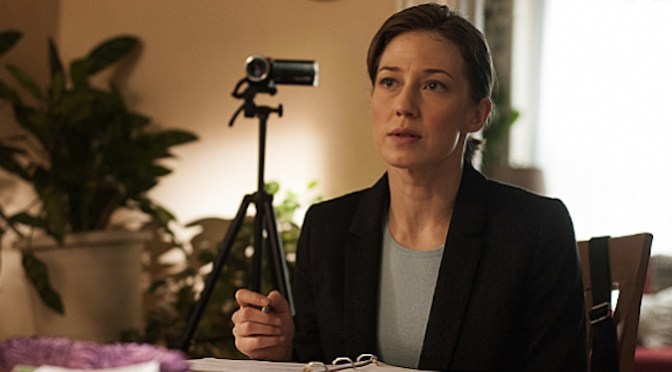
The first scene of “Guest” perfectly encapsulates the special kind of world we talked about in our review of the previous episode “Gladys“. Sure, the second scene steals the show: Nora leafs through a newspaper, makes an appointment with a prostitute advertised under the headline Nothing is Forbidden, invites the scantily-clad girl into her home, plants a pistol in her hand, dons a bulletproof vest, then demands the girl shoot her directly in the chest. Nora’s done this before, she assures the prostitute, although the last girl she got to shoot her “said she’d never do it again”. Thousands of dollars change hands, as do a great number of understandable health-related concerns. Tears fall. Eventually the gun goes off and Nora lurches backwards onto the blow-up air mattress. The hooker flees. After a long moment, Nora gasps a breath of fresh air.

Hell of a scene, no? Even if you aren’t sold on Nora’s self-help methods as a kind of New Grief — as if the old methods of grieving for lost loved ones no longer cut it — the intensity of the scene is still powerful. It builds moment by moment, starting as the prostitute steps over the threshold and holding an inhale as she darts back over it after the gunshot, finally exhaling at the same time Nora does. But a large part of the intensity of the scene might be attributed to the fact that this is the second scene of “Guest”, and the first is so deceptively twisted and unimaginably tragic that the gunshot scene almost becomes inevitable.

Continue reading The Leftovers 1.6 – “Guest”