All posts by jorgejuanlucas

The Quick and the Dead (1995)

A quick glance at Sam Raimi’s filmography shows a greater preoccupation with iconography than with originality. He’s retread the old “cabin in the woods” and “superhero origin” tropes three times over (four if you count Darkman), yet, Robert Frost be damned, it has made all the difference. Through Evil Dead and Spider-Man, Raimi has evaded the title of “hack” to become both an auteur and blockbuster filmmaker, which is no easy feat when you’ve made Spider-Man 3. He manages to inject adrenaline and humor into genres that would die of exhaustion under any other director’s hand. As for The Quick and the Dead, the Western genre has only benefited from the Raimi treatment.

The Quick and the Dead reminds us of familiar Western figures straight away: the blind shoeshine, the bumbling barkeep, the merciless sheriff, the one-eyed ex-convict, and a flamboyant assortment of gunslingers. Of course it wouldn’t be a Western without the nameless hero, and fortunately we have Sharon Stone to give us an emotional anchor as The Lady amid a grotesque cast of caricatures. She arrives in town to exact revenge on the sheriff for the murder of her father, but gets roped into a quick draw dueling competition before she can do the deed. Continue reading The Quick and the Dead (1995)
The Great Waldo Pepper (1975)

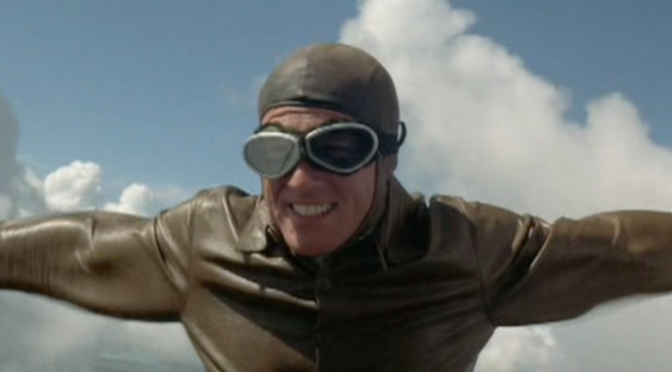
If Robert Redford is the best model of the American Dream in all its smiling, handsome glory (and I think he is), then he must also be its most effective destroyer. Through characters like the Sundance Kid (Butch Cassidy and the Sundance Kid) and Jay Gatsby (The Great Gatsby) who turn themselves into legends, and Bob Woodward (All the President’s Men) who turns politicians into criminals, Redford has made his career a mission to demystify the neatly packaged illusion of American exceptionalism. Yet I don’t think either of those crushes The Dream as brutally as The Great Waldo Pepper does, leaving it burning in the wreckage of a monoplane. And that’s saying something for a movie as lighthearted as this one.

It’s 1926 in down-home Nebraska, and all that’s left of World War I are the daredevil pilots who duke it out in barnstorming competitions right over our heads. Simple Midwesterners search the skies at the sound of a biplane engine while J.P. Sousa-style marches signal the arrival of our hero, Waldo Pepper. There’s only one problem–Pepper is a liar and a cheat. He never fought against the notorious Ernst Kessler in the war (he didn’t fight at all on account of his being a flight instructor), but he’ll say he did if it gets him an easy buck (on account of his being poor and desperate). But despite being a great storyteller and showman, Pepper is actually the real deal. He’s “Great,” not because he’s got money like Gatsby, but because his flying skills are (nearly) unmatched (that pesky Kessler is still alive after all). In this day and age, though, where almost every man and his grand-pappy seems to have a plane, Pepper’s gotta find a way to stand out. Continue reading The Great Waldo Pepper (1975)

Stay (2005)

It’s impossible to properly discuss Stay without discussing the ending. The movie depends on the last five minutes if it stands any chance of holding together. This, right off the bat, should be a bad sign. The Sixth Sense is a strong film even without the iconic (now cliché) twist, and 21 Grams (hell, any Iñárritu pic) features enough compelling drama to keep us interested until it all ties together at the end.  But Stay feels more like an exercise than a fully fleshed out story, and as anyone who doesn’t love getting high and watching Waking Life knows, that just won’t cut it. Nonetheless, Stay is a movie worthy of analysis. It’s just that you gotta get through the first sitting first. If you’re anything like me, you’ll probably experience five steps of emotion that are not unlike going on a hot date. Allow me to explain.

Continue reading Stay (2005)

Braindead (1992)

Now that The Hobbit: The Battle of the Five Armies, a.k.a. the “Defining Moment” of the Lord of the Rings saga, is nearly upon us, it’s time to acknowledge that this series has been the longest con in cinema history. Peter Jackson has pulled the wool over our eyes, and it’s about time someone blew the whistle. He’s not the David Lean of fantasy he’s made us all believe him to be. No, Peter Jackson, ladies and gentlemen, is the sick freak behind slapstick zombie horror Braindead.

Dead Alive, as it’s known (or not known) in the States, isn’t even his most deranged work–just wait till you see Meet the Feebles. But it does have the infamous reputation of being the most violent movie ever made. Obviously, Jackson had greedily set out to make a name for himself right from the beginning, though it wasn’t “Lord CG-Crowds” or “Sir Most-Number-of-Endings-Crammed-Into-One-Film” just yet. The fact is, before cannibalizing Lean, Jackson had latched onto the coattails of the Masters of Horror.

Continue reading Braindead (1992)

The Imitation Game (2014)

There is a scene in The Imitation Game where a young Alan Turing is introduced to a book of codes and cyphers by his classmate and friend Christopher. The significance of this moment is obvious (Look, it’s the exact moment Alan Turing became the Alan Turing we all know!!!). But Graham Moore’s script plays this moment as a different kind of discovery. There’s no glint in Alan’s eye as he catches a glimpse of a future in which he fathers computer science while cracking the Nazi’s Enigma code, wins the war, and is later played beautifully by Benedict Cumberbatch. Instead,  Alan recognizes a comparison between cyphers and the way people talk. Turing, who is thought to have had Aspergers Syndrome, cannot process metaphors and irony because of his extreme literalism. The concept of coded communication gives him a better understanding of how people don’t say what they mean and don’t mean what they say. This, not his mathematical genius, is his gateway into code-breaking, and it’s one of many beautiful nuances in the film.

Unfortunately, the rest of The Imitation Game, like Turing, is overly formulaic. The film adapts Andrew Hodges’ biography, Alan Turing: The Enigma, about the mathematical savant who was the biggest contributor to deciphering Nazi communications with his cryptanalytic machine. This true story could have been an otherwise simple and inspiring tale about an extraordinary Brit, alongside the likes of The Theory of Everything and The King’s Speech, if it weren’t for one major tarnish. In 1952, Turing was convicted of indecency (read: homosexual acts) and made to take hormone treatments in place of a prison sentence. He killed himself two years later. This understandably requires a different kind of film.

Continue reading The Imitation Game (2014)

The Hustler (1961)

There’s a long legacy of sports films where the heroes are the starry-eyed, passionate lovers of the game, the athletes who play from the heart and, despite a lack of technique or formal training, still come out on top. Even Rocky emerges from his loss against Apollo Creed with the blood, sweat, tears and girlfriend to prove that, in the end, he’s the real winner. Robert Rossen’s The Hustler is not one of these movies. If you asked George C. Scott’s character, Bert, what those other heroes had in common, he’d tell you it was “character.” Paul Newman’s Fast Eddie, on the other hand, has none. The Hustler tells the story of how Eddie (our hero, if you can call him that) earned his character.

The opening scene introduces Fast Eddie, a drifting pool shark, as he executes his latest con in a small town billiards hall. Just as he’s about to put away the eight ball in a finishing move and claim all the bets, the camera decides to stay on his face, completely ignoring the action on the table. We know Eddie wins because of the sound of the ball landing in the pocket, but that’s not the sound Eddie lives for. He’s there for the shit-eating grin he gets to wear the moment he wins. For the groans of gamblers that have lost money on a rigged bet. For the wad of cash he gets to shove in his breast pocket. He’s good at pool, sure. Hell, he’s the best anyone’s seen. But there’s no indication yet that he plays pool for any other reason than that it’s a game that attracts the greasy, betting types with loose wallets. For Eddie, pool’s a means to an end of fame and glory. And this, somehow, is the protagonist we’re supposed to fall in love with.

Continue reading The Hustler (1961)