Category Archives: Film Review

The World Is Not Enough (1999)

Neal Purvis and Robert Wade co-wrote the scripts for an important chunk of the James Bond franchise, penning everything from The World Is Not Enough to Skyfall. They’ll receive a credit for the upcoming Spectre, apparently advising primary writer John Logan, but the previous five films are pretty much The Wade/Purvis Era while Skyfall might end up marking an overlap with The Logan Era. There are a few stinkers throughout Wade/Purvis, namely two that are regarded among the worst Bond flicks of all time: the Joel Schumacher-esque Die Another Day and the incorrigibly self-serious Quantum of Solace. Odd that one would be too goofy and one not goofy enough. But the other three efforts comprise the real Wade/Purvis Bonds, allowing those other two to just be buffers interspersed between the flicks that actually matter: The World Is Not Enough, Daniel Craig’s introduction in Casino Royale, and the mega-hit Skyfall.

The theory goes that a Bond scribe — at least this particular duo — takes two or three tries to really get it right. Even Ian Fleming only turned out his best Bond yarns after testing the waters with the likes of Live and Let Die and Moonraker. With Wade/Purvis, the tautness of the story is the best evidence to support this theory.

Continue reading The World Is Not Enough (1999)

The Devil’s Double (2011)

Yesterday morning, after I wrote about Moneyball, I went back and looked up the other films from 2011 in my little Film’s I’ve Seen notebook. I don’t actually have a little Films I’ve Seen notebook, but I do have a computer and an uncanny ability, usually, to read the title of a movie or see the poster and recall if I have recently watched it. Sometimes not. Alex Cross? I watched that? But sometimes I manage to remember something I did without even being reminded by a computer that I did it, and watching The Devil’s Double is one of those things.

I don’t know if that thing is a good thing or not, though. The Devil’s Double is definitely memorable, but it lacks the certain whatever that would make it truly unforgettable. Dominic Cooper (Howard Stark from Captain America: The First Avenger/Agent Carter and soon-to-be-star of AMC’s Preacher adaptation) pulls double duty as Uday Hussein (the eponymous Devil) and Latif Yahia (the eponymous Double) in this highly-fictionalized biopic, and he’s the reason the film sticks in your mind at all. Latif, the man forced to become the body double for the sadistic eldest son of Saddam Hussein, is the heart and soul of The Devil’s Double; Uday, heartless, soulless, is the real force of nature within the film.

Continue reading The Devil’s Double (2011)

Me and Earl and the Dying Girl (2015)

Turning a book into a movie is often quite difficult, particularly with the tired old rhetoric that the book is always better than the movie. While this is often the case, it is tough odds to work against for filmmakers. Adapting Jesse Andrews’ novel Me and Earl and the Dying Girl into a motion picture also certainly had its own unique challenges. For starters, the book is fantastic, setting the bar rather high for the movie. Secondly, and more problematic, was the brevity of the book. MEDG is a book that can be easily read in one day. Not only that, but most of the text is dedicated to the oftentimes strange personal thoughts of the narrator and protagonist Greg Gaines. Plot-wise, I thought making a full-length film would be a stretch. Additionally, I was not exactly sure how they would go about stepping into the mind of Greg.

But, after winning both the Grand Jury Prize and Audience Award at Sundance and receiving generally high praise from critics, I figured that director Alfonso Gomez-Rejon had a found a way to work through these supposed problems and I decided to give it a watch, with an open mind that it just might be better than the book (oh, the humanity).

Continue reading Me and Earl and the Dying Girl (2015)

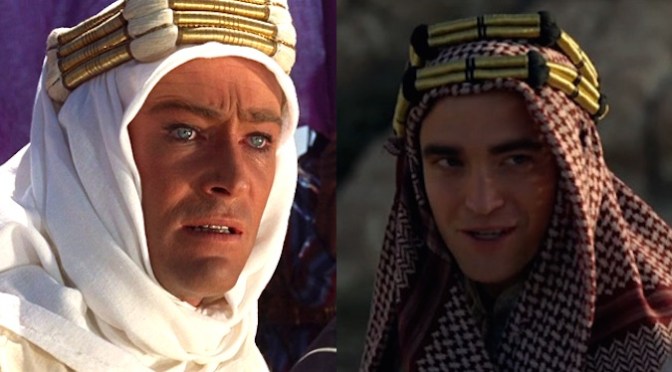
Face Off: Lawrence of Arabia (1962) and Queen of the Desert (2015)

Motion State Face Offs pit two films, franchises, or television series against each another for no reason other than because we can.

We discussed the possibility of defining an “epic” film in our review of Ed Zwick’s Legends of the Fall, concluding that it’s perhaps more of an impossibility due to the wide range of films that fall comfortably under the genre label. Despite this, we at least sought out the notion that the scope of the idea is infinitely more important than the scope of the production budget, and Lawrence of Arabia was one of the more obvious examples of true epic filmmaking in that respect. David Lean’s biographical account of the life of the adventurous T. E. Lawrence stands as one of the greatest films of its kind because the passion of the film lives up to the passion of the man, the scope of the ideas of the film seeming to mirror and amplify the ideas of the British explorer/officer/diplomat.

Lawrence is about to be back on the big screen in a supporting role in Werner Herzog’s Queen of the Desert, a film masquerading as a worthy companion of sorts to Lawrence of Arabia at least as far as the marketing campaign is concerned. As Herzog’s film progresses past the first quarter, though, it becomes painfully obvious that Queen lies on the other end of the epic spectrum in that it fails on almost every level to convey any passion. Nicole Kidman leads the film as Gertrude Bell, British explorer/writer (/archaeologist/political officer/spy/cartographer) who spent her time across Syria, Asia Minor, and Arabia in the decades following the turn of the century. Kidman is fine in the role — but it’s not her passion that Queen of the Desert lacks. It’s Herzog’s.

Continue reading Face Off: Lawrence of Arabia (1962) and Queen of the Desert (2015)

Black Mass (2015)

Part of me viewed Black Mass as a critic. I took into consideration the actors, the script, the staging, pacing, etc. What about character arcs? What about historical accuracy? You know: the usual. I considered some of the things that usually pop up on the imaginary checklist (like how many trailer-worthy zingers will we endure?) and a few that were more specific to this film (like will Johnny Depp’s makeup look as bad as it did in the set photos?); I considered that I’d have to play the game where you try to compress and bury all of those checklistable points so that you can actually watch the movie. I considered Out of the Furnace, the last film by Black Mass director Scott Cooper, and the frustrating way in which that film tried and nearly succeeded in being an epic like The Deer Hunter. Somehow, one of Furnace‘s major flaws seemed to be that it was only almost that kind of movie, something that attempted an ambitious feat but failed to stick the landing.

But despite a sneaking suspicion regarding that last point Black Mass is a hell of a lot more enjoyable than Out of the Furnace or even Crazy Heart, Cooper’s first two films which both touted incredible performances but misplaced directorial style, and that’s probably because the other part of me viewed it as a Bostonian. The Globe‘s Ty Burr says it best in his review: “For worse and for worser, James “Whitey” Bulger is a son of Boston, and moviegoers here will react differently to Scott Cooper’s film than they will in Seattle, Dallas, or Dubuque.” That was inescapably true for last night’s Boston Common screening, wherein the feeling was that everyone in the theater was already familiar with what was unfolding up on the screen.

Continue reading Black Mass (2015)

Pumpkinhead (1988)

Pumpkinhead doesn’t give a shit about your morals. He doesn’t really give a shit about anything, granted, and in true creature feature fashion the gory B-flick Pumpkinhead is more concerned with dreaming up gross ways for a pack of teenagers to bite it than with deriving any message out of the bloodshed. Oddly enough, though, there’s a distinct resistance to the crowdpleasing moments of heroism that usually typify late-’80s schlock-fests of this sort, which is evidence to the claim that somebody cared about something, which in this context is actually high praise.

Why, you ask, would the demonic Pumpkinhead be so prized within this ostensible Innocents vs. Monster tale? Why would we root for him instead of the terrified cabin-dwellers? Why would Pumpkinhead win? Simple: he’s Motherf*cking Pumpkinhead.

Continue reading Pumpkinhead (1988)

Shame (2011)

It’s just a shame that this film wasn’t a bit better.  I’m not saying I hated or even disliked Shame, but it had the potential to be a great film that handles an issue that is rarely discussed and is entirely taboo.  One thing, for sure, that impressed me about Shame was the way that it made me actually feel the shame and remorse and immense self-loathing that Brandon experienced on an hourly basis.  That was powerful, and I mainly attribute that to the sheer talent of one of my favorite actors, Michael Fassbender.  In his second collaboration with the talented Steve McQueen, Fassbender is almost frightening.  When he attacks his visiting sister in nothing but a bath towel (one that is starting to fall down, at that) and begins screaming in her face, I genuinely felt like he might have lost his mind.  His rage, which clearly stems from his own unimaginably great disappointment in and repulsion of himself, is fairly constant and, while far less intense than that of his later performance as a plantation owner in McQueen’s follow-up film 12 Years A Slave, is shocking.

At the same time, Fassbender is also wise to portray Brandon thoroughly enjoying the acts that ultimately lead to his frustration.  This is vital to his performance because it is clear that the film is attempting to show that sex addiction is, in fact, an addiction.  It is an affliction, much like alcoholism or drug addiction.  Brandon is not a freak, he’s not a pervert…he is suffering.  But, as all addicts do, Brandon enjoys doing these acts while he is doing them.  Just because a cocaine addict might desperately want to stop using the drug, this doesn’t mean that he will suddenly no longer enjoy cocaine when he does use it.  In order to achieve the goal that this film is trying to accomplish, Fassbender needs to be as dead-on as possible.  He nails it.

Continue reading Shame (2011)

Moonraker (1979)

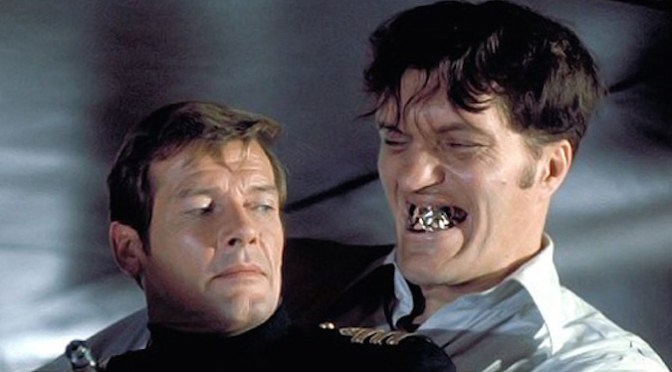
Ah, Moonraker. Shall I compare thee to another Bond film? Thou art more absurd and more simplistic. Sometime too seriously does Bond brood, and often is his complexion covered in facepaint like in Octopussy. And every fair from fair sometime declines, by chance or waning box office returns on the Dalton Versions. But your eternal ridiculousness shall not fade, Moonraker, nor will your incorrigible fan service be overlooked, so long as men can breathe or eyes can see — so long lives this and this gives life to thee…or, well, not exactly life, per se, but at the very least a juvenile rundown of Bond henchmen.

Jaws bites stuff. It’s sort of his thing. He chomped his way through The Spy Who Loved Me and was meant to die at the end of that film, but apparently test audiences preferred an ending where Jaws survives to bite another day. That might not necessarily have meant that audiences wanted to see Jaws again in the very next Bond outing, but see him they did. Consistently. I mean really, he’s in like every scene simply because.

Continue reading Moonraker (1979)

Deception (1992)

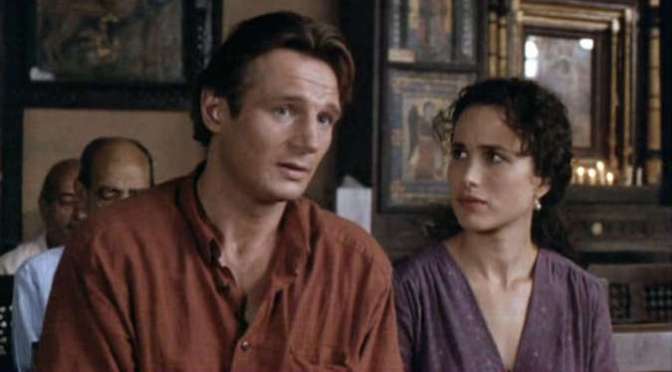
Okay. I just put on Deception, streaming on Netflix. Looks and sounds fairly enticing in an early-’90s Juror/Basic Instinct/Malice sort of way. It’s got Liam Neeson and Viggo Mortensen, both of whom I’m eager to see in a movie together, and Andie MacDowell, whom I really know nothing about. I’ve seen Groundhog Day and Four Weddings and a Funeral, so maybe it will be interesting to see her in a drama. The poster has moody lighting and Neeson is standing behind MacDowell in a subtly menacing way, suggesting that Deception is a cat-and-mouse game of, well, deception.

Okay! This sounds pretty exciting! Let’s get this movie started!

…….wow. Did David Lynch direct the credit sequence? That wasn’t very intense at all — oh, but I get it, I’m being deceived.

Continue reading Deception (1992)

Regarding Henry (1991)

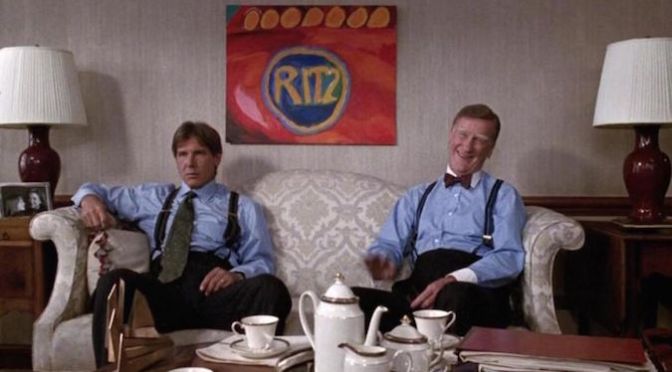
The upcoming Star Wars movie won’t mark the first time Harrison Ford and J.J. Abrams have crossed paths. As the 1980s became the 1990s and Harrison Ford traded in Han Solo, Deckard and Indy for a string of lawyers, doctors, politicians and playboys, the young writer Jeffrey Abrams was just getting his start. His first singlehanded script was Regarding Henry, a story about a heart-of-ice lawyer who is irrevocably changed by a horrific accident, and he scored big time with Ford and director Mike Nichols coming on board to bring his script to the screen.

Thankfully, even though Ford’s ’80s history is repeating itself with returns to Star Wars, Blade Runner and possibly Indiana Jones, Abrams has matured out of his Regarding Henry self and doesn’t appear to be looking back. A solid cast and crew does not a solid movie make, and Henry is far more by-the-numbers than you might expect from the Ford/Nichols/Abrams triumvirate. There must have been something in the water in Hollywood in the ’90s, as Henry takes a prominent station in the decade’s prized Overly-Emotional Tearjerker Oscar-Bait category.

Continue reading Regarding Henry (1991)