Category Archives: Film Review

Watchmen (2009)

Come senators, congressmen, please heed the call/ Don’t stand in the doorway, don’t block up the hall/ For he that gets hurt will be he who has stalled/ There’s a battle outside ragin’/ It’ll soon shake your windows and rattle your walls/ For the times they are a-changin’

Those famous Bob Dylan lyrics set the scene for the changing times the viewer finds in Zack Snyder’s Watchmen. The year is 1985, but not your parents’ 1985. Richard Nixon is still president after triumphing in Vietnam thanks to Dr. Manhattan (Billy Crudup). However, it’s not all good news — the Cold War has escalated and the world is on the verge of nuclear Armageddon.

In this alternate universe, the superhero group the Watchmen have been forced into retirement. However, after one of their own Eddie Blake (Jeffrey Dean Morgan), the Comedian, is murdered, vigilante Rorschach (Jackie Earle Haley) concludes that someone must be trying to kill off the Watchmen.

Continue reading Watchmen (2009)

Jurassic World (2015)

Right before Jurassic World started my seatmate turned to me and inquired after my favorite dinosaur. I didn’t have the heart to tell her that I hadn’t thought about what my favorite dinosaur was for a solid few years, that despite my boyish charms I actually wasn’t in third grade. I shrugged and said Tyrannosaurus. Good ol’ T. Rex is what would pop into my head if you approached me and said “dinosaur”, so maybe that kind of bias does qualify the stub-armed carnivore as a darling dino of mine. Seatmate agreed.

The more I weighed this pressing question the more I believed answering it to be a requisite for instant peace of mind. I was, I remembered, quick to raise an eyebrow when that Spinosaurus took down a T. Rex in Jurassic Park III — can they do that? This is T. Rex, Ancient King of the World, and he gets taken out by Dinosauria threequelae? And in the sequel The Lost World, which features a Tyrannosaurus loose on the mainland in the climax, we should really be honest about who we’re rooting for in that scenario. Though it traded the color and wonder of the first film for a considerably darker tone and palette, The Lost World succeeded in taking the bull of the first film and finding a more expensive china shop.

Continue reading Jurassic World (2015)

The Pawnbroker (1964)

I read The Pawnbroker at the wrong time. Jewish American author Edward Lewis Wallant published the thin novel, his second after The Human Season, a year before his untimely death in 1962. I wouldn’t be hitting the scene for another few decades, and by the time I did The Pawnbroker existed only in relative obscurity. I read it in college, where I sort of zipped through the little volume in between zipping through others.

In doing so, I read Sol Nazerman’s tale largely as a tale of urban woe. Those of suburban woe — by Updike, Cheever, O’Hara, and  even a few guys who weren’t named John — were in great supply back then, from Rabbit, Run to Bullet Park to Appointment in Samarra. These books had protagonists that were either downright miserable or just miserable without knowing it, perhaps indifferent to the constant comings and goings or the constant stillness of life around them, and in that feeble criteria they were all grouped together. Bernard Malamud’s The Assistant, about a Jewish shopkeeper in postwar New York, seemed a worthy companion to The Pawnbroker  because the protagonists seemed so similar. Assistant‘s Morris worked out of Brooklyn while Sol Nazerman’s pawnshop was in Harlem, but both were simply exhausted by life.

Continue reading The Pawnbroker (1964)

The Third Man (1949)

Graham Greene only wrote The Third Man as a novella in order to better understand the tone and characterizations before committing the story to screenplay, so in a way Carol Reed’s film adaptation can’t really be considered an adaptation at all. It was Greene himself who penned the screenplay, although Reed and Orson Welles are said to have had strong influence on the resulting film, and the novella version of The Third Man was never intended to be published. Eventually it was published, paired with the even shorter novella The Fallen Idol, and so today we have further insight into the development of the story.

Reed, who helmed a few other Greene adaptations including The Fallen Idol and Our Man in Havana, understood the novels of the author in a way that few other directors can claim. The atmosphere of The Third Man is masterful, with the long shadows of hidden still-hunters creeping along Viennese landmarks and midnight cafés. The famous sewer scene still echoes today, just as the voices of the police echoed throughout the subterranean columned halls as they hunted the elusive Harry Lime. As a whole the film and the novella share the strongest aspects of atmosphere and characterization, which is why film clubs still pore over Reed’s film while a few doors down the hallway a literature course picks apart Greene’s book.

Continue reading The Third Man (1949)

Jack Ryan: Shadow Recruit (2014)

Jack Ryan has the distinct honor among cinematic spies of being…not that great. He’s been in more films than Jason Bourne and as many as Ethan Hunt (once Mission: Impossible – Rogue Nation hits theaters next month), but after being shuffled from actor to actor over the course of the franchise the character has lost a ton of steam. Part of this is due to the caliber of actor (from Alec Baldwin to Harrison Ford [x2] to Ben Affleck to Chris Pine) and part of this is due to the fact that Ryan’s less “spy” and more “data analyst”. That’s not a cop-out, though: Jack Ryan is really just an analyst. It’s the increasing need to shove Ryan into spy territory that begs the comparison to other spies (‘magine dat), so by the time Shadow Recruit came out Jack Ryan wasn’t a mild-mannered systems professional but a sexy gun-wielding wannabe.

And hey: if you want us to make that comparison, Mr. Powers That Be, then with the ghost of Tom Clancy as our witness we’ll do so gleefully. Or not so gleefully, as it were, because no one’s having any fun at all with Shadow Recruit. Why should we? We established in our recent review of the fantastic Quiller Memorandum that a great spy movie doesn’t even need to have a spy as the main character, so forcing Ryan to be more badass than bookworm doesn’t do much for credibility in that arena. Spoon-feeding every plot point doesn’t help either, and again with Quiller the brilliance was in the sense that any John Doe walking across the screen could be a villain; the poster tagline for Shadow Recruit is a flaccidly unoriginal TRUST NO ONE…but then we get nineteen shots of the hotel maid looking suspicious, so it turns out we’re informed exactly who we should and should not trust.

Continue reading Jack Ryan: Shadow Recruit (2014)

Nightingale (2015)

I wanted to love Nightingale unconditionally. We’ve written about one-man-show films here before, from Locke to Buried to Redford‘s All Is Lost to Altman‘s Secret Honor, and Nightingale certainly stands with those true one-man-shows rather than with, say, Cast Away or Gravity or 127 Hours or any other single-character flick that actually has a small supporting cast. Nightingale has no supporting cast, no strange premise wherein the hero is trapped underground or trapped on the high seas or trapped in space. Nightingale‘s Peter Snowden is trapped in his mind, and that’s scarier than any of the aforementioned scenarios.

David Oyelowo is the single actor in question here, and to say he delivers a great performance would be a pathetic understatement. Oyelowo is an absolute force of nature from the first frame of Nightingale to the last. The storyline is unsettling, sure, and we’ll get to that in a minute, but shorn of that Oyelowo’s performance is unsettling in and of itself for the sheer velocity of it all. Not only are Peter’s highs and lows very very high and very very low, but they’re backed up into each other and jumbled up in such a way that Peter switches like a lightbulb from on to off, from calm to manic, from contemplative to downright inconsolable. It’s impressive, but before that it’s incredibly disturbing.

Continue reading Nightingale (2015)

Swingers (1996)

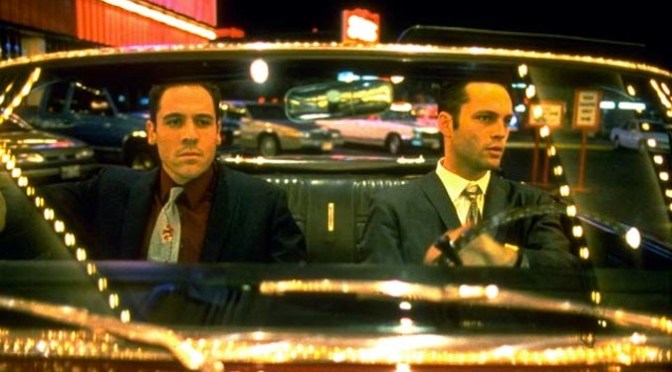
Jon Favreau and Vince Vaughn’s most recent writing/acting collaboration, Couples Retreat, had a budget of around $60 million. Their first collaboration of this sort, Swingers, had a lowly budget of $200,000. However, despite Couples Retreat having 300 times more money to work with, it is my honest belief that Swingers is at least 300 times better than Couples Retreat.

Swingers is the quintessential low-budget, indie, cult-classic film. Mostly the movie focuses on aspiring actors and best friends Trent (Vaughn) and Mike (Favreau), who meet up with other friends, such as Rob (Ron Livingston), Sue (Patrick Van Horn), and Charles (Alex Desert) in L.A. As with most other films of this similar prototype, the plot is not necessarily the most important aspect. Nothing super exciting happens per se, but it is still such a fun watch because it feels actually real.

Continue reading Swingers (1996)

Tomorrowland (2015)

“There are two wolves,” says Casey of Tomorrowland. “One represents darkness and despair, the other light and hope. Which one survives?” To be sure, the philosophizing throughout Brad Bird’s latest film is never any more subtle than this (or less). Casey, optimist to such a ridiculous degree that we learn that about her before we even learn her name, disregards any need for subtext and instead just states the thing itself: “I’m an optimist”. She answers the wolves question in a similarly matter-of-fact manner. Which one survives? “The one you feed.”

Happily, we put this very quote to work in our review of an episode of The Red Road called “The Wolf and the Dog“. It’s much less of a stretch here in Tomorrowland, and again, you don’t really have to stretch at all. It’s plainly clear that the vast majority of today’s storytelling is geared towards the grim, towards the harrowing action-filled future, towards the Cormac McCarthy-style doom and gloom. This is true of almost every medium and almost every target audience, but since Tomorrowland is so much in line with the present Young Adult craze (and because Casey is a teenager) we’ll deal in that genre. The examples should leap readily to mind: Hunger Games, The Maze Runner, The Giver, Divergent, The Mortal Instruments and Ender’s Game are all youthful dystopias with damn similar plots and damn similar everything else. Even Harry Potter, while not dystopian in any way, was a kid’s story turned dark and brooding on screen (see: everything after Daniel Radcliffe grew up).

Continue reading Tomorrowland (2015)

The Quiller Memorandum (1966)

It’s been almost fifty years since The Quiller Memorandum, and spy movies have changed quite a bit in the ensuing half-century. It’s unfair to say they’re better or worse nowadays, especially considering the qualification of “spy movie” can mean anything from Skyfall to Syriana to Agent Cody Banks (though, if we’re talking about the latter, then yes: they’re worse). Even the superhero genre is dabbling in spy-ish flicks, with the espionage thriller Captain America: The Winter Soldier drawing favorable comparisons to Three Days of the Condor; Condor, of course, is a spy movie with a main character who is not in fact a spy, nor is he a suave step-ahead killer fighting for what’s right, nor does he even know what’s going on — this all by way of saying that a great “spy” movie doesn’t even need a spy.

But Peter Quiller is a spy, and a damn good one to boot. He’s good by today’s standards, he’s good by the standards of 1966, and he’s good by the standards of his fellow spies in Memorandum. The film opens with a stark, memorable sequence of a man plodding cautiously down a dark, quiet street. He looks around constantly, fearing that the hidden blade might finally come from the shadows. Cautious, quiet. He enters a phone booth and reaches for the receiver when bam! — he’s shot in the back. Dead.

Continue reading The Quiller Memorandum (1966)

Batman: Mask of the Phantasm (1993)

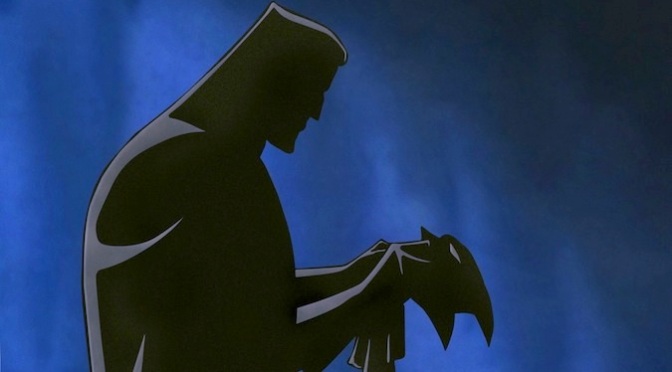
I have a few favorite Batman moments, but the one that trumps them all occurs in the first Batman animated movie Mask of the Phantasm. The comic books are full of contenders, of course — the iconic “legends can never die!” panel in Jim Aparo’s “Man Behind the Mask”, the more-iconic moment in “Hearts in Darkness” when Batman rises from the grave, or the most-iconic “fiend from hell” moment from “The Demon Lives Again!” (which we talked about in our rundown on Batman Begins). The feature films have some epic moments as well, like the introductory call-to-arms of Batman Returns or the final ascension from the pit in The Dark Knight Rises. But Mask of the Phantasm captures what many of these moments capture — the determination of Bruce Wayne, the -ness of the Bat — in a unique way.

Phantasm, of course, is more than just the best animated Batman movie — it might be the best Batman movie, period. It certainly stands with the live-action iterations of Tim Burton and Christopher Nolan, and getting over the fact that Phantasm happens to be animated (as if that’s a point against it) is just a necessary assumption akin to classing The Incredibles at the top of the list of Best Superhero Films. It’s easy to forget about The Incredibles amid the present torrent of live-action Marvel hero flicks, just as it’s easy to forget that Mask of the Phantasm is without a doubt a better Batman film than at least 6/10 live-action Batfilms. I’ll let you figure out which ones I mean.

Continue reading Batman: Mask of the Phantasm (1993)