Better Call Saul 2.8 – “Fifi”

It’s endlessly entertaining watching the montage — an old-fashioned, familiar, nearly-cliched storytelling device — and the cold open — a sort of newfangled, disorienting, “edgy” storytelling device — used to such loving and sincere effect throughout Better Call Saul. Both were hallmarks of Breaking Bad, too, from the “Crystal Blue Persuasion” cooking montage to the pesky little housefly of that third season episode. But here in Saul they’re more frequent and often more ambitious, and in “Fifi” there were multiple examples to this point.

Before we dive into those devices it’s worth noting that this is the home stretch of Saul‘s second season, and the arc has become superbly focused and compelling in ways that the earliest episodes of Season 2 (“Switch” and “Cobbler” in particular) hinted at ever-so-subtly. For a show about a guy who wears orange suits and wails on the bagpipes at the office, for a show built on flashy devices like the montage and the cold open, for a show peopled by characters as bombastic and iconic as any of the Salamancas…if the writing were equally outlandish we’d have an entirely different show. Instead, the character arcs intersect with intricacy and propel forward in subtle ways, lending no small degree of unease to the thematic undercurrent.

Continue reading Better Call Saul 2.8 – “Fifi”

Emelie (2016)

With the release of The Witch in 2016, it seemed that the title of “best scary movie of the year” was already settled. However, the recently released Emelie could give any frontrunner a run for its money as far as I’m concerned. Clocking in at just under 90 minutes, this limited release film is equal parts familiar and unsettling, leaving a lasting discomfort within viewers long after the credits roll.

Emelie is the story of the Thompson children and their unfortunate night in with a new babysitter, Anna, as their parents go out for an anniversary dinner, unaware of the horrors that await their precious threesome. Anna, as it turns out, is twisted and disturbed, forcing the children to participate in antics that become increasingly more perverse as the night goes on.

Continue reading Emelie (2016)

Better Call Saul 2.7 – “Inflatable”

I knew while reviewing “Bali Ha’i“, last week’s episode of Better Call Saul, that I’d be eating my words not long after the following episode hit the airwaves. “Bali Ha’i” wasn’t at all a bad episode; on the contrary, it was full of tension and character development and that special Saul mix of humor and meaningful symbolism. But for the first time the Jimmy McGill storyline felt like second fiddle to the Mike Ehrmantraut storyline, mostly because the latter was about a highly personal slow-boil turf war and the former was about a file audit at a law office. Doesn’t take much to discern which one of those will be more gripping.

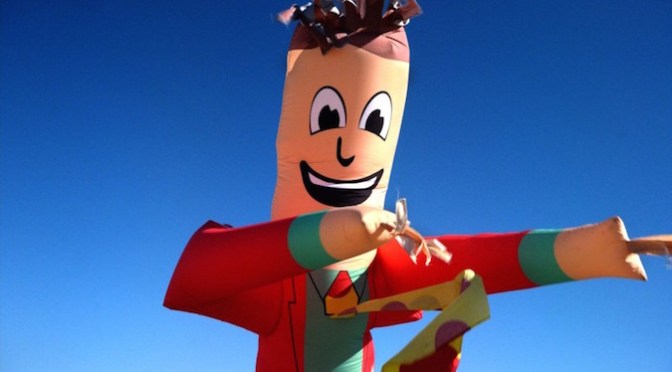
“Inflatable” did much more than put the focus back on Jimmy. After a cool flashback cold open showing some of the elements of the youthful genesis of Slippin’ Jimmy, “Inflatable” finally seemed to push Jimmy over the invisible threshold at the heart of the series itself. The conceit was always this: we watch Jimmy become Saul. In the same way that Walter White’s Mr. Chips becomes Scarface, Jimmy’s sensibilities are leading him toward a particular version of himself. One could argue that “Inflatable” is the episode where Jimmy finally becomes Saul.

Continue reading Better Call Saul 2.7 – “Inflatable”

The Hunger Games: Mockingjay – Part 2 (2015)

The final installment of the Hunger Games series, Mockingjay – Part 2, received relatively little fanfare compared to the releases of the previous films. Though it is probably fair to say that the interest dwindled after Catching Fire due to many audiences feeling the series had become “too dark,” it wasn’t really until after Mockingjay – Part 1 that the general fan base seemed to disappear entirely.

For me, the issue with the Hunger Games film series is relatively simple: it is neither brutal enough nor committed enough to what the essence of the Hunger Games story is.

I read all of the books in the Hunger Games series, and remember that I felt a similar disinterest about the final book as I did with the final film. It just seemed that the idea had run its course by the end of Catching Fire, and that anything that followed the second book’s publication was just a feeble attempt to bring in more money and to wrap up a story that didn’t particularly need more wrapping.

Continue reading The Hunger Games: Mockingjay – Part 2 (2015)

Better Call Saul 2.6 – “Bali Ha’i”

For a minute there I forgot that Better Call Saul‘s main character was not in fact Mike Ehrmantraut, nor any of the other characters dominating the landscape of “Bali Ha’i”. Jimmy McGill is here, yes, and he’s probably got more time on screen than in the phenomenal preceding episode “Rebecca“. He has a nifty little cold open highlighting the fact that he’s the kind of guy who’s more comfortable in his shitty little office than he is in his cushy new digs. He pulls another barroom short con with Kim, as in “Switch“, and the two have a meaningful make-up session after weeks on the rocks. The end of the episode belongs to Jimmy, too, as he attacks his stupid little cupholder with a tire iron in order to finally make room for his travel mug.

But for what might be the first time since the beginning of the series, the A Storyline felt like the B Storyline and vice versa. Shifting from Mike to Jimmy, frankly, felt like downshifting. Partially this is because of where we are in the second season of Saul, coming off a solid mid-season episode and entering that spate of hours tasked with setting up the final few. Last season we had “Five-O” in this slot, which in fact had a grand total of one scene with the esteemed soon-to-be Mr. Goodman. The rest of that episode was about Mike.

Continue reading Better Call Saul 2.6 – “Bali Ha’i”

Film & TV News: March 18

News

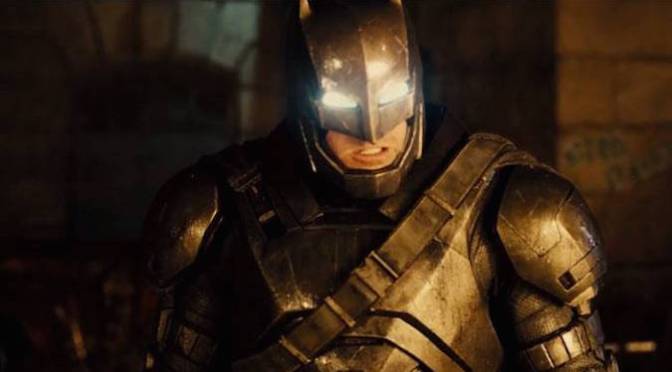
  • It’s Batman Week on Motion State for several reasons, not least of which is because no self-respecting film criticism consortium would ever be caught dead hosting a Superman Week.
  • Zack Snyder will be tackling the first installment of the Justice League two-parter following Batman v. Superman: Dawn of Justice, and now he’s stated that he also wants to adapt…The Fountainhead? Will Howard Roark be the hero we deserve?
  • J.K. Simmons will be taking the role of Commissioner Gordon in that Justice League movie, presumably leaving behind any chance of him playing J. Jonah Jameson again. Gary Oldman’s got some big shoes…
  • In other Batman news, the animated Killing Joke released a teaser photo to mark the start of production. The exciting prospect of adapting Alan Moore‘s comic with Kevin Conroy and Mark Hamill as Bats and Joker is almost enough to wash away that nostalgia for the more endearing animation of Batman: The Animated Series in favor of the new style. Almost.

Continue reading Film & TV News: March 18

The World According to Garp (1982)

The name “George Roy Hill” might not be a household name here in 2016, but if the man himself doesn’t ring a bell you probably still know his films. Butch Cassidy and the Sundance Kid and The Sting are his best, riding high on the indomitable pairing of Robert Redford and Paul Newman. That pair would be separated for Hill’s ensuing films The Great Waldo Pepper and Slap Shot, both of which are well-crafted if not ultimately as powerful as those other two. The one that might throw you for a loop is The World According to Garp, a film from late in Hill’s career starring Robin Williams in his first dramatic role.

…that phrase doesn’t mean what it did back then, though, because “Williams in a dramatic role” isn’t as much of a novelty nor is it even something that seems worthy of being highlighted today. Dead Poets, One Hour Photo, Good Will Hunting, Awakenings and Fisher King let Williams be Williams — not merely Comedic Williams or Dramatic Williams — and despite the films themselves being best suited to the “Drama” category at your local rental store you probably don’t think twice about the star being a guy who most consider to be one of the funniest ever to walk the planet.

Continue reading The World According to Garp (1982)

Better Call Saul 2.5 – “Rebecca”

Better Call Saul talks to itself. In this YouTube video about the various callbacks to Breaking Bad throughout the companion series Saul, showrunner Peter Gould refers to the “encyclopedia” of the world — the people, places, items, songs, sayings and histories of Bad and Saul — and there’s no doubt it’s an interesting way to craft a serial. We talked about the “slavish devotion to itself” present in both series in our review of this season’s opener “Switch“, but that phrase somehow makes it seem like a negative thing. So: Better Call Saul talks to itself. It talks to Bad, bringing back characters and diners and trinkets galore, but midway through the second season it’s able to turn heel and talk to itself as well. In “Rebecca” Jimmy returns to the courthouse where he spent his public defender days — seen largely in “Uno” and “Mijo” — and his return highlights both the ways in which he’s changed and the ways in which he hasn’t.

But Saul talks to us, too, and that can be a mark of a great show. Without being condescending or hand-holdy in the least, Saul pivots outward every now and then and asserts something that’s not exactly a callback or an easter egg per se; more of a cue, visual or otherwise, that acknowledges something that only the viewers would be able to appreciate. The people in the show may realize that there’s a connective thread running from the Salamancas to Mike Ehrmantraut to Saul Goodman and beyond, but there are other things that only the people outside the show would appreciate.

Continue reading Better Call Saul 2.5 – “Rebecca”

Jenny’s Wedding (2015)

Released on Netflix earlier this year, Jenny’s Wedding is somewhat of an enigma. The film, which was originally independently produced, and then featured as part of an Indigogo campaign for post-production costs, stars Katherine Heigl, Tom Wilkinson, Linda Emond, Grace Gummer, and Alexis Bledel as a group of family and friends learning to cope with a daughter coming out as gay and announcing her impending marriage. While the cast is well-known and more than competent in their art, the movie itself is puzzling in its attempt to tell a story of growth, resistance, and eventual acceptance, while never seeming to actually embrace the people around which the story revolves.

I should start by saying that I am always skeptical of “coming out” pieces – whether it’s a play, a TV episode plot, a movie, etc. The arc itself is inherently tricky because of the sensitivity of the coming out trope, and it is easy for writers to fall into the trap of making that coming out process overly dramatic. That isn’t to say that coming out isn’t rightfully dramatic for those who do go through that process, but is merely to suggest that is doesn’t always need to be a thing of tragedy.

Continue reading Jenny’s Wedding (2015)

Gods of Egypt (2016)

For a long time now the internet has been a halcyon refuge for those steadfast in the belief that opinions can be equated with facts. Prior to the actual release of Gods of Egypt the film was subjected to the fervor whipped up by the fact that the cast was almost entirely white, and before you could say CGI sphinx most had written off GoE as a waste of time. In what may have been a heartfelt apology or one driven entirely by a marketing scramble to save face, director Alex Proyas publicly stated that they dropped the ball on the whole diversity thing. #EgyptSoWhite persevered as if Proyas had stayed silent because, hey, it’s the internet. No well-meaning statement is going to stopper a good ol’ fashioned media frenzy.

After GoE came out, though, the film was subjected to another kind of criticism, this time whipped up by the notion that the movie was actually really bad. Ah, the internet. Proyas responded, as Proyas seems wont to do. Here is his post from his Facebook in near-entirety, edited only slightly for length:

Continue reading Gods of Egypt (2016)

Never judge a book by its movie