The Martian (2015)

Hands down, the best movie theater experience I’ve ever had.

Sci-fi royalty Ridley Scott’s’ latest space voyage did not disappoint.  The Martian — starring Matt Damon, Jessica Chastain, Kristen Wiig, Jeff Daniels, Michael Peña, Sean Bean, Kate Mara, Chiwetel Ejiofor, and Donald Glover (holy shit) — epitomizes the term “modern classic.”  It gets its two major themes of unrelenting determination and human bravery across gracefully and without any integrity-damaging clichés, an accomplishment that continuously eludes many filmmakers who embark upon such a journey. That’s the difference between this film and Independence Day, for me (that’s not to say that the latter doesn’t hold a special place in my heart).

I left the theater with the stupidest grin on my face. The film’s humor was the beautiful element that made it exceptional, not only in the simple sense of making the film more enjoyable, but also in the sense that it unquestionably aided Damon’s performance — otherwise, I doubt his sheer optimism would have been nearly as believable.  The humor lightened the mood for us and kept us believing that Mark Watney was going to do the impossible.  Far from falling into the category of comedic-relief-humor, The Martian might actually get nominated for Best Comedy or Musical at the Golden Globes next year.  When Watney practically blows himself up and goes I flying across the hab, I cried with laughter.  When Watney intentionally goes to town with expletives in an inter-planet online chat that is being streamed worldwide, I cried with laughter.

Continue reading The Martian (2015)

Sicario (2015)

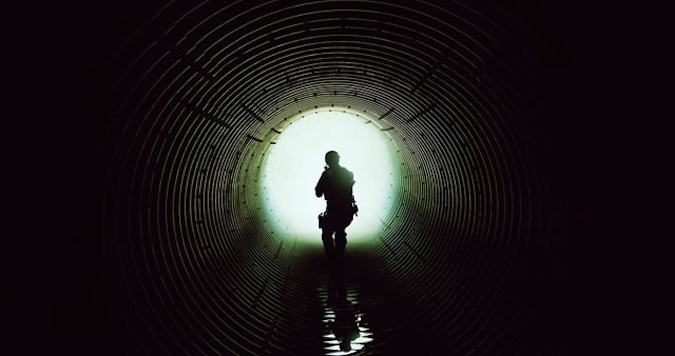
I admit: I was sold early on Sicario. Were you? There’s no shortage of seduction. Emily Blunt leads a stellar cast that includes Josh Brolin and Benicio Del Toro in some of the finest roles of their respective careers; Roger Deakins (blame him for this) is behind the camera, which is hardly ever wrong; and Denis Villeneuve is in the director’s chair, following up on Enemy and Prisoners with another intense thriller. Not completely onboard yet? How about a poster that recalls The Third Man?

The Third Man (1949)
Sicario (2015)
Sicario (2015)

Ah, works every time. Happily, as we sit down in the darkened theater and Sicario (a film which by the way has little to do with The Third Man) begins, it turns out the theme of seduction was at the heart of the film all along.

Continue reading Sicario (2015)

The Leftovers 1.10 – “The Prodigal Son Returns”

Sometimes drama is hard. Part of the reason why people are throwing around phrases like The Golden Age of Television is because great drama often implies a certain longevity, a depth not only of feeling but of space and time as well. Rust Cohle’s True Detective arc spans more than a decade, and we’re allowed insight into that arc for eight hours rather than for the limited runtime of a film. Walter White’s (d)evolution is likewise more effective for the time it takes building itself. In the coldest sense television allows what comic book chronology allows, simply more, and thus more of a compounding effect in the later hours or later seasons. True Detective and Breaking Bad are intense in their final sequences mostly due to brilliant writing, brilliant directing, brilliant acting — nothing replaces storytelling (preach!) — but partially due to what came before.

And yes: sometimes drama is easy. Fabricated drama isn’t hard to find. Heck, take Best Picture winner Argo, which climaxes with a harrowing scene at the airport where the heroes are really just standing in a room sweating as to whether they’re about to be let out of the country or not. Quick cuts are made to the drama, vehicles holding the bad guys hurtling along the tarmac. It’s all spiced up, and usually when you have to spice up your scene with cuts to action that simply happen faster and faster as the music plays faster and faster — well, maybe there’s another way to extract drama, a less easy way, an infinitely more effective way. Argo is hardly the worst example. The cringeworthiest one that leaps to mind is all the extraneous shit going down at the end of The Amazing Spider-Man 2, because Spidey battling his enemy isn’t enough. And Spidey battling two enemies isn’t enough. And Spidey battling two enemies while a hospital full of people is in danger and a plane full of people is about to crash isn’t even enough, so throw Gwen Stacey in there. There we go: amazing.

Continue reading The Leftovers 1.10 – “The Prodigal Son Returns”

Calvary (2014)

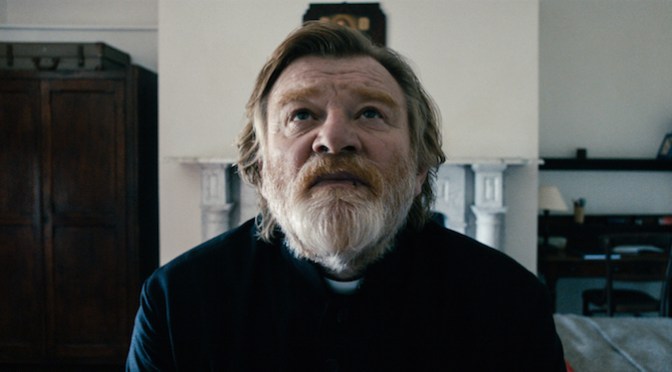
Seeing as I am spending this academic year studying abroad in Ireland, I suppose it would be appropriate to review some good Irish cinema. In the starring role of Father James, the brilliant and wildly underestimated Brendan Gleeson turns in one of his most impressive acting efforts in Calvary, channeling the frustration of a man who’s spent a lifetime actually giving a shit. Sporting a thick reddish-brown mane and sounding his still-thicker brogue, Gleeson covers a great range of emotions, as convincing in his attempts to mold the children of Sligo into proper men and women as he is in sardonically issuing back-handed compliments and even some more blatant insults.

Calvary’s dialogue is probably its strongest suit.  While the film is a clever black comedy with a plethora of lines that are as obscene as they are hilarious, there is also a cloud of seriousness and deep-meaning that hangs over the few players in this small-budgeted indie flick. Every jest is followed closely with an exasperated sigh, telling of the emotionally crippling environment in which these people live.  Where questionable jokes about child molestation are made frequently, there is a great deal of it happening. Where people often contemplate taking their own lives, jokes about such things are tossed around haplessly. So, while the film’s overtones are rather comedic, its undertones are actually quite upsetting. I suppose this is fairly insightful, as people do seem to make light of the real problems they face in order to cope.

Continue reading Calvary (2014)

The Leftovers 1.9 – “The Garveys at Their Best”

“The Garveys at Their Best” is probably the most illuminating episode of the first season of The Leftovers, and had it been placed at the beginning where it belongs chronologically it might have heightened the impact of a lot of the symbolism that came in the first eight hours. Pure benefit of the doubt dictates that The Leftovers is playing the long game, see, and so this is still the beginning. Fair enough, and the rewatchability factor is not to be discounted either. But those who claim the series is often purposefully obscure or figurative for the sake of being figurative can probably point to “Garveys” as evidence of that, and despite the realizations that come about during the episode there are just as many new questions.

Set in the few days leading up to the Departure, “Garveys” is the first look at “normal” life in The Leftovers aside from the season-opening scene in the grocery store parking lot and a brief swath of “Two Boats and a Helicopter” depicting Matt Jamison’s horrific personal experience on October 14th. Having an entire episode follow the main characters of the show in their day-to-day lives provides a huge amount of context for the often-questionable ways in which the same characters conduct themselves in the Brave New post-Departue world, and it also betrays the fact that pre-Departure life was possibly not as “normal” as everyone might like to believe.

Continue reading The Leftovers 1.9 – “The Garveys at Their Best”

The Walk (2015)

The Walk is being compared to Gravity in a recent spate of fairly misleading TV spots, intense Inception-esque music set to critic quotes that swoop in to say things like DOES WHAT GRAVITY DID FOR SPACE! It’s clear what they’re trying to say: this is more an experience than a movie. It’s partially true, and certainly the most affecting parts of the film are those which purport to be more than film. Lots of movies try to push for that as a selling point, and the floating and swooping superlatives in the Walk trailers recall all of those other movies that are GUARANTEED TO BLOW. YOUR. MIND.

Robert Zemeckis handles the majority of the story of Phillippe Petit, the eccentric and restless French high-wire artist, with much the same eccentricity and restlessness as characterizes his subject. There’s voiceover narration hosted by a Statue of Liberty-bound Petit (get it? France!), there’s a black-and-white sequence, a few flashbacks, a few time lapses, a few time jumps. The Walk, like Petit’s mind, is all over the place. At times the quick pace is paradoxically dragging, but I suppose such is the case for Petit as well. He’s bored by ropes strung between lampposts and trees. He wants a true high wire. He wants to see New York, to see the towers. He wants to see mountains again, Gandalf, mountains.

Continue reading The Walk (2015)

O Brother, Where Art Thou? (2000)

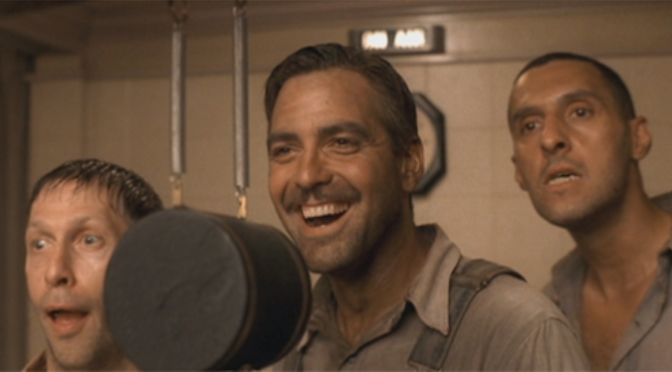
This year’s New York Film Festival played host to a 15th Anniversary screening of O Brother, Where Art Thou?, the Coens’ Dirty Thirties road movie, though it hardly seems like that much time has passed. I might have described O Brother differently — say, the Coens’ Dust Bowl love letter or the Coens’ Homer homage or the period highbrow escapee buddy whatever — except that the directing duo melted all of that babble away in the post-screening “discussion” of their writing process. “We just started with ‘three guys on the road'” said Joel; Ethan added, “then we tarted it up with Homer.” That was that. Next question. The Coens are experts at both of those things: interpretive film direction and film interpretation deflection.

But they were no less the storytellers on stage, despite their succinctness, and they were joined by O Brother stars George Clooney, John Turturro and Tim Blake Nelson as well as legendary cinematographer Roger Deakins. The latter was a pleasant surprise, and though the Coens have recently worked with the likes of Emmanuel Lubezki and Bruno Delbonnel it’s endlessly exciting that Deakins will return to the fold (as will Clooney) for the next Coen film Hail, Caesar!; if it’s at all the blend of O Brother and Barton Fink that it appears to be, then it can’t come soon enough.

Continue reading O Brother, Where Art Thou? (2000)

Film & TV News: September 29

News

  • The Prometheus sequel is moving forward as Ridley Scott’s next film under the official title Alien: Paradise Lost. Hard to pass judgement on title alone, but for the moment we’re cautiously pessimistic.
  • Speaking of Alien, Sigourney Weaver has confirmed a cameo in the upcoming Ghostbusters reboot, which you probably know as “the all-female Ghostbusters reboot” to such a degree that the title could be The All-Female Ghostbusters Reboot.
  • Spectre‘s theme song “Writing’s on the Wall” has been released, featuring the crooning vocals of Sam Smith, and can be heard in full over on Spotify. I haven’t actually listened to it, and won’t until I’m firmly in my seat in the theater for Spectre, but apparently it’s divisive so far without any of the visual/story context. On another note, isn’t it weird that so few photos of Christoph Waltz’s villain have leaked?
  • Some beautiful new stills from The Revenant hit the interwebs yesterday, teasing the exclusive use of natural light throughout Alejandro González Iñárritu’s Birdman follow-up. For those of you who have been pining for a shot of Leonardo DiCaprio standing before a mountain of buffalo skulls, today is your lucky day.

Continue reading Film & TV News: September 29

The World Is Not Enough (1999)

Neal Purvis and Robert Wade co-wrote the scripts for an important chunk of the James Bond franchise, penning everything from The World Is Not Enough to Skyfall. They’ll receive a credit for the upcoming Spectre, apparently advising primary writer John Logan, but the previous five films are pretty much The Wade/Purvis Era while Skyfall might end up marking an overlap with The Logan Era. There are a few stinkers throughout Wade/Purvis, namely two that are regarded among the worst Bond flicks of all time: the Joel Schumacher-esque Die Another Day and the incorrigibly self-serious Quantum of Solace. Odd that one would be too goofy and one not goofy enough. But the other three efforts comprise the real Wade/Purvis Bonds, allowing those other two to just be buffers interspersed between the flicks that actually matter: The World Is Not Enough, Daniel Craig’s introduction in Casino Royale, and the mega-hit Skyfall.

The theory goes that a Bond scribe — at least this particular duo — takes two or three tries to really get it right. Even Ian Fleming only turned out his best Bond yarns after testing the waters with the likes of Live and Let Die and Moonraker. With Wade/Purvis, the tautness of the story is the best evidence to support this theory.

Continue reading The World Is Not Enough (1999)

The Leftovers 1.8 – “Cairo”

The question of protagonist Kevin Garvey’s sanity was first raised in the pilot, wherein he may or may not have fired his gun at a pack of wild dogs. The second episode “Penguin One, Us Zero” seemed to look on uncaringly as poor Kevin lost his shit over a disappeared bagel. Since then he’s inexplicably lost track of a closet full of white shirts, tethered a dog to his fence without any recollection of doing so, and crusaded across Mapleton to find a stolen baby Jesus doll. After all of that it’s still not exactly clear what’s eating Kevin Garvey, nor is it even clear whether he is or is not crazy. Moreover, it’s not clear how Kevin losing his sanity ties in to the greater themes of The Leftovers.

“Cairo” changes all of that. Crazy is a strong word, but Kevin’s definitely not A-OK upstairs. Clear is a strong word, too, so perhaps we should state that the clarity we get on Kevin’s mental state and how that mental state ties into the grander schemes of the series isn’t exactly a straightforward answer. But Kevin’s sleepwalking comes with serious bouts of amnesia, and he often wakes up to find he’s done something questionable — like tying a dog up in the yard — during his waking slumber. In “Cairo”, he gets downright violent, so much so that the part of himself that he never remembers becomes something that he doesn’t want to be a part of himself at all.

Continue reading The Leftovers 1.8 – “Cairo”