Tag Archives: Matthew McConaughey

True Detective 1.2 – “Seeing Things”

This review appeared shortly after the initial premiere of True Detective in early 2014 — slight edits have been made since the original posting.

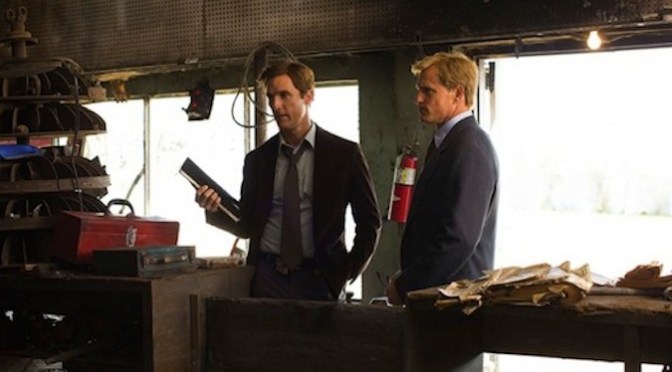
After a strong, stimulating pilot episode last week, True Detective returned with a second episode that further steeped us in the characters of Rust Cohle and Martin Hart. Headway is made on the murder investigation, but True Detective continues to emphasize the characters over the plot. Spoilers follow for the second episode “Seeing Things”.

Last week, the 1995 murder of Dora Lange brought State Police Detectives Cohle (Matthew McConaughey) and Hart (Woody Harrelson) together for the investigation while their disproportionate attitudes kept them distanced outside of work. A connection was made between the Lange murder and the shady disappearance of the young Fontenot girl years earlier, but other than that very few pieces of the puzzle can be placed by the young detectives. The pilot episode also introduced a part of the story unfolding seventeen years after the Dora Lange murder, and in 2012 Cohle and Hart are seemingly estranged, definitely changed from the men they used to be, but somehow definitely still the same.

Continue reading True Detective 1.2 – “Seeing Things”

True Detective 1.1 – “The Long Bright Dark”

This review appeared shortly after the initial premiere of True Detective in early 2014 — slight edits have been made since the original posting.

Touch darkness, says the promotional poster for HBO’s latest series True Detective, and darkness touches you back. A tagline like this is all too generic these days, paired with a moody title card or a black-and-white shot of the strong-willed protagonist of a new film or television series. True Detective’s ad campaign has all of that — but one thing to take away from the pilot episode, which aired Sunday night in the US, is that the weighty tagline is rightfully deserved. Spoilers follow for the first episode “The Long Bright Dark”.

Conceived as an anthology series (more on that in a bit), True Detective’s first season stars Matthew McConaughey and Woody Harrelson as newly-paired State Police Detectives in backwater Louisiana. The year is 1995, and the detectives are still operating in an awkward alliance as they begin an investigation into a gruesome murder. The victim’s name is Dora Lange, and it’s already clear that her case is a driving element of this season — and yet the vast majority of “The Long Bright Dark” is spent with McConaughey and Harrelson, and it’s also clear that this is a show that will focus on the character above the plot. The tension in the partnership is nothing revelatory for a cop show: McConaughey’s Rust Cohle is the unconventional but brilliant loner, Harrelson’s Martin Hart is the by-the-numbers family man looking to succeed in his position. These parts are acted perfectly, though, and McConaughey especially deserves to ride high on the wave of critical praise he’s received for recent roles such as this.

Continue reading True Detective 1.1 – “The Long Bright Dark”

Film & TV News: February 2

News

The Imitation Game won the 2015 USC Scripter Award this past Saturday, which honors both screenwriter (Graham Moore) and original source author (Andrew Hodges). The other nominees were Gone Girl, Inherent Vice, Wild and The Theory of Everything.

-The Sundance Film Fest Awards were announced, with Me & Earl & the Dying Girl taking a Grand Jury Prize and Robert Eggers collecting the Directing Award for the horror film The Witch.

-In casting news, Rose Byrne will be returning for X-Men: Apocalypse after having sat out for Days of Future Past, the American remake of Sleepless Night announced Jamie Foxx and Michelle Monaghan as leads, and Matthew McConaughey joined Born to Run. Aside from that, it was a fairly uneventful week for casting.

Continue reading Film & TV News: February 2

Prisoners (2013)

I’m not typically a genre purist. I don’t believe an artist should be constrained to single genres, and I have a great admiration for movies that blur the lines to create something fresh. There are two very different, but very good movies in Prisoners that, in this case, don’t exactly result in synergy. The first is about two families dealing with the disappearance of their daughters. It’s haunting, gut-wrenching, and hyper-realistic. To me, this is the stuff of reality. The second is about the mysterious detective trying to catch the abductor. It’s creepy, riveting, and grotesque. This is the stuff of crime thrillers. Frankly, each one would be nearly perfect on its own. But together, in the form of Prisoners, they feel like a cheap blow below the belt.

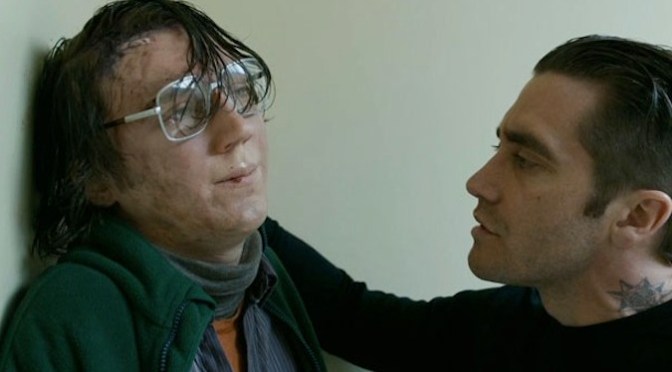
Anna’s parents, played by Hugh Jackman and Maria Bello, attend Thanksgiving dinner at Joy’s parents’, played by Terrence Howard and Viola Davis. When the two girls don’t return from playing outside, and it starts to rain, and a mysterious RV is spotted, the families go into panic mode. Days later, with the authorities on the case 24/7 and vigils being held for the missing girls, the families continue mourning and start resigning to the bad news that’s likely to come. But Keller Dover (Jackman) never really leaves panic mode. There was one suspect–the child-like, catatonic owner of the RV (Paul Dano)–but the cops had to let him go. So Keller does what any frustrated father who’s built like Wolverine would do and takes matters into his own hands. Next thing you know, he’s leading Terrence Howard into an abandoned apartment complex where the suspect is chained to a sink and badly beaten. Continue reading Prisoners (2013)

The Affair 1.4

There were a couple new story elements and plot revelations in the fourth hour of The Affair, but like the third episode this one didn’t have nearly the same degree of crackle-and-pop as the opening segments. Let’s hope that’s not a new trend, and let’s dive right into episode four.

I’m somewhat surprised it’s taken me this long to mention any parallels to True Detective, as the structure alone is pretty much identical to that of The Affair – future-set interrogations framing a series of flashbacks that may or may not be true, an overbearing sense that the past and the present are linked by something we viewers just can’t grasp yet, etc. Now, though, the comparison is both unavoidable and deeper than the structure. The fifth episode of that first season (“The Secret Fate of All Life”) is the first time that the verbal recounting of the old case by Matthew McConaughey’s Rust Cohle is in direct conflict with what we’re actually seeing. Likewise, the memories of Noah and Alison are now starting to seem more and more dubious (or are they? Dun dun dun).

Continue reading The Affair 1.4

The Wolf of Wall Street (2013)

This is certainly one of those films that you either absolutely love or downright hate, and I can understand why. Martin Scorsese’s latest work, The Wolf of Wall Street, really isn’t that much different from many of his other pictures except for the intensity of the vulgarity -the literal sex, drugs and rock n’ roll – which turns certain people off from the film. The use of 569 F-words, numerous sex scenes including a gay orgy, the consumption of copious amounts of Vitamin B (posing as cocaine) and Quaalude’s, as well as speeding cars, helicopters and yachts, all add to the excessive feeling and tone that the movie captures so well, love it or hate it. Whether or not you enjoyed this film, you cannot deny how energized it is and that watching it was probably the quickest 180 minutes of your life.

It is easy for someone watching The Wolf of Wall Street to miss many of the film’s truly great aspects due to this vulgarity. The endless bare breasts and drunken and/or high (usually and) benders that the majority of the characters go on may serve as a kind of invisibility cloak for the less well-trained moviegoer. First off, the wittiness, intelligence, and authenticity of the dialogue is likely the most impressive thing about The Wolf of Wall Street. The script, penned by the Sopranos genius Terry Winter, is undeniably phenomenal; see “the McConaughey lunch scene,” “the Jean Dujardin negotiating scene,” “the epic f@#king DiCaprio speech scenes.” At the same time, however, Scorsese encourages his muses to improvise, delve deeply into their characters and bring that necessary authenticity to their performances and the film. It is this combination of impeccable writing and spontaneous inspiration that makes the dialogue in this film so good.

Continue reading The Wolf of Wall Street (2013)

Interstellar (2014)

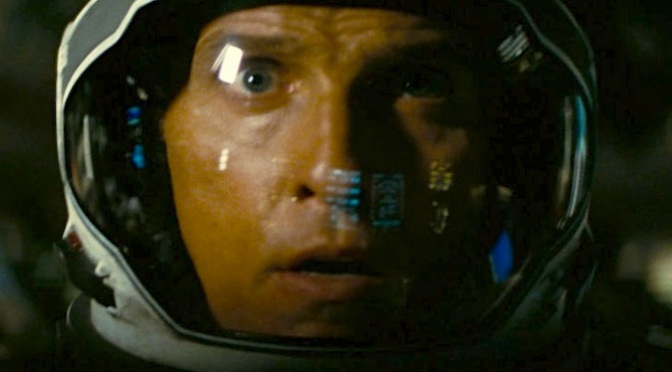
With brand-new releases the tendency is usually to shy away from spoilers in reviews, and those potential spoilers can be especially sensitive with a long-anticipated film like Interstellar (“I waited two years for this and find out the night before that [censored] is really [censored] the whole time??”). I respect reviewers who are able to provide an accurate representation of a film without divulging any/many of its secrets, but I’ve never been one of them. I can tread lightly, sure, but to really talk about a movie like Interstellar there are important plot points that need to be laid out in the open. Just the fact that we have a three-hour movie with a two-minute trailer means that the film holds vast sequences, settings, and even actors that you couldn’t possibly expect, and it’s partly those revelatory realms that we’ll be dealing with here. Consider yourself warned.

Now: let’s talk about ghosts.

Continue reading Interstellar (2014)

Awakenings (1990)

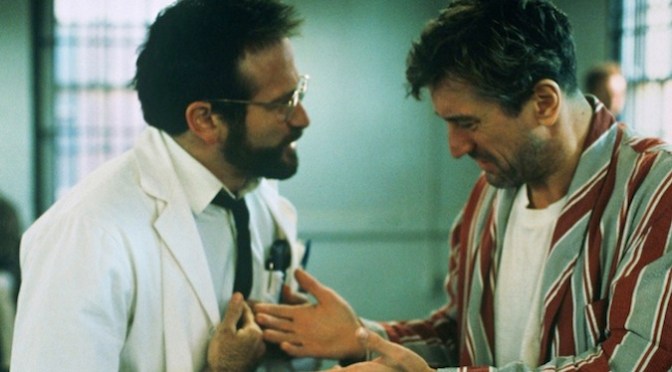
Penny Marshall’s Awakenings is most superficially compared to Barry Levinson’s Rain Man for a few understandable reasons, not least of which being the two films feature a famous lead actor playing a character with a severe medical affliction. The two films also came out within two years of each other, and some may suspect Rain Man‘s success to have influenced Awakenings.

Starring Robin Williams as Dr. Malcolm Sayer (an analogue for real-life Dr. Oliver Sacks, whose memoir provided the basis for Awakenings) and Robert De Niro as mostly-catatonic patient Leonard, the film follows both men as they experience a breakthrough with regards to Leonard’s condition. Sayer’s intuition leads to the application of a new drug which brings Leonard and other patients of the ward out of catatonia and into a clearer existence, “awakened” to the world. The continued treatment of Leonard proves a heartbreaking experience for Dr. Sayer.

Continue reading Awakenings (1990)

Evidence of Blood (1998)

A late-’90s made-for-TV flick by no-name director Andrew Mondshein starring hardbody sex idols David Strathairn and Mary McDonnell? Sign me up!

While there’s literally not one thing to get excited about when looking over Evidence of Blood on paper, it passes with a push from a realistic script and fairly believable twist ending. Strathairn stars as crime novelist Jack Kinley, who returns to his smalltown home (as all such protagonists seem to do) and gets embroiled in a decades-old murder mystery (as all such protagonists seem to do). McDonnell and the rest of the supporting cast sport drawling Southern accents and go around wondering why city boy Kinley can’t just let the past be the past, for Chrissake.

Also notable here is the overused protagonist-has-suppressed-the-one-thing-that-cracks-the-case trope, wherein Kinley’s childhood nightmares end up informing the whodunit in a highly convenient way. Was that trope overused in 1998, though? Does it matter?

The script, again, is realistic to a fault and quite solid as far as made-for-TV flicks go – and sad, then, that the aforementioned “quirk” of the protagonist is not only unrealistic but also jarring in such an otherwise true-to-life landscape. These “quirks” are super prevalent today, apparent in Dr. House and every “gifted” crime investigator on CSI and NCIS and LAPD Whatever. Hell, even Matthew McConaughey’s Rust Cohle from True Detective had spells of hallucinations amidst his obsessive and manic mannerisms.

Is no main character interesting enough without these kinds of fabricated “connections” ingrained somewhere in their psyche? That screenwriter Dalene Young and/or book author Thomas H. Cook (maybe it worked better in the novel?) succumbed to this trope is ultimately what sets this writer-solving-a-mystery story below stronger efforts of similar sensibility, like Midnight in the Garden of Good and Evil.

The framing and cinematography may also be what set Evidence of Blood aside as TV fodder rather than something fit for theatrical release, and Kinley’s dreams and premonitions fade in and out of the reality of the story with barely a trace of care or subtlety. They just happen. In better hands, the weak points in the story could still have been fashioned into compelling viewing, which is to say that in better hands Evidence of Blood could have been a heck of a lot more affecting.