All posts by hangmantitan

Better Call Saul 1.7 – “Bingo”

I was away from Better Call Saul for two weeks. The Mexican prison in which I was caged had neither televisión nor computadora, and for some reason the chip in my brain that live-streams anything and everything related to Breaking Bad directly into my eyeballs seemed to be out of juice. Por favor, I wheezed, necesito…Saul. My captors never budged. At length I escaped with the help of a beautiful young Mexican woman named Alejandra, by foot, by horseback, by freight train bound for the States, by the skin of my teeth. I collapsed onto my couch seventy-two harrowing hours later. As “Bingo” began I felt like I’d missed something, I felt disconnected, I felt for the first time like I actually needed the previously on montage. I felt lost. I longed for Alejandra.

Oddly enough, “Bingo” was actually partially about exactly that: is Jimmy going anywhere? Even if you forget about him for two weeks, is he still just going to end up in the same place he started? This is a guy who constantly reinvents himself with chameleonic disregard for each successive former self. The episode “Hero” went a long way to depicting this, first showing the con man Slippin’ Jimmy, then the upstart lawyer Jimmy McGill, then the coiffed and suited James M. McGill, Esq. beaming down from that billboard. The trick of the thing, of course, was that it’s all still Jimmy. That billboard thing was a con, plain and simple, just like the kind Slippin’ Jimmy used to pull.
Continue reading Better Call Saul 1.7 – “Bingo”

Kidnapping Mr. Heineken (2015)

It’s actually borderline impressive how dull Kidnapping Mr. Heineken ends up being. The true story of the capture, ransom and eventual release of beer mogul Freddy Heineken is a harrowing one. Heineken was one of the richest men in the Netherlands when he was kidnapped. He was held for weeks in a brilliantly-constructed soundproof cell that probably inspired that twist from Denzel’s Inside Man. His ransom was the largest ever paid for an individual, and his captors evaded police for weeks following their release of Heineken. The media had an absolute field day with the entire affair, but the personal motives on the part of the captors are interesting as well.

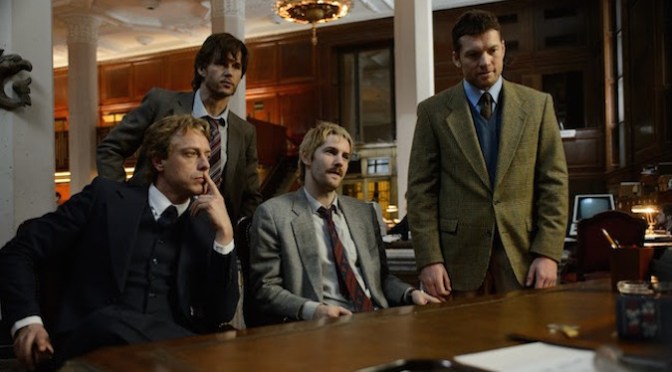
As a film, though, pretty much all of that falls flat. Jim Sturgess plays the ringleader and de facto mastermind Cor Van Hout, flanked by Sam Worthington’s Willem and Ryan Kwanten’s Cat, and each actor does fine with the part allotted to them. Anthony Hopkins is the veteran and obvious draw in the part of Freddy Heineken. Finally, director Daniel Alfredson is an intriguing choice as well, having previously helmed the original Millennium Trilogy before David Fincher took over for the American version of Girl with the Dragon Tattoo.

Continue reading Kidnapping Mr. Heineken (2015)

The Red Road 1.6 – “Snaring of the Sun”

The first season of The Red Road ends with a whole lot of action, but the finale also manages to depict some important moments of character development as well. Junior takes a decisive step toward the dark side, Jean comes to terms (sort of) with the long-ago death of her twin brother, and Harold and Kopus find themselves in new positions as well. “Snaring of the Sun” isn’t as well-written as the penultimate episode “The Great Snake Battle“, but it makes up for that with some fantastic direction by Terry McDonough. McDonough has a solid body of work in television that includes three episodes of Breaking Bad and the Better Call Saul episode “Nacho“, so here’s to hoping he returns to The Red Road in future seasons.

It’s very possible that two of my story-based qualms with Road will have evaporated following “Snaring of the Sun”. First is the unevenness of Jean’s character — she’s necessarily all over the place, emotionally dragged around by Harold and, indirectly, by Kopus. But her smooch with the latter midway through “Sun” is cringeworthy, not just because of the usual kisses-are-cringeworthy reason but because this is the guy she’s pinned her brother’s death on for decades. Sure, she’s just discovered he had nothing to do with it. So she’s suddenly attracted to him? Anyway, the second qualm is the convenience of the taped recordings of Jean’s brother Brian (I called him “Scotty” in a previous review — refuse to change it) and “Sun” actually wrapped up that storyline well. I’d be surprised if those tapes pop up again.

Continue reading The Red Road 1.6 – “Snaring of the Sun”

Film & TV News: March 30

News

  • Hugh Jackman has confirmed that he’ll only be playing Wolverine one more time, and that means he won’t be appearing in X-Men: Apocalypse. What happened to “playing Logan until you die”, Hugh? Can’t you just defy Hollywood studio machinations and somehow cameo in Avengers: Infinity War? Can’t you just come back and do an Old Man Logan movie? No Country for Old Man Logan? Please?
  • Speaking of Marvel movies, Adam McKay is now rumored to occupy the director’s chair for an upcoming MCU film. Money’s on Inhumans, and money’s also on this still not being anywhere near as enticing as Edgar Wright’s Ant-Man. Sigh.
  • The Walking Dead spinoff is now officially titled Fear the Walking Dead, and a brief tease premiered during last night’s WD finale. As our friends at Collider so eloquently put it, at least it ain’t as bad as The Walking Dead Into Darkness.

Continue reading Film & TV News: March 30

The Red Road 1.5 – “The Great Snake Battle”

The opening scene of the first season Red Road episode “The Great Snake Battle” reminded me of a scene from James Gray’s directorial feature Little Odessa. Both use a skinny hallway of a rundown New York City tenement as their setting, both depict a passionate confrontation between father and son, and both show how quickly a power dynamic can change from one man to the next. The comparison is strengthened somewhat by the fact that Gray directed Road‘s pilot episode “Arise My Love, Shake Off This Dream“; this fifth episode, focusing almost exclusively on main characters Phillip Kopus and Harold Jensen, is also the best since Gray’s opening hour.

We’ve seen how smart and manipulative Jason Momoa’s Kopus can be in pretty much every episode so far. He always seems to have the upper hand, even when he’s pissed off or cornered or spoken to like a child by his manic father Jack. It’s Jack and Phillip who come head-to-head in that dim hallway, the former ripping the door open with a gun in his hand and demanding his payment, the latter hardly saying a word at all. It’s not the fact that Phillip is quiet that makes this scene different — we’ve talked at length about the silent observations of Kopus, watching from afar and gathering ammunition to use against anyone and everyone. But he’s more than just quiet in this hallway scene. As his father rips into him, Kopus seems truly sad. Sad Kopus is without a doubt a new Kopus.

Continue reading The Red Road 1.5 – “The Great Snake Battle”

The Insider (1999)

A smash cut can be a beautiful thing. It can also be a broadly-defined thing, somewhat unfortunately, which means I have to reel you into a conversation about Michael Mann’s The Insider by providing a narrowed definition of smash cut. Excited yet? The added problem, of course, is that one of you damn dear readers will no doubt have the time to point out precisely where I’m mistaken in my definition, holding my hand and stating that, no, that’s not a smash cut, that’s a match cut, and that one over there is a jump cut, and over there is…my, oh my! Is that a Dutch angle shot in its natural habitat?

Anyway, the thing I’m thinking of might not even qualify as a smash cut, but for now that descriptor will have to suffice. Mann loves an extreme close-up, especially in his earlier works like Heat (I’m thinking of that early bouncing shot of Val Kilmer), and in his follow-up The Insider we probably get closer to the facial pores of Russell Crowe and Al Pacino than we’ve ever been before. But there are a few close-ups not of faces but of objects, inserted for a second or a half-second right smack in the middle of a scene, and those cuts are what I’m talking about. They smash to the forefront when you’d least expect them, these otherwise uninteresting objects. Why does Mann shove these in so boldly, and how does he get it to work so damn well?

Continue reading The Insider (1999)

The Red Road 1.4 – “The Bad Weapons”

We discussed the significance of the episode titles of the first season of The Red Road in our review of the second episode “The Wolf and the Dog“, one of a handful of Native American legends employed as allusion and metaphor for the events of the series. “The Bad Weapons” is no different, but the episode goes one further in attempting to apply the belief systems of the given tribe (in this case the Blackfoot Nation) to the moral quandaries of Philip Kopus, Harold Jensen, and the other residents of Walpole, NJ.

There’s a Red Road subplot revolving around the years-ago death of Jean’s twin brother that rears its head again in “Bad Weapons”. It’s certainly an important history for the show (or at least the opening season), mainly because of the subtle intimation that Kopus might have been involved in that untimely demise. But as Jean and Harold’s daughter Rachel discovers tape recordings of the twin’s stream of consciousness, that particular storyline slips away from importance and approaches convenience instead.

Continue reading The Red Road 1.4 – “The Bad Weapons”

Top Five (2014)

You have to marvel at Top Five, the third and best feature directed by Chris Rock, because it occupies what good ol’ Dave Matthews might call The Space Between (right now you’re saying this motherf*cker just referenced Dave Matthews in a review of a Chris Rock movie — you’re damn right). There’s the in-betweenness of the genre itself, which like main character Andre Allen keeps toggling from comedy to drama and back again. Even within the more likely genre of the two — comedy, for those of you who’ve never heard of this “Chris Rock” fellow — there’s the sense that the movie is stuck in the middle between the comedy we expected and the comedy we didn’t. Rock, after all, made his directorial debut with Head of State, and it’s pretty clear that with Top Five he’s partly digging stuff like that instead of just doing it all over again.

Mostly, though, the tightrope walking in Top Five occurs in the dialogue. Andre’s a has-been comedian, known to the masses for playing Hammy the Bear in three Hammy movies, and as of now he’s trying to break into more serious roles (like the leader of the Haitian Revolution in his new movie Uprize). He’s also trying to stave off his alcoholism, and Top Five provides a nice link between Andre’s sobriety and his ability to be funny. So the dialogue reflects this in the obvious way, in the events of the script and the plot points and such, but it also reflects this in the way it seems by turns well thought-out and yet totally spontaneous.

Continue reading Top Five (2014)

The Red Road 1.3 – “The Woman Who Fell from the Sky”

The Red Road, great as it is, is like any other show in the history of television: it has weak spots. “The Woman Who Fell from the Sky”, the third episode of the opening season, is likely the first time the chinks in the armor are visible. The writing up until this point has been largely commendable, succumbing to the occasional been-there-done-that moment, but mostly avoiding them, hinting at new roads (red ones) instead of relishing the old ones. “Woman” is a bit shakier, but thankfully Jason Momoa’s Philip Kopus, far and away the best character on the show, does what he can to save this particular episode from sliding wholly into those moments of cliché.

These days, “antihero” is like a curse word. We’re living in a post-Breaking Bad world, so the last word on the TV antihero thing has kind of been said. Does that mean antiheroes should be avoided altogether? Of course not. But is that what Kopus is? Hard to say. He has some qualities of an antihero in that he’s definitely a bad guy, robbing medical wholesalers and dealing in guns and drugs and manipulating kids, but he’s simultaneously someone you root for. It’s fun as hell to watch him do his thing, even if that thing isn’t strictly legal.

Continue reading The Red Road 1.3 – “The Woman Who Fell from the Sky”

Bloodsport (1988)

After watching the surprisingly affecting JCVD last week, a return to the glory days of action hero Jean-Claude Van Damme seemed in order. A dozen movies and a kamillion roundhouse kicks later, I emerged in a blearyeyed stupor with a stark reminder of the true nature, dark and terrible, of a Van Damme flick. The horror…the horror…

Bloodsport is definitely the one that shot JCVD to fame, and by all accounts it’s a pretty typical outing for the Muscles from Brussels. Most of his films from the early ‘90s are either about a) a young fighter looking to high-kick his way to the top or b) a studly defender of the meek who high-kicks the shit out of the oppressive. There are some decent movies in there, to be sure, namely John Woo’s unapologetically action-oriented Hard Target and Van Damme’s Die Hard attempt Sudden Death. For every one of those there are two stinkers, though, like the Aggro Crag-set Cyborg and the unbearably campy Street Fighter.

Continue reading Bloodsport (1988)