

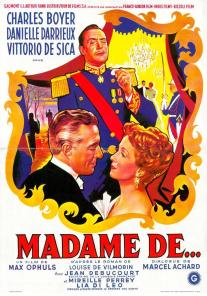
 The Earrings of Madame de… is the English-language title for Madame de…, as it was released in France, which heralds the heart-shaped diamond jewelry — not its owner — as the star of the film. The earrings do indeed play a major role, significantly altering the lives of those who possess them, seemingly propelled by their own willpower from one owner to another and back again. With a pinch more malice this would be The Lord of the (Ear)rings, a fantasy tale about tempting jewelry that instills a deadly pride in those who dare purport to wield such power. But the passionately humanist Max Ophüls ensures that this is always really the story of Madame de…, not simply of her diamonds, and the themes of pride and ownership don’t necessarily involve the earrings at all.
That sleight-of-hand is one of the many reasons Madame de… stands as the most highly-praised work by Ophüls, whose career as a filmmaker was constantly capsized by the onset of World War II. A German-born Jew, Ophüls fled and became a French citizen in 1938, only to have to flee further to the U.S. There he failed to break into Hollywood until an admirer of his work recommended him to Howard Hughes; it helped that the admirer was none other than Preston Sturges. Ophüls directed five Hollywood productions before returning to Europe in 1950, where a new stage of his filmmaking career blossomed. Each of his final films — La ronde (1950), Le plaisir (1952), Madame de… and Lola Montes (1955) — is a masterful achievement in its own right, championed thereafter by the likes of Samuel Fuller, Stanley Kubrick and Paul Thomas Anderson.

 Those with a dream to fulfill have a better chance of survival. This is the idea put forth to Diego Fairman, a once-famous film director, as he lies in his hospital bed. He’s dying of cancer at the moment, given only a few months to live, his body ransacked by the disease at every turn. Diego’s life outside his body has been ransacked, too, the cancer boiling within him such that deep issues in his marriage, his family and his work all bubble to the surface. The ailing artist knows he wants to survive, but he doesn’t yet know that this means more than simply “staying alive.” Even if you’re in perfect health, your chances of survival are better with a dream to fulfill.
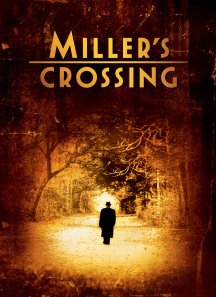 There may be no other gangster film in existence that walks the tightrope Miller’s Crossing walks. On the one hand, the third film from the Coen Brothers is of a piece with the 1930s gangster flicks that influenced it, full of colorful criminals and double-crosses and rat-a-tat action. The dialogue is straight from Dashiell Hammett and the production design is straight from the pre-Code era, à la Scarface and Little Caesar. The gangster subgenre and critical thinking on the subgenre are historically grounded in realism, unlike the mythic and symbolic trappings of the film Western, and Miller’s Crossing honors that in its gritty, ruminative approach to a complex plot. It is, in short, a quintessential gangster film.

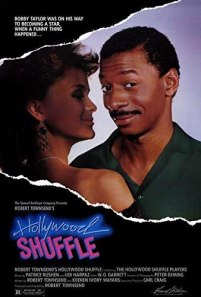 One of the best collections available on the Criterion Channel is one called Film Plays Itself, a self-reflexive assemblage of movies about movies. Here you’ve got your classics, like Sunset Boulevard and 8½. You’ve got your “out-there” stuff, like the experimental Symbiopsychotaxiplasm or Godard’s New-Wave Contempt. And you’ve got some modern triumphs like The Player and
 We’re always experiencing history now. Few grasp this concept like Alex Cox, who frequently eschews the traditional idea of “historical accuracy” in favor of something we might pretentiously refer to as historical truth. In 1986’s
 The Coen Brothers have been on my mind as of late. They usually are, granted, but especially so now that we’ve made the (ill-advised?) decision to dive into

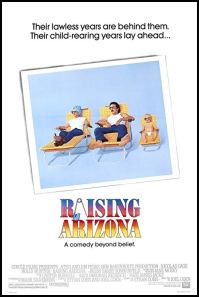 One of the most impressive things about the Coen Brothers is their ability to succeed in both self-aware comedy and super-serious drama, and their first two movies encapsulate both ends of that spectrum. Apart from
 Rather than a standard film review, we’ve been compiling a visual glossary of likely inspirations in Paul Thomas Anderson’s 2012 film The Master. Huge props go to


 As far as indicators of things to come are concerned, Blood Simple has everything you need to know about the Coen Brothers right there in the opening. Okay, maybe not everything — after all, daring to think you’ve nailed down the Coens is,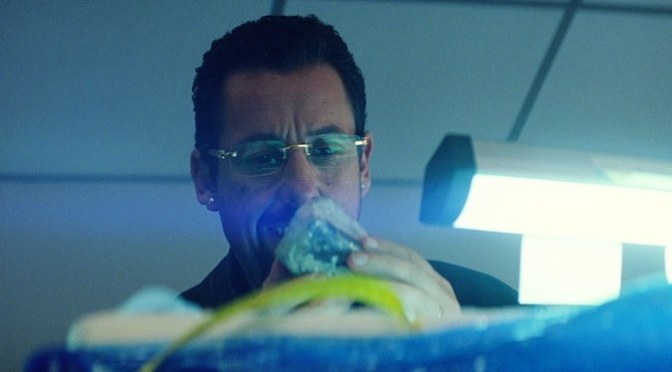
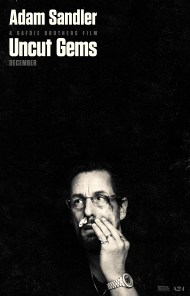 The films of the Safdie Brothers tend to share a few recognizable qualities. Most apparent is the kinetic, stressful energy with which each of their films unfolds, a ride that weaves unexpectedly while continuously approaching a breakneck speed. Those weaves are almost always a result of character decisions, though, and I respect that the Brothers keep memorable figures at the fore through even their most plot-twisty jaunts. They seem drawn to slightly-delusional protagonists, too, if not fully-delusional, and so the common logline usually follows a familiar trajectory: Main Character makes increasingly dumb decisions and pays for it. And then there’s the street-level realism, from the single-parent struggles of Daddy Longlegs to the exploration of addiction in Heaven Knows What to the petty life of crime in Good Time.
 Motion State Review