Category Archives: Director Series

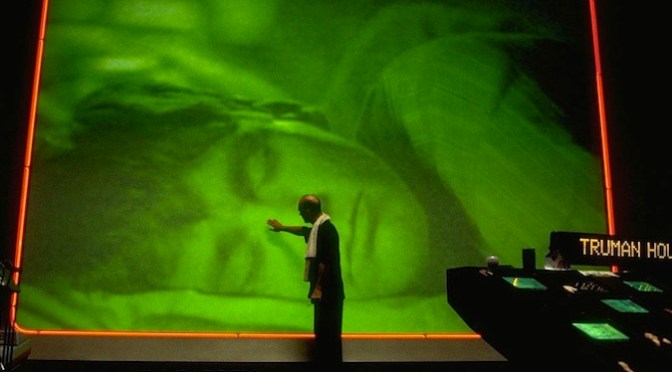
The Truman Show (1998)

Despite dealing largely with dramatic cinema, Peter Weir had the good fortune of working with two of the most gifted American comedians of this (or any) era. He drew out a defining performance from the late Robin Williams in Dead Poets Society, casting him as Professor John Keating not for the simple unconventionality of Williams in a “serious” role but more likely because Williams could convey passion in a way most actors of “serious” roles rarely can. Likewise, even though The Truman Show is pretty damn funny at times, Jim Carrey’s career in comedy matters little for his role as Truman Burbank — he’s perfect for it for another reason.

I didn’t always think so. On first pass Truman seemed to have more tragedy in him than the actor was able (or willing) to provide, especially considering that Carrey’s Joel Barish from Eternal Sunshine of the Spotless Mind fought a similarly paranoid crusade and through it became a beautiful tragic hero for our modern age. In this retrospective light Truman seemed caught in the middle between Carrey the affable goof and Carrey the tragic everyman.

Continue reading The Truman Show (1998)

We Own the Night (2007)

There are obvious similarities between James Gray’s third film We Own the Night and his first two features Little Odessa and The Yards, and they’re mostly positive points. All three are New York crime dramas that focus on families straddling the moral wires of right and wrong, all have strong supporting characters, and all have a good handful of unique and intense action scenes. Considered side-by-side We Own the Night might be the “glossiest” of the three, lacking some of the grit of Odessa and Yards but also lacking some of the exciting virility Gray brought to those films. Still, the result is a more-than-passable NYC crime story.

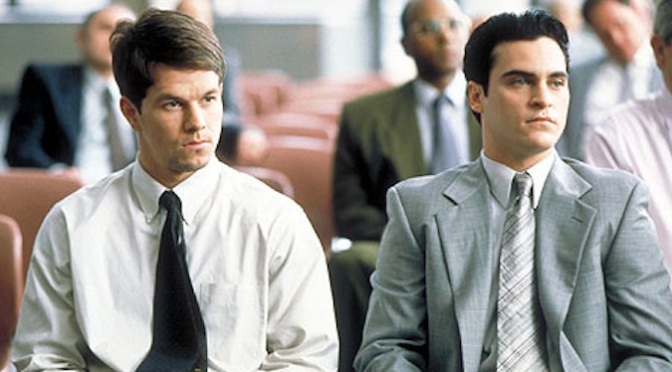
The premise is highly familiar, and that alone may relegate Night to the rung below the likes of the arrestingly deviant Little Odessa. Joaquin Phoenix and Mark Wahlberg play Bobby and Joey, brothers on opposite sides of the law, the former owner of a seedy drug-fueled nightclub and the latter a golden boy NYPD officer. The events that bring them together aren’t altogether unfamiliar either. The big bad Russian drug dealer Vadim frequents Bobby’s place, so Joey (for some strange reason) believes his estranged brother to be the only person in the entire packed nightclub who can inform on him. Vadim (for some strange reason) suddenly puts an inordinate amount of trust in Bobby, letting him in on a secret to which only his most trusted henchmen are privy. If this all sounds disappointingly typical for an opposite-sides-of-the-law drama, that’s because it is.

Continue reading We Own the Night (2007)

Fearless (1993)

The Peter Weir we have today is one that seems to take his time releasing new films. It’s been four years since The Way Back, more than ten since Master and Commander, and nearly twenty since The Truman Show. Those most recent films of his are pretty great across the board, and perhaps the time and care taken with each is a major reason why. This wasn’t always the case with Weir, though: he released five films in the 1980s alone (Gallipoli, The Year of Living Dangerously, Witness, The Mosquito Coast, and Dead Poets Society), all of which were fantastic, and he had a pretty productive early ’90s too.

The film that forms the divide between super-productive Weir and less-so Weir seems to be Fearless, a 1993 drama starring Jeff Bridges as a plane crash survivor. For whatever reason, Weir took more time off following Fearless than he had since he first started directing (although one might find it hard to believe it was truly “time off”). From then on, a new Weir film would be all the more cherished for the infrequency now associated with it.

Continue reading Fearless (1993)

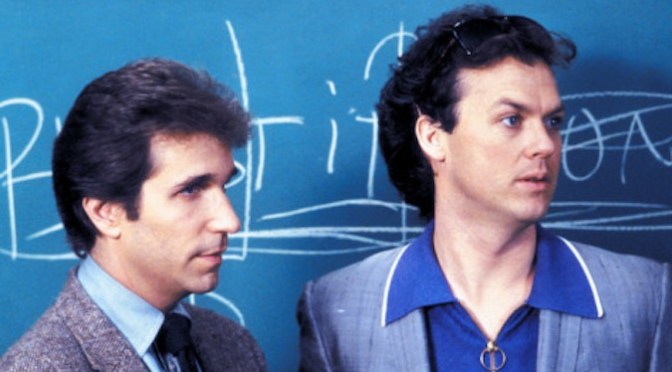
Night Shift (1982)

The upgrade in quality from Ron Howard’s directorial debut Grand Theft Auto to his sophomore effort Night Shift is pretty remarkable. Howard did direct a string of TV movies in the interim (Cotton Candy, Skyward, and Through the Magic Pyramid) and had directed a few shorts prior to Auto, so it wasn’t like Night Shift was only the second time he touched a camera. He was also doing this really weird thing called “acting” on occasion.

Regardless of where it falls, Night Shift is a surprisingly hilarious addition to Howard’s early canon. Auto relied heavily on Happy Days cast members and members of the Howard Family to round out the cast and crew, which isn’t necessarily a bad thing but could be a bit distracting at times. Speaking of distracting, Auto also had a funk-bass-porno soundtrack that served to bolster the overall feel of the thing as hastily-made. And most importantly, the character motives in Auto just didn’t make a whole lot of sense across the board.

Continue reading Night Shift (1982)

Ordinary People (1980)

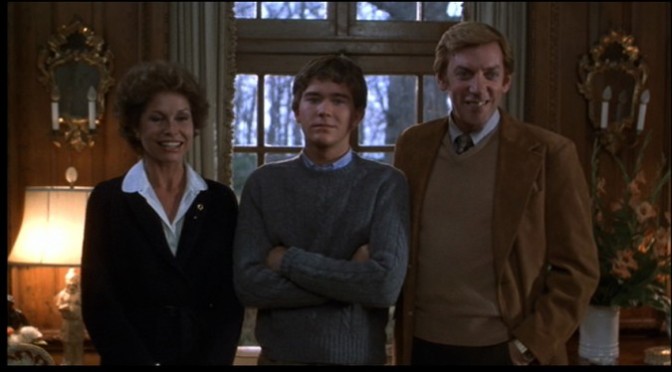
Halfway through Ordinary People, there is a scene in which high schooler Conrad Jarrett’s parents are taking family portraits. His mother and father take turns posing with their only son while his grandparents run the camera. Conrad awkwardly folds his arms, not knowing whether to smile. Father flashes a genuine grin, truly relishing the moment. When it’s Mother’s turn, the two stand together uncomfortably. Father’s trying to take the perfect picture, but Mother doesn’t know how to show Conrad affection, and her fake smile is growing tired. Father takes too long with the camera, Mother gets increasingly frustrated, Grandparents are talking over everyone as usual, and suddenly Conrad explodes. He’s had enough. Not so much with the photo, but with his mother’s inability to stand next to him and smile. Everyone freezes, except Mother. She carries on like nothing happened, hoping to fade back into normality like another ordinary person.

It’s a perfect representation of the family’s dynamic, though not the only one. Ordinary People is made up of small moments like these where characters aren’t saying how they feel, partly to keep up appearances, and partly because they don’t actually understand how they feel. In his directorial debut, Robert Redford proves to be an actor’s director, finding the ticks and gestures that characterize these humans better than any line of dialogue would. This is a movie about a family’s lack of understanding, of each other, yes, but mostly of themselves. They fidget, they pace, they stare blankly, lost in thought. They don’t understand why they feel and act the way they do, so they look to blame each other. After all, Conrad once screams, “It’s gotta be somebody’s fault or there ain’t no goddamn point.”

Continue reading Ordinary People (1980)

Grand Theft Auto (1977)

It’s easy to see how Ron Howard made Grand Theft Auto. He was 23 years old in 1977 and already had a few years of Happy Days under his belt, not to mention enough TV credits to satisfy the entire career of most actors. He had connections, and those connections included his family of actors as well. Grand Theft Auto, frankly, is nothing phenomenally special, at least not in terms of script or directing. The hasty editing and funky bow chicka wow wow soundtrack do, at times, make the thing seem like it’s about to throw the hyuk hyuk Days of Happy out the window and become a low-budget adult film. But it’s Howard’s first film! He was 23! We can give him a break on quality here, for sure, and in fact I’m surprised most debut features from eventually-famous directors don’t look more like Grand Theft Auto.

Howard plays Sam Freeman, nice young lad from a modest family woefully in love with the beautiful Paula Powers. Paula’s played by Nancy Morgan, and she’s a great reminder that every desirable teenage girl in the ’70s had alliterative given and surnames. Paula’s also rich, and so her proposed engagement to Sam is not received well by her parents. They call him a fortune hunter and kick him out of the house before locking the door and blasting Kanye’s “Gold Digger”. Love, however, is not so easily swayed. Paula steals her father’s Rolls Royce and picks up Sam, and they hit the road to Vegas to get married and inspire an inexplicable epidemic of carjacking in their wake.

Continue reading Grand Theft Auto (1977)

The Yards (2000)

On the surface, The Yards isn’t a whole lot different than James Gray’s debut feature Little Odessa. Both follow a young man with a rough past returning to his hometown after a long time away. Both explore the family dynamic in the wake of that return. Both watch as man and family alike are sucked back into old ways as if the place in which they all grew up would hold a dark fate regardless of how loudly they all raged against it. Both Little Odessa and The Yards, tragic movies about reluctant criminals, are criminally underseen as well (although they’re both now streaming on Netflix).

In Gray’s sophomore effort Mark Wahlberg is Leo, recent ex-con out on parole and returned to his ailing mother and his seedy extended family in Brooklyn. His good friend Willie is happiest to see him again, eager to reintroduce him to “the way things work”. Charlize Theron, James Caan and Faye Dunaway round out the impressive cast, but Joaquin Phoenix as Willie is the only one who mines his character for all he’s worth. If there’s anything that separates this feature from Little Odessa, it’s that the potential of The Yards is greater than the final result.

Continue reading The Yards (2000)

Little Odessa (1995)

There are probably a great many directors who could claim to be “New York directors” or directors of “New York movies”. Plenty of auteurs film in the Big Apple, sure, but true New York movies have more than just the location and the accent. They have the feel, dumb as it sounds. Martin Scorsese is the name most likely to crop up in the present conversation, and in fact the case with Scorsese is such that the relationship might occasionally become reversed: Scorsese made his name depicting “New York things”, and he got so good at it that certain “Scorsese things” are now taken lock, stock and barrel as “New York things”. Take this simple, unadorned, stage-setting shot from James Gray’s debut feature Little Odessa:

Little Odessa (1994)

Doesn’t something about that just scream Scorsese? The obvious comparisons are there in the smokiness, the coloring, the detail in the clothing and the food on the tables. The neon sign in the window. But the staging and perspective, too, seem to recall Scorsese’s camera. This is one of the more straightforward examples of such influence on the young James Gray, but the point isn’t to highlight how Gray made Little Odessa on the foundations laid by guys like Scorsese – he didn’t, and it’s clear even in this debut feature (made when Gray was just twenty-five) that his style is a distinct one largely free of ties to any cinematic giants of note. And the point isn’t even to prove that James Gray is deserving of a prominent rank amongst New York directors like Scorsese, although he is. The point, for now, is that Gray crafted Little Odessa as a New York movie, crafted it with that New York feel, and he did so for a very specific reason.

Continue reading Little Odessa (1995)

The Osterman Weekend (1983)

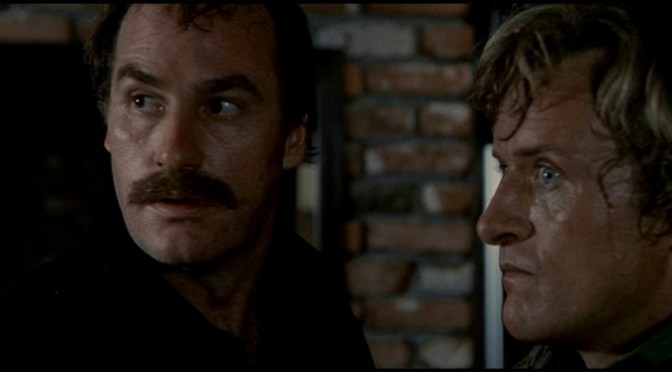
The problem isn’t that The Osterman Weekend is a bad movie. It certainly is, mind you, but that’s not the main problem. The books of Robert Ludlum are that strange breed of airport literature that often seems perfect for film adaptation but rarely manages to translate well, and by that criteria Osterman isn’t even that bad – this first adaptation was followed by the godawful Michael Caine-starrer  The Holcroft Covenant in 1985, an equally shitty made-for-TV version of The Apocalypse Watch in 1997, and then nothing until the Bourne movies finally showed up and allowed the Ludlum Estate to wipe its collective brow. The Ludlum Lens (heckuva title for his biography!) isn’t what we’ll be viewing this film through, but if it were this might actually turn out to be a favorable review.

Instead: The Peckinpah Perspective. The problem with The Osterman Weekend is that Sam Peckinpah directed it – the issue there being that the final film barely resembles what one would come to know as a Peckinpah film. At one point in time, that phrase was gold – it’s a Peckinpah film. It meant violence in a somewhat hyperbolic sense, but it also meant well-drawn characters with muddled motives, it meant ugly people doing ugly things under a microscopic lens. A Peckinpah film, at best, meant an insanely detailed story, and most importantly it meant a story unlike any you’ve seen before. There’s a reason people shake their heads and grind their teeth and comment cynically on message boards across the internet about how nothing in Hollywood is original anymore, about how Michael Bay makes the same movie over and over. It’s because they just watched a Peckinpah film, and because they’re hard up to think of any other film to compare it to.

Continue reading The Osterman Weekend (1983)

21 Grams (2003)

Director Alejandro Gonzalez Iñárritu began his uplifting “Trilogy of Death” with his directorial debut of Amores Perros. Just three years later, he and writer of the entire trilogy Guillermo Arriaga completed the second installment of the trilogy: 21 Grams. In many ways, 21 Grams tries to emulate Amores Perros both in style and content. The strategy seems well-guided, for Amores Perros was a true masterpiece in the way it employed non-linear story-telling, showed important themes such as companionship, and brought seemingly unrelated stories together. Additionally, the action in the different stories constantly kept the viewer intrigued. In other words, the movie never dragged. Unfortunately, despite its clear attempts, 21 Grams fails to live up to Amores Perros in many aspects, most notably in overall intrigue and pace. It’s still impressive in its directing, non-linear nature and convergence of unrelated stories, though, and even surpasses Perros in acting, particularly of main characters Naomi Watts, Benicio Del Toro, and Sean Penn.

Iñárritu is one of the few directors who dares to completely throw linear storytelling out the window while, at the same time, juggling different storylines. 21 Grams follows the stories of Jack Jordan (Del Toro), an ex-con, born-again Christian; Paul Rivers (Sean Penn), a man with a heart condition and one month to live; and Cristina Peck (Naomi Watts), a happy wife and mother of two. All three of their lives are brought together by Jack accidentally running over Christina’s husband and two daughters. The use of a car accident to bring the stories together is a not-so-subtle relation to Amores Perros and the downward spiral each character faces following the accident is comparable as well. Jack turns himself in to the police, attempts suicide in prison, and never can reconnect with his family or God following the accident while Cristina struggles to deal with her crippling loss and falls back into alcohol and drugs. Paul is the only one who benefits, receiving Cristina’s husband’s heart which prompts him to forge a relationship with Cristina.

Continue reading 21 Grams (2003)