Category Archives: Director Series

Countdown (1968)

James Caan and Robert Duvall starred in quite a few films together in their early careers. In 1969 Francis Ford Coppola would cast them both in The Rain People, and the director would go on to give them each one of their finest roles as Sonny Corleone and Tom Hagen in The Godfather and The Godfather Part II. The pair would reunite in 1975 for Sam Peckinpah’s The Killer Elite, and the fact of that film failing shouldn’t be faulted to either actor. But their first collaboration was on one of the earliest feature films of the great Robert Altman: the man-on-the-moon drama Countdown.

Altman had years of television and film experience prior to Countdown. His first feature The Delinquents appeared in 1957, around the same time as his James Dean documentary The James Dean Story, both of which led to television gigs on the likes of Bonanza and Alfred Hitchcock Presents. It was Countdown, though, that seemed to herald Altman’s career as a film director – he would basically direct a film every single year for the next two decades, which is pretty unheard of in this day and age.

Continue reading Countdown (1968)

The Year of Living Dangerously (1982)

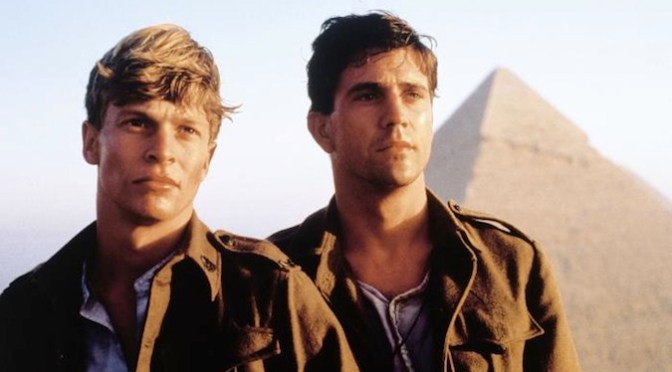
After their 1981 collaboration on Gallipoli, Peter Weir cast the young Mel Gibson again the following year in his feature adaptation of the C.J. Koch novel The Year of Living Dangerously. The film would ultimately end up being one of the first collaborations between an Australian studio and a Hollywood studio, and thus the most ambitious Australian film to date. Good news for both the director and the actor, then, that the movie ended up being one of the year’s finest achievements. If Gallipoli was the announcement of Weir as a commanding big-budget filmmaker and Mel Gibson as a major star, The Year of Living Dangerously was the solidification of that announcement.

The storyline(s) are admittedly numerous, often incomplete, occasionally downright implausible. The historical accuracy isn’t necessarily…accurate. Yet none of that really matters in the grand scheme of Living Dangerously because the characters and the atmospheric beauty of the picture are so absorbingly irresistible, and because the meandering and multifaceted plot is probably actually more true to life. Lives don’t play out in neat one-two-three act scenarios, and the subplots each of us tends to engage in hardly ever come to definitive “ends”. Love comes and goes, things become more important or less, people we thought were one way act another – all of these expressions are at the heart of The Year of Living Dangerously, and the overall impact far outweighs that of a great number of films preaching straightforward plots and historical accuracy only to forget to leave some breathing room for a little passion.

Continue reading The Year of Living Dangerously (1982)

The Killer Elite (1975)

It’s tough to find defenders of The Killer Elite. Watching the film without any knowledge of the chaotic production or of director Sam Peckinpah’s personal, financial and artistic woes at the time probably makes for a bland and unexciting viewing experience; sadly, a little background on Peckinpah effectively makes it even worse, as it’s hard to watch The Killer Elite without noticing that the gleefully indulgent heart characteristic of his best films seems to have vanished.

The set-up ain’t bad, although that hardly ever matters in the hands of a capable director. James Caan and Robert Duvall star as CIA-contracted assassins and friends who have worked together for years. Duvall’s George betrays Caan’s Mike, shooting him in the elbow and knee and leaving him badly crippled. The rest of the film follows Mike as he recuperates, retakes his post at the shady government operations agency, and ultimately seeks revenge on his old pal George.

There are plenty of rumors associated with The Killer Elite that may or may not be true. First is that Peckinpah took the project specifically as an attempt to recreate the financial success he had with the Steve McQueen-starrer The Getaway, which marked the last financially successful movie Peckinpah would direct. Bring Me the Head of Alfredo Garcia was both more in line with Peckinpah’s Western sensibilities and more of a box office flop, and so it is admittedly easy in that regard to draw parallels between The Getaway and The Killer Elite. The fact that the project may have been more associated with money than with any real passion pretty much sets the thing up for failure out of the gate.

Continue reading The Killer Elite (1975)

Gallipoli (1981)

Gallipoli is arguably the feature that catapulted both Mel Gibson and Peter Weir onto the international stage. Though both the actor and the director had found success in the years prior – Weir with The Cars That Ate Paris, Picnic at Hanging Rock and The Last Wave and Gibson with Mad Max – their first collaboration would prove to bring out the best in both of them. Gallipoli spawned plenty of war films and series that would attempt to ride that wave of popularity, but to this day it still remains one of the greatest WWI films out there.

Gibson stars alongside Mark Lee, the latter of whom actually has the larger role despite Gibson’s mug being the only one plastered across the U.S. marketing materials. Lee is Archy Hamilton, hopeful young sprinter from Western Australia who continually hears of the efforts of the Australian Imperial Force on the peninsula of Gallipoli. He first crosses paths with Gibson’s Frank Dunne during a footrace, after which both men travel together to Perth in order to enlist. Their journey is long and full of joy and laughter, but it eventually takes them to the front lines at Gallipoli. Here they confront the reality of war, attempting to hold onto whatever remnants of home they can in the face of such horror.

To be sure, there are no shortage of “loss of innocence” war films. You could even argue that all war films address this in one way or another, even if it’s tangentially through a supporting character or two as in the likes of The Hurt Locker. Not only does Gallipoli get credit for being a precursor to some of the best WWI films of our era, but it’s also worth paying attention to the structuring of the film as a kind of growing, building framework on which we can hang this theme as the credits roll. First off, the focus is very much on Archy and Frank for the entirety of the movie – we only see the battlefield when they see the battlefield, and any notions we have of the war are stemmed from the opinions of the people they meet and the newspapers they read. In this sense, the war is almost a backdrop for a tale about two friends, and Gibson himself expressed as much in an interview (according to the almighty Wikipedia [so it’s gotta be true!]).

Continue reading Gallipoli (1981)

Three Days of the Condor (1975)

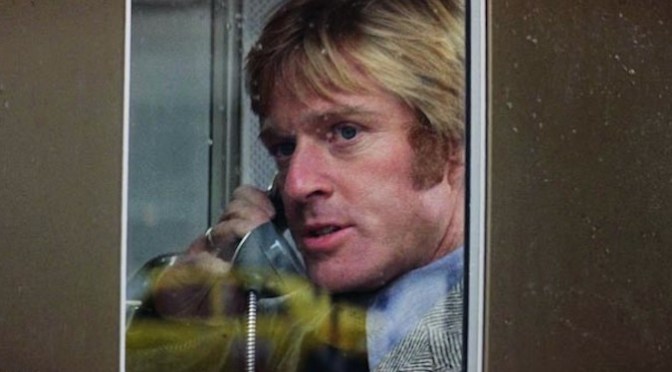
When people say it’s just like a ’70s spy thriller! or if you like ’70s spy thrillers, you’ll love this!, the movie they’re all referring to whether they know it or not is Three Days of the Condor. This is how we measure the influence that the Pollack-Redford political drama has had on our current film industry: in remakes, spinoffs, tributes, allusions, shoutouts and straight-up copies of the original.

Written as the novel Six Days of the Condor by James Grady, the book translated to the screen so well thanks to the the meticulous aplomb of Sydney Pollack and the solid performances of the entire cast. Three Days of the Condor wasn’t written to be an overtly political film, all appearances to the contrary, and according to Pollack and Redford the “thriller” aspect of “political thriller” was the part they tried to emphasize. It worked. Still, the political associations were all but unavoidable in 1975; Watergate was certainly still fresh, but more immediate was the leaking of highly sensitive CIA documents known as the Family Jewels scandal. This occurrence ended up being one of those Hollywood coincidences where a movie gets made about a particular subject and then that particular subject, one day out of the seeming blue, becomes the particular subject of the day’s news. Three Days of the Condor came out too close to the Family Jewels scandal to be able to say anything explicitly about it, but it managed to wrestle with the issue all the same.

Continue reading Three Days of the Condor (1975)

The Yakuza (1974)

Sydney Pollack’s The Yakuza was released at a time when depictions of Asia in Hollywood films were either simple vehicles for big stars or grossly Westernized misrepresentations. There are notable exceptions, of course, and The Yakuza is probably one of them. Starring Robert Mitchum as a retired detective returning to Japan for a new case, the film manages to give real playing time to actors who aren’t straight from Hollywood. Chief among these is Ken Takakura, who shines as the conflicted brother of a former love interest of Mitchum’s character.

As was the case with several of his films, Sydney Pollack wasn’t the first director to be attached to The Yakuza. Robert Aldrich, best known for The Dirty Dozen and the brilliant Flight of the Phoenix, was initially slated to reteam with Mitchum after their collaboration on The Angry Hills back in 1959. Aldrich, a fine director, would have done fine with The Yakuza, but it just seems more interesting as a part of the early Pollack filmography. Following Jeremiah Johnson and The Way We Were and preceding Three Days of the Condor, the Tokyo- and Kyoto-set noir provides a nice break from the Redford-starrers.

Continue reading The Yakuza (1974)

Bring Me the Head of Alfredo Garcia (1974)

Sam Peckinpah is nearly always divisive in his filmmaking, but perhaps never more so than with Bring Me the Head of Alfredo Garcia. Unlike The Wild Bunch or Straw DogsAlfredo Garcia (or BMTHOAG, as it may be lovingly referred to) isn’t necessarily controversial because of the level of violence. While other Peckinpah films seem set as classics even in spite of their explicit scenes of brutal violence, most people just can’t decide whether Alfredo Garcia is any good or not.

The set-up comes in the wake of the proclamation that serves as the film’s title. Alfredo Garcia has impregnated a young girl, and her powerful father offers a million dollars to the man who delivers him from the neck up. Warren Oates plays Bennie, a piano player in a rundown bar who eventually becomes tangled up in the hunt for Garcia at the prospect of a large payoff. His girlfriend, played by Isela Vega, comes along for the ride – and needless to say there are vicious consequences. Soon the head of Alfredo Garcia is in Bennie’s possession, but a darker drive swells up within him and his plans change.

Why would people dislike Alfredo Garcia? For starters, the set pieces from the first half of the movie leave a lot to be desired. In fact, there aren’t very many set pieces at all between the initial “Bring me the head!” scene and a mid-movie altercation with two biker thugs. This altercation serves a) to begin to show a few cracks in the otherwise happy-go-lucky demeanor of Bennie (as Warren Oates brilliantly snarls “you two guys are definitely on my shit list”) and b) to show the promiscuity of Bennie’s girlfriend. Both of these revelations are compounded and built upon in later scenes, but during the scene in question the sense of urgency and pacing of Garcia seems lost.

Continue reading Bring Me the Head of Alfredo Garcia (1974)

The Cars That Ate Paris (1974)

Peter Weir’s directorial debut The Cars That Ate Paris, like a few other movies from the early career of the Australian filmmaker, tends to defy most attempts at classification and at fitting it comfortably into one genre or another. Most slap “horror-comedy”, a broad and unsatisfying label, onto films like this. While it’s certainly funny and creepily disquieting by turns, shoehorning The Cars That Ate Paris into a genre just so we may talk about it as “this kind of film” or “that kind of film” quickly becomes a useless exercise.

Set in the fictional hamlet of Paris in rural Australia, the film follows young Arthur after his brother George dies in a car accident just outside the town. The Parisians welcome Arthur and console him, but it soon becomes evident that Paris is no ordinary town. Arthur himself hardly seems to notice any questionable behavior apart from a few odd comings and goings – but we become aware very soon that the town of Paris thrives on car accidents from the dangerous outskirts roads, and that the townsfolk engineer accidents for their own benefit.

Silly set-up, no? What characterizes the tone of The Cars That Ate Paris is just that: a silly, comedic set-up that suddenly takes a darker turn, a bubbly Sunday drive turning instantly into a fiery wreck. While calling the entire thing a “horror-comedy” is too easy, it can be said that the tone of the film hinges on those two genres without ever slipping over into either for too long. The pivoting itself can provide comedy or shock, and Weir and Co. bring us back and forth over the course of the film more times than I care to count. The effect turns the film into a kind of tonal collage that’s tough to pin down at any one point in time.

Continue reading The Cars That Ate Paris (1974)

Jeremiah Johnson (1972)

Starring Robert Redford’s burly mane, Jeremiah Johnson is the story of an absolutely incredible beard and the mountain man who carries it around on his face. The beard just wants to live a quiet life, moving gently in the Rocky Mountain breeze and catching a few snowflakes, but other forces dwelling in the range cause trouble for the beard. As seasons pass in the valleys below, the beard wisens to the truths of the world and becomes a broader, more understanding beard.

Sydney Pollack directed five or six films – five including 1969’s They Shoot Horses, Don’t They?, and six if you count 1968’s The Swimmer, which Pollack eventually took over without an actual directing credit – and plenty of TV before he got to Jeremiah Johnson in 1972. Not long before production began, it was Clint Eastwood in Johnson’s role and Sam Peckinpah set to direct him, but the pair clashed and Eastwood said “Dirty Harry sounds a lot less dangerous” (paraphrased) and Redford was cast in his place. Having worked together on This Property Is Condemned in 1966, it was Redford who secured Pollack as Peckinpah’s replacement. Contrary to what one may think when watching Redford ride around on horseback for two hours Jeremiah Johnson actually cost quite a bit of money, and it was money that the studio wasn’t prepared to give out after advancing Redford a hefty salary. Pollack mortgaged his house and financed parts of the film himself, all the while strictly adhering to the budgetary and time constraints the studio laid down.

In short, you wouldn’t blame Pollack for being a bit sour after such a stressful production. But the director cited it as a great trial-by-fire learning experience, essentially because the money he was risking was his own. It probably helped that Johnson did well and remains a bit of a mountain-man classic today.

The kernel of the film, at least for me, comes when Jeremiah sits by a freshly-killed dinner with his de facto family – a wife he was all but forced to marry and a son he was all but forced to adopt. First, the irony of a man sojourning to the Rockies to live a life of quiet solitude and ending up married with a kid is a rich one. As they sit around munching rabbit or whatever Jeremiah teaches his non-English speaking wife a new word: “Yes”. He then asks her some questions about himself, the last of which is “I am a fine figure of a man, yes?” Now, this lady has no idea what in the hell this guy is talking about. She’s goaded into answering all the same, showing off her new word “yes”. Jeremiah sits back satisfied.

A definition of manhood in any form, validity apparently notwithstanding, keeps cropping up in Jeremiah Johnson. He achieves legendary status among some of the puny town-dwellers, achieves something of a nemesis status among a tribe of Crow Indians, and achieves something that begins as pity but matures into respect with two like-minded mountain men. What of himself? Does “being a man” equal “living a full life”, or is there a gap there somewhere that leaves this manly man’s man ultimately unfulfilled?

Pollack and Redford manage to pull an extremely strong narrative out of what could easily have been a semblance of shots of Jeremiah riding a horse. The beard helps. Tragically, the beard’s career went sharply downhill following Jeremiah Johnson and was hardly ever seen in Hollywood again, sinking into a drunken oblivion and leading a shattered existence that would one day serve as the basis for Leaving Las Vegas.

Walker (1987)

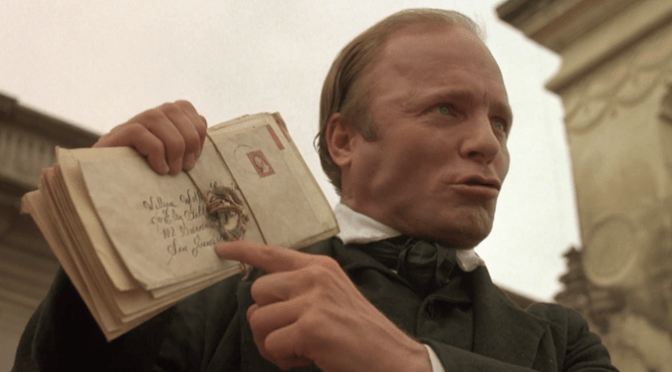
William Walker was a freewheeling filibuster of a distinct class. Alex Cox’s biopic Walker – branded A TRUE STORY at the outset – features Ed Harris in the title role of the American adventurer whose ideals and morals become muddled. Journeying to Nicaragua in the 1850s, Walker and his band have democracy as their glorious intention. What happens, of course, is something else entirely, and Walker comes to resemble more of a tyrant than anything else.

First, though – wait, was that a helicopter? And a computer? Isn’t this 1850? It becomes increasingly clear throughout Walker that Cox has little regard for historical accuracy, and blatant anachronisms like Walker on the cover of Time and Newsweek pop up all over the place. Cox’s sense of humor is very often visual, as seen again and again in the visual gags running through his first feature Repo Man, and in Walker the intentional inaccuracies certainly do provide laughs. But they have a point, too, and that’s to draw a parallel between Walker’s crazed methods in Nicaragua in the 1850s and American efforts in Latin and South America in the late 1980s.

Whether you enjoy this political narrative bent or not is probably dependent on your own political views. Walker didn’t fare well at the box office upon release in 1987, and Cox never returned to studio filmmaking again. While it doesn’t necessarily come across as heavy-handed, the comparison and damnation of American foreign policy is poured on pretty thick.

Rudy Wurlitzer writes William Walker beautifully, though, and the contrast from Walker to each man in Walker’s miscreant band of somehow-loyal followers is also well done. Straight off the bat the gang – for they certainly could be called no more than a gang – are shown to be unable to even comprehend Walker’s orders that violence should stop and common laws of hygiene be adhered to. “What’s hygiene?” one man asks just before the gang erupt into a murdering spree in the middle of a village. There’s some of the Glanton Gang from Cormac McCarthy’s Blood Meridian in here, making Ed Harris’s Walker the indomitable Judge Holden, the terrifying hawker of war and death.

Soon, though the men latch onto Walker’s lofty ideals more as an excuse for violence than anything else, the “true north” of Walker’s vision begins to stray. “Some of the men are confused as to just what it is we’re fighting for,” one man confides in him. “I know and they know that the liberals are our friends and the conservatives are our enemies…but to tell you the truth, sir, I can’t tell them apart. They all seem the same to me.”

“That is no concern of yours, nor of the men,” Walker advises. “All you have to remember is that our cause is a righteous one.” Later, Walker dictates to another man trodding in his footsteps that the ends justify the means. The man tiptoes after Walker as the landscape around them seems drier and drier. “What are the ends?” he asks, to which Walker immediately replies, “I can’t remember.”

So again, the political aspect will either heighten your appreciation of Walker or it very well may sour it, depending on whether you find Cox to be earnest or overbearing in the depth of his unsubtle satire. I submit that the character of William Walker alone, shorn of all the directorial “slight of hand” on Cox’s part, is one that can’t be ignored.  “Clearly,” as another character remarks, “this is no ordinary asshole.”