Category Archives: Festival Series

The Imitation Game (2014)

There is a scene in The Imitation Game where a young Alan Turing is introduced to a book of codes and cyphers by his classmate and friend Christopher. The significance of this moment is obvious (Look, it’s the exact moment Alan Turing became the Alan Turing we all know!!!). But Graham Moore’s script plays this moment as a different kind of discovery. There’s no glint in Alan’s eye as he catches a glimpse of a future in which he fathers computer science while cracking the Nazi’s Enigma code, wins the war, and is later played beautifully by Benedict Cumberbatch. Instead,  Alan recognizes a comparison between cyphers and the way people talk. Turing, who is thought to have had Aspergers Syndrome, cannot process metaphors and irony because of his extreme literalism. The concept of coded communication gives him a better understanding of how people don’t say what they mean and don’t mean what they say. This, not his mathematical genius, is his gateway into code-breaking, and it’s one of many beautiful nuances in the film.

Unfortunately, the rest of The Imitation Game, like Turing, is overly formulaic. The film adapts Andrew Hodges’ biography, Alan Turing: The Enigma, about the mathematical savant who was the biggest contributor to deciphering Nazi communications with his cryptanalytic machine. This true story could have been an otherwise simple and inspiring tale about an extraordinary Brit, alongside the likes of The Theory of Everything and The King’s Speech, if it weren’t for one major tarnish. In 1952, Turing was convicted of indecency (read: homosexual acts) and made to take hormone treatments in place of a prison sentence. He killed himself two years later. This understandably requires a different kind of film.

Continue reading The Imitation Game (2014)

Ida (2014)

The most impressive aspect of Ida, the 2014 EFA champion and Polish Golden Globe nominee from director Pawel Pawlikowski, is without a doubt the stark visual staging and meticulous shot composition. Unlike Andreas Prochaska’s The Dark Valley — another awards season foreign language contender — the visual beauty of Ida meshes seamlessly with the story rather than overwhelming it. Newcomer Agata Trzebuchowska plays the young nun-in-training of the film’s title, and her forays from the convent into what some might call “the real world” provide the framework for Ida.

Ida was essentially born into her role in the convent, abandoned as a child and only now old enough to venture out. She’s nearly ready to take her final vows and become a full-fledged nun (“It’s morphin’ time!”) but before she does, she leaves the convent to track down her estranged aunt and get a little taste of the outside world. It’s not long before this Catholic nun discovers a truth about her past: she’s Jewish. This is only the first of many threats to Ida’s identity, one focused squarely in the past and in the present, and the revelation of the love and struggle and verve of the world outside the convent shakes up Ida’s future.

Continue reading Ida (2014)

Inherent Vice (2014)

Doc Sportello ain’t a do-gooder, as one of the trailer lines for Inherent Vice sings, but he’s done good. Paul Thomas Anderson’s seventh movie doesn’t seem to match up with anything else he’s done, tempting though it may be to shove it in the same category with Boogie Nights simply because they’re both comedies. There’s a little Boogie in there, for sure – there’s also mid-’80s Leslie Nielsen zaniness, a bit of Robert Altman, a bit of early Guy Ritchie, a bit of everything. Joaquin Phoenix plays Doc, a sofa-riding P.I. suddenly embroiled in a kidnapping/murder case that’s way, way over his head. The moving parts of the case are as perplexing to Doc as those of the film proper might be to us, and when Doc gives up trying to make sense of it all is about the time we do the same.

So, yeah: Inherent Vice has Jewish real estate moguls, ex-convicts, flat-topped cops, Japanese drug cartels, the Aryan Brotherhood, doped-up dentists, maritime lawyers and an increasingly large cross-section of people known from San Fran to San Diego with clear disdain or clear indifference as hippies. There are loan sharks, FBI agents, tenor sax players. There’s a big boat which might be called The Golden Fang, might not. How could these disparate agencies possibly be connected?

Continue reading Inherent Vice (2014)

Starred Up (2014)

Starred Up played this week at the tail end of the Fall Focus presented by Independent Film Festival Boston. Though technically a 2013 release, the British prison drama has yet to really come out stateside and remains very much a movie of interest. Part of this is due to the recent emergence of Jack O’Connell on the international stage – he carried the little-seen ’71 and will carry the likely-to-be-widely-seen Unbroken, and he’s even in the Oscar conversation for the latter. O’Connell’s been in a bunch of stuff prior to the last few years, and his young role in the comparatively weak Michael Fassbender film Eden Lake probably foreshadows what’s to come most effectively. But if you want top-notch O’Connell in a nearly-top-notch film, Starred Up is the one to check out.

The prison genre is a storied one in film. Starred Up is a very different movie than Bronson – one of the most brilliant entries in the genre in recent memory – but it still recalls the 2008 Tom Hardy flick a little too heavily at times. This might be an inescapable element of the genre – it’s a prison movie, what did you expect? – but it might also be because O’Connell’s Eric Love simply seems to want the incredible amount of violence swirling around his little stone cell. Bronson and Love seem to share that from the outset – there is a scene in both films in which guards pile up outside the cell door in full riot gear as the gleeful prisoner, be it the hulking Bronson or the roguish Love, douses himself in oil and and prepares for the fight. The fight seems ritualistic, and for Bronson it certainly is. It’s sport. But this is where Starred Up and Eric Love diverge, and while it’s not necessarily a better film it’s certainly a more grounded, realistic genre entry.

Continue reading Starred Up (2014)

Nightcrawler (2014)

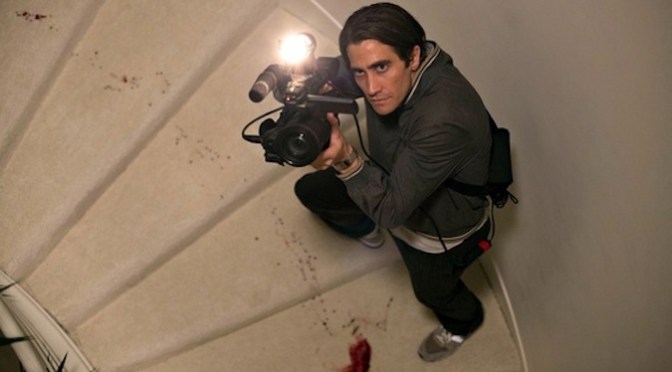
When we first meet the scavenging Lou Bloom, it’s clear that he’s an opportunist. He steals anything – copper tubing, swaths of aluminum fence, manhole covers (“the nice thick ones”) – and sells what he’s stolen to a construction foreman. Then he fights the foreman over the price, and then he asks the foreman for a job. So Lou’s mentality isn’t so much “when life gives you lemons, make lemonade”, but more “I have no lemons, so I’ll take yours”. This is the strongest aspect of Lou Bloom’s character, and indeed at times it’s overwhelmingly strong. Jake Gyllenhaal and writer/director Dan Gilroy don’t nail everything in Nightcrawler, but they nail that.

There’s a definite stylishness to Nightcrawler that aims to capture the seedy neon after-hours of downtown Los Angeles and the surrounding, more affluent suburbs. Lou graduates from scavenging to a real (ahem, “real”) job when he happens upon a highway car accident one evening: crime scene photography, he learns, can be a lucrative business. “If it bleeds, it leads,” says Bill Paxton’s mentor-photographer in a very trailer-suitable explanatory monologue. So Lou buys a camcorder and a police scanner and begins working. He’s all about opportunity, so when it knocks Lou answers. Opportunity, of course, keeps knocking, and Lou keeps answering. Soon he’s creating his own opportunities, which means everyone except Lou is about to get their lemons jacked.

Continue reading Nightcrawler (2014)

Boyhood (2014)

This is Boyhood. This is right now. This is no ancient Greek tragedy; there is no intricate or precise or necessarily coherent plot structure. What this film is all about is in the title: Boyhood is the narrative of a young man growing up in a difficult and harsh world. This film will make you laugh hysterically, and it will make you cry. Watch this film alone for the first time. That way, you can let yourself truly feel it. That’s important, because this is more than a movie. This is a therapeutic exercise.

It is possible that I am partial to Richard Linklater’s film because: one, I am a boy; two, I share some of the same experiences that Mason (Ellar Coltrane) has had. I know what it is like to have divorced parents, and I know what it is like to see my mom cry. I know what it is like to be bullied and I, too, have often wondered why the world has to suck so much. Many of us have. Many more will. That is why this film is so truthfully beautiful. It captures such incredible, emotional aspects of human life and brings you back in time to the moments in your own life that are relatable to what is going on in the film. I cannot even begin to think of another film that has brought me so close to tears so many times. Boyhood is able to give its audience that inexplicable Dead Poets Society vibe. Just that feeling that makes the film relevant to life in such an actual and immediate way. This is the type of film that leaves you unsure what there is to do next. When you decide to sit down and watch this film, you effectively decide to spend the next three hours completely and totally immersed in and consumed by the universe of Boyhood.

Continue reading Boyhood (2014)

The Assassination of Jesse James by the Coward Robert Ford (2007)

Casey Affleck presented a screening of The Assassination of Jesse James by the Coward Robert Ford at the Brattle Theatre in Boston last night, on hand for a Q&A following the film. Though Assassination is still sadly much more of an “obscure” offering – at least in terms of films starring Brad Pitt – it nonetheless remains a fascinating character study of both a young man and his mythical idol.

Robert Ford joins the James Gang alongside his brother Charlie at a time when Jesse James has already achieved infamy through his brazen robberies and brutal murders. Bob is only nineteen years old at this point (although he “feels older”), and his fascination with the gang is a mixture of childish wonder, starstruck glee, and perhaps a hint of inflated self-importance. He believes he’s destined for “great things”, by which he really means he believes himself to be a worthy follower of Jesse or even one who could take his place. As his place in the gang is solidified over the course of the film and his presence at Jesse’s side becomes more and more common, Bob’s perception of his onetime hero begins to deteriorate.

Continue reading The Assassination of Jesse James by the Coward Robert Ford (2007)

Olive Kitteridge 1.1 – “Pharmacy”

We’re getting to the point where anything produced by HBO is pretty much guaranteed to be a worthwhile watch. A history of cutting funding for the likes of Deadwood, Rome and even The Wire at one point shows the premium service isn’t afraid to ditch something they’re not 100% confident in, no matter how good the early episodes are. Olive Kitteridge, of course, isn’t really a show – the four-hour miniseries spanned two nights earlier this week and will probably play on a loop for the next week, but after that no más. Still, the HBO association is evident in a high production value and a deep care taken with the characters and material that few other channels can afford to provide.

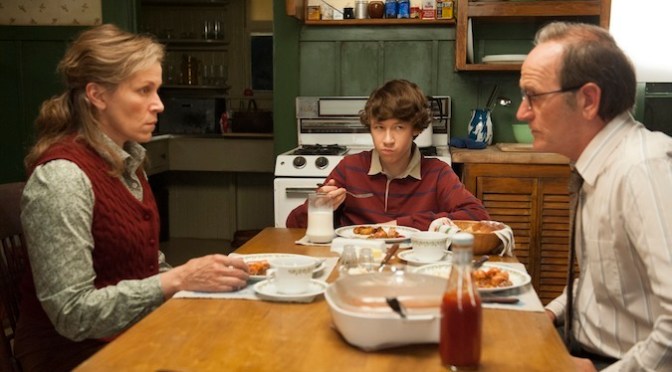
Frances McDormand plays the titular Olive, aging middle-school teacher in smalltown Maine, mother of a bratty son and wife of an irrepressibly optimistic husband (played by the always-brilliant Richard Jenkins). We meet Olive as she walks through the forest, gray ratty hair stemming out from her pale skull, and she calmly lays out a picnic blanket and removes a loaded gun from her coat. We suddenly backtrack to twenty-five years earlier, but the tone is set in that initial sequence: Ollie is unhappy, gazing longingly at the gnarled branches reaching toward the hazy sky, and maybe we’re about to see why.

Continue reading Olive Kitteridge 1.1 – “Pharmacy”

Interstellar (2014)

With brand-new releases the tendency is usually to shy away from spoilers in reviews, and those potential spoilers can be especially sensitive with a long-anticipated film like Interstellar (“I waited two years for this and find out the night before that [censored] is really [censored] the whole time??”). I respect reviewers who are able to provide an accurate representation of a film without divulging any/many of its secrets, but I’ve never been one of them. I can tread lightly, sure, but to really talk about a movie like Interstellar there are important plot points that need to be laid out in the open. Just the fact that we have a three-hour movie with a two-minute trailer means that the film holds vast sequences, settings, and even actors that you couldn’t possibly expect, and it’s partly those revelatory realms that we’ll be dealing with here. Consider yourself warned.

Now: let’s talk about ghosts.

Continue reading Interstellar (2014)

The Judge (2014)

The Judge looks like your typical ’90s courtroom drama, playing in the vein of The Rainmaker or The Firm, and looks aren’t deceiving in this particular instance. Starring Robert Downey Jr. and Robert Duvall as estranged family brought together to face a potential injustice, the film ticks all the expected boxes on the checklist and rarely surprises. Still, The Judge survives on the strength of the performances of the two leads and manages to be a largely enjoyable family drama.

Downey Jr.’s Hank Palmer is a bigshot city lawyer who returns to his minuscule hometown when his mother passes away. Contact with his father, the county judge, has been minimal at best over the past years. But Hank is forced to stay when a murder investigation targets the judge and an implacable prosecutor (played by Billy Bob Thornton) arrives to put Judge Palmer behind bars for the rest of his life. Only Hank can defend his father and his the legacy of his family.

If you’ve seen the trailer for The Judge, the actual movie will probably just feel like an elongated version. Downey Jr. is absolutely perfect for the role, but I don’t mean that as a full compliment. This is a character he’s played over and over again: immoral, arrogant, power-hungry, never home to see his daughter, aces in the workplace at the expense of his real-world relationships, bound to see the error in his ways through the events of the film. He’s basically Tony Stark without the Iron Man suit (so The Judge is Iron Man 3, basically), and it just would have given the film a much-needed edge if the protagonist wasn’t exactly who we imagined him to be.

Continue reading The Judge (2014)