

Each Motion State Face Off pits two films, franchises, or television series against each another for no reason other than because we can.

The inspirations for Nicolas Winding Refn’s 2011 film Drive are no secret. Perhaps the most direct analogue is Walter Hill’s The Driver (1978), which shares so many of the same characteristics that Refn’s film stops just short of being a remake. The general plot of both follows a nameless getaway driver of exceptional skill as he navigates a complex web of criminals, cops and would-be lovers, speeding to stay one step ahead as these forces converge around him. Drive features more minute homages to Hill’s film, too, including a redo of a particularly iconic scene in which the eponymous Driver (Ryan O’Neal) executes a high-speed chase in reverse gear. There’s something very American about a car chase in reverse, no? Difficult to say whether the instances of breakneck backpedaling in Drive or The Driver are done well, though, when the only competition is from the likes of The Transporter, Fast and Furious, Talladega Nights, etc…

Anyway. There’s sadly no reverse car chase in Le samourai, Jean-Pierre Melville’s quiet masterpiece of crime and criminal code. But it is undoubtedly an influence on Refn’s Drive, and is in many ways a more appropriate analogue than Hill’s Driver. Starring Alan Deloin as a largely-emotionless killer-for-hire, Le samourai went a long way to establishing a minimalist aesthetic in the gangster film — a genre more often associated with shootouts, explosions, larger-than-life mobsters and, yeah, reverse car chases. But the quietude of Melville’s film is haunting, reflected in the flat visage of its main character, and Le samourai went on to influence Woo’s The Killer (1989), Frankenheimer’s Ronin (1998), Jarmusch’s Ghost Dog (1999), Mann’s Collateral (2004) and countless others.
Continue reading Face Off: Le Samourai (1967) and Drive (2011)
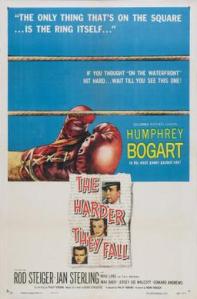 In The Harder They Fall, sportswriter Eddie Willis (Humphrey Bogart) finds himself in a moral conundrum. He’s covering the boxing phenom Toro Moreno (Mike Lane), an absolute barn of a fighter who’s touring across America on an unprecedented winning streak. The conundrum? Toro can’t actually box worth a damn. The glassjawed giant has been set up by his manager Nick Benko (Rod Steiger) and had all of his fights fixed, though that particular fact is kept secret from Toro himself. Benko’s scheme ensures that the audience has a built-in perception of this fighter, that Toro’s reputation — even if it’s engineered behind his back — will equal dollars in Benko’s pocket. People love a clear-cut hero, an undeniable winner, and Benko forms Toro into exactly that. But Eddie’s not convinced, even if the blissfully-ignorant Toro seems to be having the time of his life in this heroic role. Shouldn’t the athlete himself have some say in how he’s portrayed to the world?
 The second season of Netflix’s Mindhunter is the best single season of television the streaming giant has ever produced. I’d entertain an argument for the best series overall being something else — Stranger Things,




 Motion State Review