Category Archives: Featured

Almost Famous (2000)

Sex, drugs, and rock & roll. This is what Cameron Crowe’s Almost Famous is about, although it’s mostly rock & roll. If you enjoy music, particularly classic rock bands such as Zeppelin, The Who, The Stones, Dylan, Hendrix, and plenty of others, I can near guarantee that you will fall in love with this film.

Also, I can near guarantee that you will fall in love with Kate Hudson, playing Penny Lane, or Lady Goodman. Aside from the fact that she is absolutely gorgeous, Hudson portrays one of the single coolest females of all time in her character. She is a die-hard rock lover, and a simply down to Earth, kind and generous person. Undoubtedly wife material. While the acting in this film is not necessarily something that jumps out at you, Hudson turns in a really enjoyable and fun performance that helps establish a strong emotional connection to her character.


Continue reading Almost Famous (2000)

Before the Devil Knows You’re Dead (2007)

How badly can two brothers mess up a supposedly simple robbery? Apparently, very, very badly. This is what we learn in Sidney Lumet’s Before the Devil Knows You’re Dead when Hank and Andy try to rob their parents’ jewelry store to cure some financial woes and, well, it doesn’t go according to plan, which is to say their plan did not involve botching the actual robbery and leading to six deaths, including their own mother, in just a few days. Definitely not good.

At the very least, I can say that the movie is done much more pristinely than the brothers’ plan, but, like the attempted robbery, it certainly could have been executed better. Before I get to any of my problems with the film, I must first admit that the acting is superb. The late Phillip Seymour Hoffman is fantastic as Andy, the older brother pushing for the robbery. Then there’s Ethan Hawke (who just loves being in movies that start with “Before”, as he’s been in four such movies) who plays Andy’s younger brother Hank, a loyal, but non-custodial parent (Boyhood, anyone?), behind on child support. Hawke, as he has been known to do, truly captures the role.

Continue reading Before the Devil Knows You’re Dead (2007)

Somewhere (2010)

I’ve always been spectacularly underwhelmed by anything within a ten mile radius of Stephen Dorff. He is in a ton of stuff I haven’t seen, to be fair, but then again most of those seem like instantly forgettable action flicks with airy titles relating to crime (Felon, Officer Down, .45) or cars (Brake, Carjacked) or just ambiguously intense shit (Heatstroke, Riders, Deuces Wild). Maybe there’s an unseen masterpiece buried in there somewhere. The things with Dorff I’ve had the distinct pleasure (ahem) of enjoying (ahem) have been Blade, in which he plays the most annoyingly puerile vampire this side of Twilight; Immortals and The Iceman, which I had to look up to make sure he was actually in because I don’t remember him at all; and, of course, those stupid ads for Blu Cigs. To boot, I mix the guy up with Skeet Ulrich, and that’s never good.

And yet Johnny Marco from Somewhere is a categorical douche, and wouldn’t you know it? Dorff is actually a great choice for the part. After he breaks his arm falling down the stairs at a party, Hollywood actor Johnny spends a few weeks at a high-price resort in the Hills getting pampered and watching strippers flail around in his room. He drinks and smokes. He sits. He orders room service and opens another beer and returns to the couch to smoke and sit some more. Every now and then his phone buzzes, receiving texts from a private number that say things like You’re a fucking asshole and You think you’re such hot shit, don’t you? and Johnny hardly manages a shrug as he lounges around his room.

Continue reading Somewhere (2010)

Never Say Never Again (1983)

The next Bond movie will be Spectre, which will mark the fourth outing for Daniel Craig’s modernized James Blonde and the second for director Sam Mendes following 2012’s Skyfall. Mendes won’t be the first to return for another helping of 007, and in fact the trend since Dr. No has hewed closer to “we’ll ask you back if your movie doesn’t suck” than anything else. The math, for those of you struggling here: Skyfall doesn’t suck = Mendes returns.

But Spectre will also mark the return of…well, SPECTRE. The evil organization (SPecial Executive for Counter-intelligence, Terrorism, Revenge and Extortion) has been absent from the Bond franchise for the past eleven films, at least according to Bond purists. According to everyone else, the last time SPECTRE plotted against MI6 was in 1983’s Never Say Never Again, the only Bond film not produced (or sanctioned) by Eon Productions, a film that saw the valiant (ahem) return of Sean Connery to the James Bond role. Never Say Never Again pits this 53-year-old version of the spy against SPECTRE as the organization counter-intelligences, terrorizes, revenges and extorts all over everybody’s ass. Math: SPECTRE = evil.

Continue reading Never Say Never Again (1983)

Leviathan (2014)

Leviathan is chilling. It’s many things, of course — it’s beautiful, stunningly shot by director Andrey Zvyagintsev and cinematographer Mikhail Krichman; it’s grand and sweeping, ceilingless in theme and character; it’s relevant, despite criticism by the Russian government regarding an “unpatriotic” message. But most of all Leviathan is hauntingly realistic, defiant of many of the plot developments one might expect from such a film. Nominated for Best Foreign Language Film at this year’s Oscars (and arguably the frontrunner alongside Ida), Leviathan is also Russia’s first appearance at the Academy Awards in nearly a decade.

The plot stems from a land dispute between a corrupt town mayor and a family living by the seashore. After having been harassed by the mayor’s men, the short-fused patriarch Kolia brings in his friend Dmitri, now a lawyer in Moscow, to help fight the takeover. Dmitri digs up some dirt on the mayor that he thinks he can use — but in this tiny Northern town it seems everyone is dirty. Kolia’s life begins to unravel as he watches helplessly, and before long it’s not just his home that lies in jeopardy but his job, his wife, his son, his freedom.

Continue reading Leviathan (2014)

Blade Runner: The Final Cut (1982/2007)

This article first appeared as a part of the Brattle Theatre Film Notes commentary series, presented by the Brattle Theatre in Boston, MA, for a special screening of Blade Runner: The Final Cut. Slight edits have been made from the original posting.

So: is Deckard a replicant? This is the question that most everyone comes to after seeing Blade Runner, especially if the version in question is Ridley Scott’s 2007 Final Cut. There are seven distinct version of the film — including the U.S. and International Theatrical Cuts (both 1982) and the Director’s Cut (1992) — each of which is evidence of a continued preoccupation with this dystopian vision of our future. Granted, the broad strokes of all seven versions are more or less the same. Harrison Ford plays Rick Deckard, an android-hunting policeman quite different than most other Ford heroes. Regardless of which version you’re watching, Blade Runner is about Deckard’s brush with dehumanization after he’s assigned to track down a band of escaped androids (“replicants”) and terminate them before they discover a way to extend their own lifespans.

But the Final Cut is the only version to place emphasis squarely on that question: is Deckard himself a bioengineered replicant? The original versions certainly leave little reason to doubt the humanity of the protagonist. Deckard and Rachel run away at the end of the theatrical cuts and presumably live happily ever after. Along with a completely restored picture, a restored sound mix, removal of Deckard’s voiceover narration and addition of several improved effects shots that simply weren’t possible in 1982, the Final Cut also subtracts that happy ending and includes a few key scenes that had been cut from the initial releases.

Continue reading Blade Runner: The Final Cut (1982/2007)

The Theory of Everything (2014)

Eddie Redmayne becomes Stephen Hawking in a rare and exciting way in The Theory of Everything, giving a performance that extends far beyond simply mimicking Hawking’s look. He’s a young actor — currently 33 — but already has a sizable body of film work under his belt, in addition to a Tony Award and an Olivier Award for his work in the play Red alongside Alfred Molina. In short: it’s a good time to be Eddie Redmayne. His success in this role will doubtless launch him onto the international stage, and judging by his next role (a part in Jupiter Ascending, his first big-budget action film) he’s already there.

And yet it’s all he and co-star Felicity Jones can do to drag The Theory of Everything out of the tired, trodden mud in which the film itself is set. To claim outright that a certain biographical film is “boring” isn’t necessarily the equivalent of deeming the life of the subject to be similarly boring, but it’s close enough to warrant a perfunctory disclaimer: Hawking had a life that was anything but boring. Sure, everyone knows that math and science themselves are really incredibly boring — certainly no one is denying that. But Theory can’t even fall back on that, because there’s surprisingly little math or science in the film.

Continue reading The Theory of Everything (2014)

French Connection II (1975)

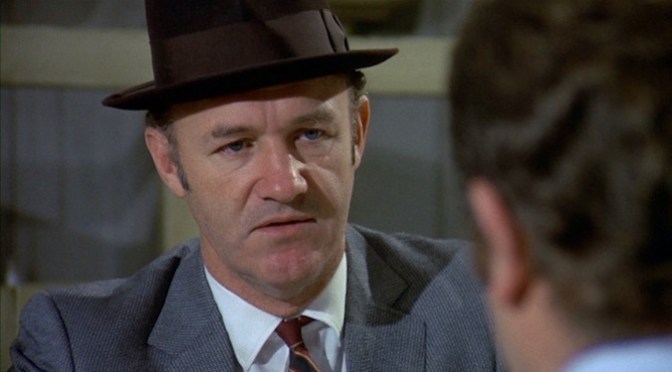
On one hand, a sequel to The French Connection is completely logical. Popeye Doyle sees things through, probably more out of psychosis than out of any loyalty to law and order, and so it does make sense that he’d track the kingpin Alain Charnier all the way to Marseilles after the events of the first film. French Connection II begins right there, not long after the first film left off, and when he pulls up in a cab it’s pretty great to see Popeye again. He pulls his hat onto his head and pays the driver, then glares at him when the driver shakes his head and insists he’s owed more. “I’m taking your number, fella — that’s in case you screwed me,” he snarls. Yes: it’s Popeye.

On the other hand, though, a sequel to the perfectly imperfect conclusion of the first film seems simultaneously illogical. The first Connection ends somewhat suddenly when Popeye accidentally shoots a fellow cop, thinking him to be the evasive Charnier (or “Frog One”). Not only is a wishy-washy ending avoided, but Popeye’s character is further complicated by the brevity of his victory. The smarmy sarcastic wave that Popeye gives Frog One on the bridge is bittersweet, and maybe even a karmic contributor to the ultimate conclusion of Connection (in the same way that Hank’s wave to Walt in Breaking Bad represents his own short-lived supremacy).

Continue reading French Connection II (1975)

Birdman (2014)

Birdman is not your typical Alejandro Gonzalez Iñárritu film. Correction: Birdman is not your typical anyone film — which is part of what makes it so good. Iñárritu’s inventive cinematography combined with exceptional dialogue between intriguing, fantastically-acted characters make Birdman a masterpiece, and one that deserves all of the praise it is receiving in terms of Academy Award nominations.

The film follows Michael Keaton’s Riggan Thomson, a past-his-prime actor who was once famous for playing the titular superhero Birdman (Keaton himself knows a thing or two about formerly playing a superhero). Riggan’s past character haunts him throughout the film as he tries to become relevant as an actor outside of just the superhero role. He attempts to shake loose of Birdman by directing and starring in Raymond Carver’s play “What We Talk About When We Talk About Love”. Carver’s play provides an appropriate backdrop for Riggan’s attempt at a career revival. Carver, himself, is quoted to start the movie in what reveals a central theme of the movie: “And did you get what you wanted from this life, even so? I did. And what did you want? To call myself beloved, to feel myself beloved on the earth”.

Continue reading Birdman (2014)

A Most Violent Year (2014)

A Most Violent Year is set in New York City in 1981, the most violent and murderous time in the history of the city. Oscar Isaac plays ambitious immigrant Abel Morales, manager of a successful oil enterprise, and Jessica Chastain plays his beautiful wife/accountant. On the eve of a major business deal, Abel must simultaneously contend with a federal investigation into his practice and a band of hijackers attacking his drivers.

Things fall apart fast for Abel, A Serious Man style, with pretty much everyone turning against him, and it’s in this set-up that A Most Violent Year seems like it’s going to be a pretty great gangster film. Abel is beaten down but never defeated, constantly levelheaded and rarely unprideful. In one scene he speaks to three new employees about business procedure, and though we know he should probably be frantically dealing with everything that’s happened to him in the past week we find him here instead, describing sales tactics with such gusto that Jordan Belfort would buy oil from him. In scenes like this Isaac’s Abel recalls Pacino’s Michael Corleone more fully than any character you care to name, stonefaced as he looks people directly in the eye, staunch in his beliefs.

Continue reading A Most Violent Year (2014)