
Category Archives: Film Review

Young Ones (2014)

These days future-set postapocalyptic fables are so common that anything such a movie can do to make the idea fresh and original is more than welcome. Cormac McCarthy’s popular The Road and John Hillcoat’s ensuing adaptation with Viggo Mortensen helped to cement the profitability of the genre after a distinct lag since the Mad Max/Blade Runner heyday, and now dystopias seem to be coming through the woodwork. The fact that both Mad Max and Blade Runner will be getting new treatments soon should attest to that desire to recapture the glory days of the genre.

One of the latest entries is Jake Paltrow’s Young Ones, set in a world where water has finally become a scarce and precious commodity. The film is divided into sections focusing on different characters, starting with Michael Shannon’s Ernest Holm, continuing with Nicholas Hoult’s rogueish Flem, and ending with Kodi Smit-McPhee’s son-of-Ernest Jerome Holm. They’re all changed irrevocably by the drought, guarding what little they have with violence and ruthlessness, and most shades of innocence are gone by the time Young Ones takes place. As in most dystopias, it’s the state of things that causes this darker and more animalistic aspect of humanity to come to the surface.

Continue reading Young Ones (2014)

Chef (2014)

Sometimes, a movie like Chef is just exactly what you need. Jon Favreau’s latest directorial effort seems a far cry from his Iron Man days and is just about as different as it gets from a fall blockbuster, although Robert Downey Jr. does pop up. The closest you get to an action sequence in Chef is a skillful wielding of a carving knife going to town on a smoked pork loin, which itself certainly isn’t an ascetic display. It’s simple, but that’s not to say it’s ever dull.

The casting for Chef caused an early stir – “the dude who kicked off the Marvel Cinematic Universe directing and starring in a film also starring Iron Man himself, Black Widow herself, and Sid from Ice Age himself?! Chef is going to be so badass!!” – but the fact of the matter is that Chef isn’t the type of movie that has hype or sequels or post-credit cameos by other superpowered chefs from the same franchise. Chef is a tiny, unassuming, been-there-done-that flick about a guy who really just wants to cook some delicious food. Somehow, that’s supposed to be a compliment.

Continue reading Chef (2014)

The Big Sleep (1946)

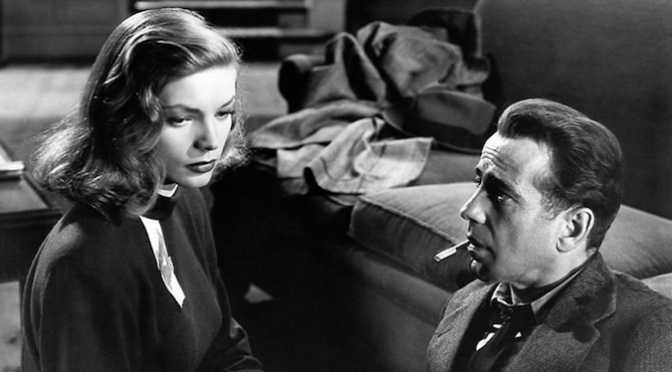
Our Director Series on Robert Altman is partially responsible for a look at The Big Sleep, as the overlapping rapid-fire back-and-forth dialogue characteristic of Altman’s films was first characteristic of the films of Howard Hawks. Toss in the fact that the source material is by Raymond Chandler and the fact that William Faulkner himself helped write the screenplay, and The Big Sleep is still one of the finest American film scripts ever committed to celluloid.

Private eye Philip Marlowe has appeared in a few films – notably portrayed by Elliott Gould in 1973’s The Long Goodbye (also Altman) and then by Robert Mitchum in both 1975 and 1978 – but Humphrey Bogart’s time in the role is the most valuable. He’s Marlowe in the way that Sean Connery is Bond: it’s not the only portrayal of the character…but yeah, it’s the only portrayal of the character. Marlowe’s investigation into a whole host of strange occurrences rolled out one after another, starting with the disappearance of one Sean Regan, provides the drive for the film. But one solution inevitably leads to two more problems in The Big Sleep, and there’s little hope of piecing everything together into a neat little answer to “so what actually happened?”

Continue reading The Big Sleep (1946)

Automata (2014)

Just by virtue of being a smaller, lesser-known project with a scrappy underdog mentality, Automata has an instant advantage over similar sci-fi dystopias of recent memory like Elysium, the Dredd remake, Oblivion and the godawful In Time. The comparison to Neill Blomkamp’s Elysium and his earlier District 9 is especially unavoidable, as the world-building employed here is every bit as important and every bit as impressive. This is a distinct Earth that’s very unlike our own, but it doesn’t take a second to get used to.

The credits sequence says it all, really: our ecosystem has crumbled and our atmosphere has become unbearable, and so the future humankind invents a whole host of technological solutions: mechanical “clouds” that produce fake rain and shield our planet, massive walls that keep the desert from encroaching upon our cities, and most importantly a vast array of “automata” – robot slaves who weld our machines, cook our food, wash our dishes and wipe our asses when we get old. The credits sequence already pulls a 180 on us, though, by depicting this future as the past. By the time the events of Automata take place, humankind is jaded to the wonders of these technological advances, and the automata themselves seem to have become a bit jaded too.

Continue reading Automata (2014)

The Judge (2014)

The Judge looks like your typical ’90s courtroom drama, playing in the vein of The Rainmaker or The Firm, and looks aren’t deceiving in this particular instance. Starring Robert Downey Jr. and Robert Duvall as estranged family brought together to face a potential injustice, the film ticks all the expected boxes on the checklist and rarely surprises. Still, The Judge survives on the strength of the performances of the two leads and manages to be a largely enjoyable family drama.

Downey Jr.’s Hank Palmer is a bigshot city lawyer who returns to his minuscule hometown when his mother passes away. Contact with his father, the county judge, has been minimal at best over the past years. But Hank is forced to stay when a murder investigation targets the judge and an implacable prosecutor (played by Billy Bob Thornton) arrives to put Judge Palmer behind bars for the rest of his life. Only Hank can defend his father and his the legacy of his family.

If you’ve seen the trailer for The Judge, the actual movie will probably just feel like an elongated version. Downey Jr. is absolutely perfect for the role, but I don’t mean that as a full compliment. This is a character he’s played over and over again: immoral, arrogant, power-hungry, never home to see his daughter, aces in the workplace at the expense of his real-world relationships, bound to see the error in his ways through the events of the film. He’s basically Tony Stark without the Iron Man suit (so The Judge is Iron Man 3, basically), and it just would have given the film a much-needed edge if the protagonist wasn’t exactly who we imagined him to be.

Continue reading The Judge (2014)

Killing Them Softly (2012)

In America you’re on your own. One of the most criminally overlooked movies of 2012 was Andrew Dominik’s Killing Them Softly, a rough-and-tumble tale of petty holdup artists, mob enforcers and the suit-and-ties that control them (or think they control them). Dominik’s follow-up to his excellent The Assassination of Jesse James by the Coward Robert Ford retains some of the same cast and makes a few substitutions, and Killing Them Softly is a very different movie from Dominik’s earlier film and from most American crime dramas on the whole.

When two smalltime down-and-outers (played with hilarious gusto by Scoot McNairy and Ben Mendelsohn) hold up a mob-protected card game (run by Ray Liotta’s Markie), the local criminal economy crumbles into chaos. It’s not so much that the robbery is botched as the criminals themselves are botched, making it a fairly simple procedure for Brad Pitt’s Jackie Cogan to arrive in town and put the pieces together. His systematic deconstruction of the situation provides the rest of the drive for Killing Them Softly, but Domnik and Co. enhance the subtleties of every punch and gunshot along the way.

An interesting feature of Killing Them Softly is the way the 2008 presidential election campaign – focused largely on the recession and the floundering economy – plays into the story. Unlike a lot of modern crime dramas, this one is very “bottom-up” – the players we watch are the lowest rungs on the ladder, broke and struggling men desperate to make any kind of score. This isn’t American Gangster or Goodfellas. The highest we go up the totem pole is a glorified messenger played by Richard Jenkins (who is fittingly out-of-place among the rest of the cast), and other than that it’s junkies, drunken hitmen, and enforcers who don’t think twice about shooting a guy. Even Dillon, a world-famous-all-over-New-England enforcer mentioned time and again by nearly every character, appears only once (and happens to be played by Sam Shepard). Addresses from Obama and McCain reach this subfloor of humanity nonetheless, but the blanket statements made by presidential candidates don’t exactly apply way down here.

Continue reading Killing Them Softly (2012)

Alex Cross (2012)

Seeing Tyler Perry in a mostly-dramatic role in David Fincher’s Gone Girl last week prompted a visit to 2012’s Alex Cross, the most recent big screen incarnation of James Patterson’s famous detective previously played by Morgan Freeman in Kiss the Girls and Along Came a Spider. Appearances to the contrary, Alex Cross ended up being more of a comedy than a drama after all.

Perry’s brilliant Detective Cross faces off against Matthew Fox’s bonkers serial killer known as “Picasso” after the former foils the latter’s assassination attempt and the latter retaliates by killing the former’s wife. The latter realizes his nemesis is The Guy From Madea and uses the opportunity to hone his stand-up routine by exchanging some truly side-splitting dialogue. The game of cat and mouse comes more to resemble a game of mouse and cheese, and the former and the latter eventually decide to duke it out in an abandoned building because cliché. Edward Burns is also in this movie, as is Jean Reno.

Are you excited yet? Well just wait until you witness that final fight scene, whoo boy. Keep in mind that we see Picasso manhandle an impossibly jacked MMA fighter with ease early on in the film and beat the ever-lovin’ out of pretty much everyone else along the way, only to lose in a half-assed scuffle with Madea when his fighting skills actually matter. And you know that cliché moment in 95% of movie fight scenes where the hero seems beaten and is bent over, breathing heavily as blood drips dramatically onto the floor, only to suddenly surge up again with a wicked punch that knocks the bad guy out and gets the music going again? There’s a moment like that, but it isn’t a punch. It’s a kick. It’s in slow motion. The buildup and everything is there and the dude kicks his freaking nemesis in the groin in slow motion. Make sure you’re not drinking Cristal when you watch this scene because you will spit it out laughing and that would be such a waste.

Continue reading Alex Cross (2012)

Defiance (2008)

Defiance was one of the few Edward Zwick movies I hadn’t seen, so the recent addition to the Netflix catalogue was a welcome one. Zwick – helmer of the undoubtedly great Glory and Blood Diamond and the possibly-great-but-jury’s-maybe-still-out Legends of the Fall and The Last Samurai – is a filmmaker who can balance blockbuster epicness and fragile emotional sentiment like few other directors. Defiance is no exception in this regard, although it suffers in ways that some of Zwick’s previous films do not.

Daniel Craig stars as Tuvia Bielski, Belarusian Jew and oldest brother to three youngers. The Bielski brothers flee and take refuge in the deep forest when Nazi aggression escalates and their parents are murdered. The forest hides them well enough until more and more refugees hear the tale of the Bielski camp and show up for food, shelter, safety, comfort, destabilizing the small hideout with each new hungry child. As the camp grows more rules and hierarchies must be created and maintained and enforced, and it falls to Tuvia to protect his countrymen against the German threat.

Continue reading Defiance (2008)

Wolf (1994)

He’s a wolf – and not just in the bedroom! Jack Nicholson’s turn as publisher Will Randall in the Mike Nichols werewolf flick Wolf is, well, a Jack Nicholson performance. He’s sleazy, hairy, and manic as ever here, and so your enjoyment of Wolf might depend entirely upon your enjoyment of Jack Nicholson. There are other things floating around in the movie to distract you, but Jack’s at the heart and soul of everything for better or worse.

Nicholson’s Will encounters a black wolf one night and suffers a bite to his hand. He soon encounters the slinky Laura Alden, played slinkily by Michelle Pfeiffer, and the two begin a romantic relationship. Meanwhile, as Will’s animalistic tendencies simmer to a boil within him, James Spader’s office yuppie Stewart Swinton schemes viciously for Will’s job at the publishing firm. These three characters swirl around each other as the full moon rises, and eventually Joker and Catwoman and Ultron all meet for a fateful reunion.

So is Wolf actually good, or is it B-movie horror trash? Interestingly, really strong arguments can be made for both cases. The first hour of Wolf is pretty razor-sharp: Nichols delights in the blacks and yellows of a bedroom lit by the harvest moon, and the cinematography is damn-near beautiful; writer Jim Harrison (who penned Legends of the Fall) focuses as much on the back-and-forth of workplace politicking as on the back-and-forth between man and wolf, and the parallels he draws are amazing; to boot, a sparkling Ennio Morricone score doesn’t hurt. These guys make Wolf extremely palatable, and Nicholson knocks what they give him out of the park. The metaphorical rise of the wolf is handled with a subtle sophistication by the leading man, apparent only when you consider how hammy and over-the-top the entire thing could have been.

Continue reading Wolf (1994)

Cop Land (1997)

Cop Land can be classed with recent entries Oblivion and Lawless under the “Decent Movie, Terrible Title” banner that seems more and more popular these days. The lineup is impressive – Sylvester Stallone, Robert De Niro, Harvey Keitel, and Ray Liotta lead a character actor-fest that includes a bunch of guys with two first names like Robert Patrick, John Spencer, and Frank Vincent. Also, master thespian Method Man is on hand to pick up De Niro’s slack.

The plot is not nearly as stupid as the title, but it is a fairly rote procedural as far as corrupt cop flicks go. De Niro is good cop (duh), Harvey Keitel is bad cop (duh), and Ray Liotta is drug addict cop (duh). Stallone is the only noteworthy one here, surprising as that may be. As naïve heart-of-gold Sheriff Frank, Stallone brings something other than the usual slackjawed tough-guy macho talk to the screen. Frank is Sheriff of Garrison, New Jersey, dubbed by De Niro in a trailer-suitable monologue as COP LAND. BOOM, baby. You can almost see the ALL CAPS on the script. COP LAND is corrupt and STALLONE has something to say about it.

Continue reading Cop Land (1997)