
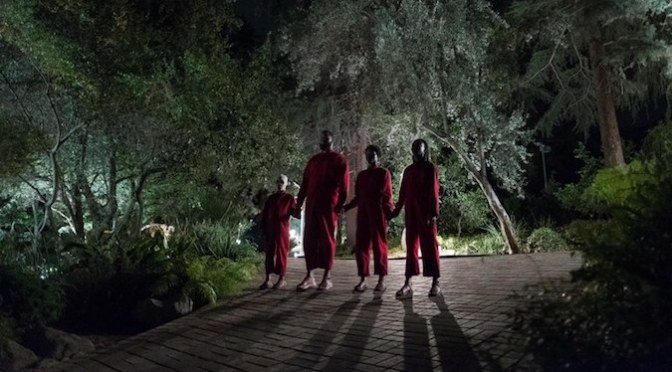
 Jordan Peele’s Us is nothing short of exceptionally entertaining horror. Starring Lupita Nyong’o and Winston Duke as the mother and father of a prototypical American family, Us joins a long tradition of doppelgänger horror while still emerging from that tradition into definitive modernity. Like Peele’s debut Get Out, the American Dream — as a white-picket-fence fantasy and as a dark reality — is crucial not only to the implicit themes of the film, but to the reason both films are scary in the first place. Yes, Us has a preponderance of classic horror moments, from jump-scares to home invasions to creepy coincidences foreshadowing a coming threat. But these tropes become entertaining again only in context of a strong underlying assertion that speaks to something in our everyday life, and while Us may not speak as explicitly as Get Out, the potency of the film is drawn from a similar source.
That aforementioned line of doppelgänger-narrative-as-horror is an interesting one, and one that makes perfect sense for Peele’s sensibilities as a writer. It’s a premise that’s been used for terrifying stuff like Invasion of the Body Snatchers, Dead Ringers, Denis Villeneuve’s Enemy, and a number of unsettling works from David Lynch. Last year’s venture was Annihilation, which played with the doppelgänger motif in a supernatural way. It’s elementally creepy, the idea of meeting yourself. The question it raises is as existential as it gets: if that’s me…then who am I?
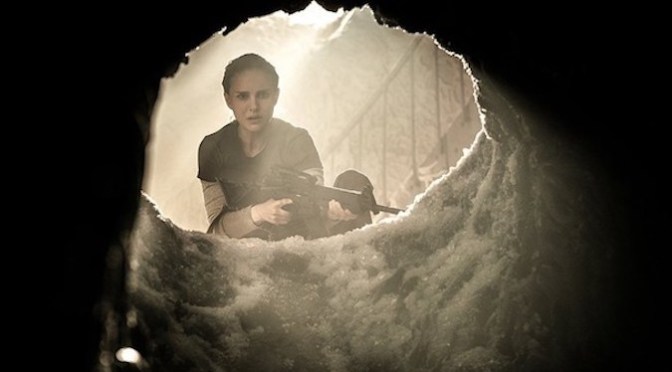
 In the climactic finale of Annihilation, there is a moment in which a shape-shifting alien bioclone with burning arms lovingly embraces a charred corpse in a lighthouse that has been struck by a meteor and overtaken by a mutated blight that threatens all life as we know it. Go ahead and read that sentence again if you have to. I dare you to try to come up with something so outlandish, so unsettling, so straight-up weird, much less deploy it at a crucial moment in a multimillion-dollar motion picture production. We live in a time where pretty much every sci-fi film with a budget this size (about $40 million) ends one way: explosions. The scripts all contain the same line: Big CGI Thing bursts into CGI flame. Heck, explosions probably typify the finale of most Hollywood films, sci-fi or otherwise, and the scripts for their inevitable sequels all contain the same line: Bigger CGI Thing bursts into bigger CGI flame.
 Motion State Review