

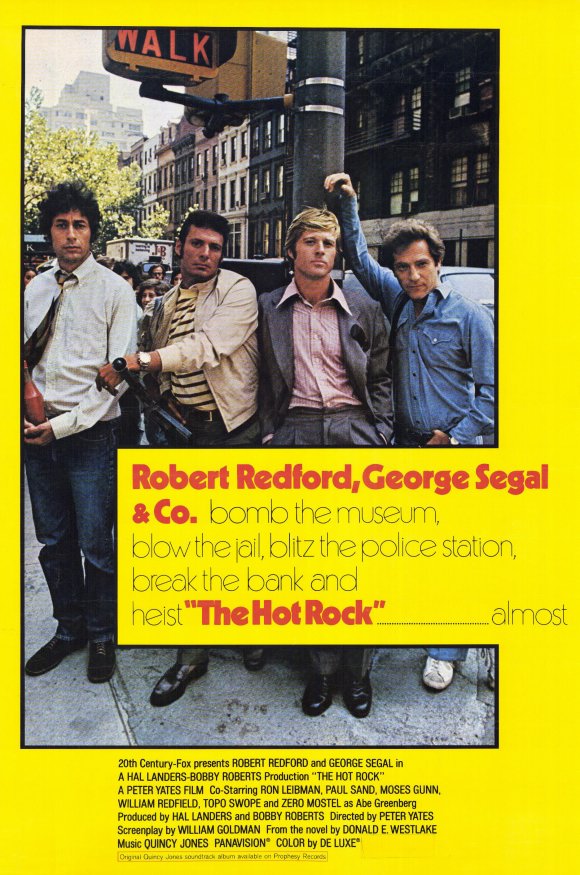
Here’s the starting lineup: William Goldman, red-hot off his Oscar win for Butch Cassidy and the Sundance Kid, is your screenwriter. He’s adapting a novel by Donald E. Westlake, whose protagonist John Dortmunder will soon become one of his most popular creations. Robert Redford plays Dortmunder, with George Segal cast as his right-hand man. And you’ve got Peter Yates (Bullitt, The Friends of Eddie Coyle) in the director’s chair, seeking to marry his sensibilities for comedy and crime in the same film. Top it off with Quincy Jones for the score, and The Hot Rock should be shaping up to be a hell of a film.
One can understand and appreciate the drive to make a lighthearted caper in early ’70s New York, when the crime genre was growing in popularity but also in self-seriousness. Dirty Harry did much to cement a gritty remorselessness in the genre in 1971, asserting an edgy protagonist with no reservations about killing his enemies. In March 1972, The Godfather would in turn spawn a million imitators looking to recapture the Very Serious Drama of American crime. So the conceit of The Hot Rock, at the time, was explicit: bring back the fun.
Continue reading The Hot Rock (1972)
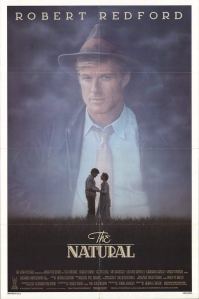 Bernard Malamud wrote The Natural, his debut novel, in 1952, the year the Yankees beat the Dodgers in the World Series. The tale of once-promising baseballer Roy Hobbs was almost universally praised upon the novel’s release, with many championing it as the first great novel about baseball. Critical consensus, though, agreed that the actual baseball — the strategy, the technicalities, the game — mattered less than the fable at hand. In some ways the myth behind Roy Hobbs was more interesting than Roy Hobbs.
 In many instances a film is like a con: it wants to hook you, it wants to make you personally invested in the outcome, and it wants you to walk away with a smile on your face and slightly less in your wallet. If the endeavor is a success, there will always be enough to suggest that the artist — the film artist or the con artist — knows a truth that you do not. If the endeavor is unsuccessful, the feeling of being cheated will linger and frustrate.
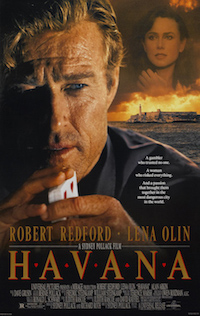 Any cook will admit that having delicious ingredients doesn’t necessarily make for a delicious meal, even if you are faithful to the recipe. The most masterful chef can combine a snazzy main course with cool, exotic sauces and side dishes, pepper in some flair, and tie it all together with pristine presentation — but if the temperature isn’t just right, or if just one of the ingredients has started to turn, or if the sous-chef finally makes his move by sabotaging his tyrannical chef’s best meal, well, at least those would be reasons. Sometimes it just doesn’t taste good. Questions arise: why didn’t the dish work? Didn’t we follow the recipe to the letter? Did you freeze that thing overnight like I told you to? When does one traditionally bring their extended metaphor to a close? Now?


 Motion State Review