All posts by hangmantitan

Ida (2014)

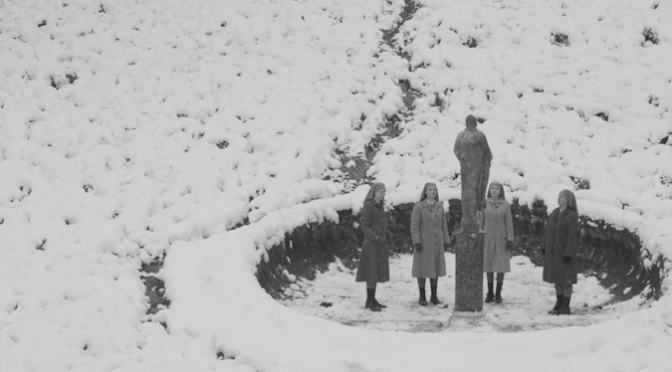
The most impressive aspect of Ida, the 2014 EFA champion and Polish Golden Globe nominee from director Pawel Pawlikowski, is without a doubt the stark visual staging and meticulous shot composition. Unlike Andreas Prochaska’s The Dark Valley — another awards season foreign language contender — the visual beauty of Ida meshes seamlessly with the story rather than overwhelming it. Newcomer Agata Trzebuchowska plays the young nun-in-training of the film’s title, and her forays from the convent into what some might call “the real world” provide the framework for Ida.

Ida was essentially born into her role in the convent, abandoned as a child and only now old enough to venture out. She’s nearly ready to take her final vows and become a full-fledged nun (“It’s morphin’ time!”) but before she does, she leaves the convent to track down her estranged aunt and get a little taste of the outside world. It’s not long before this Catholic nun discovers a truth about her past: she’s Jewish. This is only the first of many threats to Ida’s identity, one focused squarely in the past and in the present, and the revelation of the love and struggle and verve of the world outside the convent shakes up Ida’s future.

Continue reading Ida (2014)

Inherent Vice (2014)

Doc Sportello ain’t a do-gooder, as one of the trailer lines for Inherent Vice sings, but he’s done good. Paul Thomas Anderson’s seventh movie doesn’t seem to match up with anything else he’s done, tempting though it may be to shove it in the same category with Boogie Nights simply because they’re both comedies. There’s a little Boogie in there, for sure – there’s also mid-’80s Leslie Nielsen zaniness, a bit of Robert Altman, a bit of early Guy Ritchie, a bit of everything. Joaquin Phoenix plays Doc, a sofa-riding P.I. suddenly embroiled in a kidnapping/murder case that’s way, way over his head. The moving parts of the case are as perplexing to Doc as those of the film proper might be to us, and when Doc gives up trying to make sense of it all is about the time we do the same.

So, yeah: Inherent Vice has Jewish real estate moguls, ex-convicts, flat-topped cops, Japanese drug cartels, the Aryan Brotherhood, doped-up dentists, maritime lawyers and an increasingly large cross-section of people known from San Fran to San Diego with clear disdain or clear indifference as hippies. There are loan sharks, FBI agents, tenor sax players. There’s a big boat which might be called The Golden Fang, might not. How could these disparate agencies possibly be connected?

Continue reading Inherent Vice (2014)

Being John Malkovich (1999)

Let me tell you about the ending of Being John Malkovich.

For a long time prior to 1999, the spec script by Charlie Kaufman bounced around Hollywood without causing much hubbub. Kaufman’s 1994 draft made no mention of John Malkovich whatsoever, and only after two years and dozens of refusals did eventual director Spike Jonze get ahold of the screenplay. Jonze was primarily a music video director at the time and had never directed a feature film before, but clearly something about Being John Malkovich piqued his interest. He brought it to Propaganda Films and a year later casting was underway.

At this point, though, Being John Malkovich had a final act that was so bonkers and off-the-wall wild that, frankly, it put the rest of the bonkers and off-the-wall wild film to shame. The Being John Malkovich that we know ends on a subdued, somber note, uncomfortably tragic, undoubtedly affecting. Craig, the puppeteer played by John Cusack, abuses the magic portal to John Malkovich’s brain and becomes trapped in the next “vessel”, the brain of a prepubescent girl, from where he presumably is forced to watch her life unfold as a caged and powerless homunculus. The original draft of Malkovich didn’t have this muted, chilling conclusion – instead, it had chainsaw juggling, human-chimp intimacy, a reincarnated Harry Truman battling a firebreathing Malkovich, Kevin Bacon, and the Devil himself.

Continue reading Being John Malkovich (1999)

Starred Up (2014)

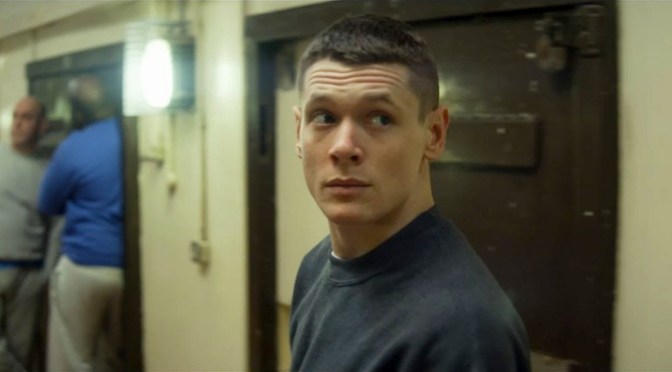
Starred Up played this week at the tail end of the Fall Focus presented by Independent Film Festival Boston. Though technically a 2013 release, the British prison drama has yet to really come out stateside and remains very much a movie of interest. Part of this is due to the recent emergence of Jack O’Connell on the international stage – he carried the little-seen ’71 and will carry the likely-to-be-widely-seen Unbroken, and he’s even in the Oscar conversation for the latter. O’Connell’s been in a bunch of stuff prior to the last few years, and his young role in the comparatively weak Michael Fassbender film Eden Lake probably foreshadows what’s to come most effectively. But if you want top-notch O’Connell in a nearly-top-notch film, Starred Up is the one to check out.

The prison genre is a storied one in film. Starred Up is a very different movie than Bronson – one of the most brilliant entries in the genre in recent memory – but it still recalls the 2008 Tom Hardy flick a little too heavily at times. This might be an inescapable element of the genre – it’s a prison movie, what did you expect? – but it might also be because O’Connell’s Eric Love simply seems to want the incredible amount of violence swirling around his little stone cell. Bronson and Love seem to share that from the outset – there is a scene in both films in which guards pile up outside the cell door in full riot gear as the gleeful prisoner, be it the hulking Bronson or the roguish Love, douses himself in oil and and prepares for the fight. The fight seems ritualistic, and for Bronson it certainly is. It’s sport. But this is where Starred Up and Eric Love diverge, and while it’s not necessarily a better film it’s certainly a more grounded, realistic genre entry.

Continue reading Starred Up (2014)

The Leftovers 1.2 – “Penguin One, Us Zero”

Apart from having an awesome title, “Penguin One, Us Zero” serves to better establish what The Leftovers looks like as a week-by-week television series. The pilot episode did a great job of setting up the new post-Departure America while not hitting us over the head with that world-building aspect, but the second episode really begins to delve deeper into the hearts and minds of those still remaining.

Chief among these (get it?) is Justin Theroux’s Kevin Garvey. Later episodes of The Leftovers will take pages from the Lost playbook and focus entirely on single characters, and “Penguin One, Us Zero” isn’t exactly one of these. But Kevin is front and center, as he should be, and some key elements of his character come to the surface in this second hour. His relationship with his father (played by Scott Glenn) is also introduced, and that’s an important relationship going forward into the thick of the first season. Most importantly, though: there is a bagel. Yes. On second thought, screw everything else. Let’s talk about that bagel.

Continue reading The Leftovers 1.2 – “Penguin One, Us Zero”

Little Odessa (1995)

There are probably a great many directors who could claim to be “New York directors” or directors of “New York movies”. Plenty of auteurs film in the Big Apple, sure, but true New York movies have more than just the location and the accent. They have the feel, dumb as it sounds. Martin Scorsese is the name most likely to crop up in the present conversation, and in fact the case with Scorsese is such that the relationship might occasionally become reversed: Scorsese made his name depicting “New York things”, and he got so good at it that certain “Scorsese things” are now taken lock, stock and barrel as “New York things”. Take this simple, unadorned, stage-setting shot from James Gray’s debut feature Little Odessa:

Little Odessa (1994)

Doesn’t something about that just scream Scorsese? The obvious comparisons are there in the smokiness, the coloring, the detail in the clothing and the food on the tables. The neon sign in the window. But the staging and perspective, too, seem to recall Scorsese’s camera. This is one of the more straightforward examples of such influence on the young James Gray, but the point isn’t to highlight how Gray made Little Odessa on the foundations laid by guys like Scorsese – he didn’t, and it’s clear even in this debut feature (made when Gray was just twenty-five) that his style is a distinct one largely free of ties to any cinematic giants of note. And the point isn’t even to prove that James Gray is deserving of a prominent rank amongst New York directors like Scorsese, although he is. The point, for now, is that Gray crafted Little Odessa as a New York movie, crafted it with that New York feel, and he did so for a very specific reason.

Continue reading Little Odessa (1995)

Nightcrawler (2014)

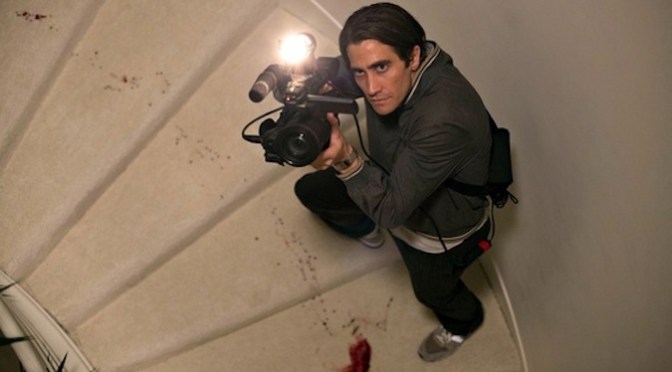
When we first meet the scavenging Lou Bloom, it’s clear that he’s an opportunist. He steals anything – copper tubing, swaths of aluminum fence, manhole covers (“the nice thick ones”) – and sells what he’s stolen to a construction foreman. Then he fights the foreman over the price, and then he asks the foreman for a job. So Lou’s mentality isn’t so much “when life gives you lemons, make lemonade”, but more “I have no lemons, so I’ll take yours”. This is the strongest aspect of Lou Bloom’s character, and indeed at times it’s overwhelmingly strong. Jake Gyllenhaal and writer/director Dan Gilroy don’t nail everything in Nightcrawler, but they nail that.

There’s a definite stylishness to Nightcrawler that aims to capture the seedy neon after-hours of downtown Los Angeles and the surrounding, more affluent suburbs. Lou graduates from scavenging to a real (ahem, “real”) job when he happens upon a highway car accident one evening: crime scene photography, he learns, can be a lucrative business. “If it bleeds, it leads,” says Bill Paxton’s mentor-photographer in a very trailer-suitable explanatory monologue. So Lou buys a camcorder and a police scanner and begins working. He’s all about opportunity, so when it knocks Lou answers. Opportunity, of course, keeps knocking, and Lou keeps answering. Soon he’s creating his own opportunities, which means everyone except Lou is about to get their lemons jacked.

Continue reading Nightcrawler (2014)

The Osterman Weekend (1983)

The problem isn’t that The Osterman Weekend is a bad movie. It certainly is, mind you, but that’s not the main problem. The books of Robert Ludlum are that strange breed of airport literature that often seems perfect for film adaptation but rarely manages to translate well, and by that criteria Osterman isn’t even that bad – this first adaptation was followed by the godawful Michael Caine-starrer  The Holcroft Covenant in 1985, an equally shitty made-for-TV version of The Apocalypse Watch in 1997, and then nothing until the Bourne movies finally showed up and allowed the Ludlum Estate to wipe its collective brow. The Ludlum Lens (heckuva title for his biography!) isn’t what we’ll be viewing this film through, but if it were this might actually turn out to be a favorable review.

Instead: The Peckinpah Perspective. The problem with The Osterman Weekend is that Sam Peckinpah directed it – the issue there being that the final film barely resembles what one would come to know as a Peckinpah film. At one point in time, that phrase was gold – it’s a Peckinpah film. It meant violence in a somewhat hyperbolic sense, but it also meant well-drawn characters with muddled motives, it meant ugly people doing ugly things under a microscopic lens. A Peckinpah film, at best, meant an insanely detailed story, and most importantly it meant a story unlike any you’ve seen before. There’s a reason people shake their heads and grind their teeth and comment cynically on message boards across the internet about how nothing in Hollywood is original anymore, about how Michael Bay makes the same movie over and over. It’s because they just watched a Peckinpah film, and because they’re hard up to think of any other film to compare it to.

Continue reading The Osterman Weekend (1983)

Raiders of the Lost Ark (1981)

This article first appeared as a part of the Brattle Theatre Film Notes commentary series, presented by the Brattle Theatre in Boston, MA, for a special screening of Raiders of the Lost Ark. Slight edits have been made from the original posting.

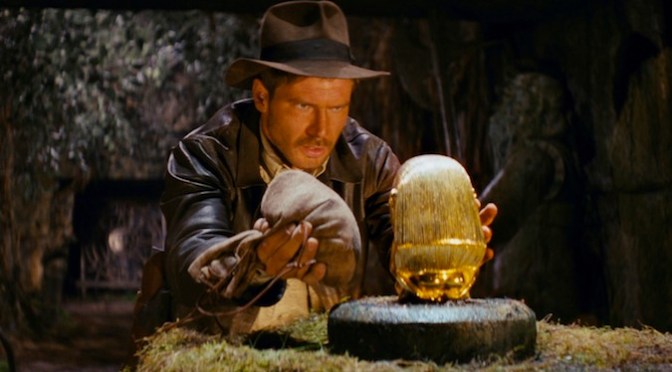
Not long ago Steven Soderbergh removed all of the color and sound from Raiders of the Lost Ark in an attempt to better study the visual staging of Steven Spielberg’s massively influential adventure film. The theory – according to Soderbergh – is that “a movie should work with the sound off”, that the coordination and arrangement of the visual elements of the story should, essentially, tell the same story that the dialogue tells. With Raiders, the theory certainly holds water: from the thick rainforest and cobwebbed tunnels of the opening action sequence to the quiet Archaeology classroom of the very next scene, from the snake-infested underground temple to the desert chase, the staging and pacing of the film is continuously surefooted. “No matter how fast the cuts come, you always know exactly where you are,” Soderbergh writes – and the attention he calls to the visual aspect of Raiders proves that Spielberg’s dedication to a strong sense of story isn’t compromised by a black-and-white color palette or a bass-laden electronica soundtrack.

To put it another way: Indiana Jones, even with these major elements stripped away, is still Indiana Jones. The color is one thing, but you’d think the absence of the iconic “Raiders March” would really shake things up for the worse. The John Williams score is inextricable from Indy, arguably as much a part of the adventurer as his hat or his bullwhip. You wouldn’t take the Bond theme away from James Bond any more than you’d take away his tux or his martini, for fear that the character before you wouldn’t seem like the same familiar spy anymore. Indy seems the same way, seems like a character so reliant on these iconic elements – but while Soderbergh’s exercise proved its point with regards to scene staging, it also pointed out what sets Indy apart.

Continue reading Raiders of the Lost Ark (1981)

The One I Love (2014)

It might just be because of the scenes in the pool, but John Cheever’s short story “The Swimmer” was never far removed from my viewing of The One I Love. The obsession with suburban America that Cheever shared with the likes of John Updike also seems applicable here, but it’s probably more the hazy blur of realism and surrealism that brings the late writer’s most famous story to mind throughout the film. Granted The One I Love is more lighthearted than anything Cheever ever wrote, but there’s still a sustained  feeling of dread and discomfort here. That’s coincidentally what sets the movie apart from most others, pulling it safely out of rom-com zaniness territory while managing to maintain a humorous mood.

Mark Duplass and Elisabeth Moss are Ethan and Sophie, troubled young couple who find their marriage in jeopardy. Their counselor (who, for some reason, is played by Ted Danson) suggests a getaway at a picturesque hillside home designed specifically, it seems, for troubled young couples. They go. They have a great first night. After that, though, things go a little haywire. There’s something off about the little guest house in back. What was all the confusion about that first night? Could this be a dangerous place? Should they leave? Stay? Was this Ted Danson’s intention?

Continue reading The One I Love (2014)