Category Archives: Director Series

Absence of Malice (1981)

The story of Paul Newman’s 1981 film Fort Apache, The Bronx is far more interesting than the film itself. When Newman suited up as a police officer in the South Bronx for a film about his ongoing fight for justice in the toughest neighborhood in the city, the context was a little too close for comfort: in the nine months preceding the filming of Fort Apache, at least twelve unarmed black and Puerto Rican individuals were killed by police officers throughout NYC (this is 1981, the most violent year of A Most Violent Year). The staunch opposition to the film saw massive protests, riots, a lawsuit and the formation of the Committee Against Fort Apache, all geared toward the halting of a film that many perceived to be defamatory and racist. Fort Apache got made, but it was one of the more dangerous film productions in the city’s history.

Newman himself got a big slice of Defamation Pie, too, courtesy of The New York Post. After reading the printed “facts” that Newman claimed were nothing of the sort, the actor accused the paper of “irresponsible journalism” and eventually referred to the Post as a “garbage can”. The paper ran a piece called “What Paul Didn’t Tell Us About Fort Apache” in the days following, and the dispute went in circles from there — people blamed the filmmakers for racism and defamation, Newman blamed the newspapers for false reporting and defamation, and film critics blamed Fort Apache, The Bronx for being kind of a shitty movie anyway. Paul Newman felt strongly about the journalistic integrity issues he encountered, and ultimately his extremely charitable history and consistent care for the underprivileged outweighed anything the Post said about him.
Continue reading Absence of Malice (1981)

The Electric Horseman (1979)

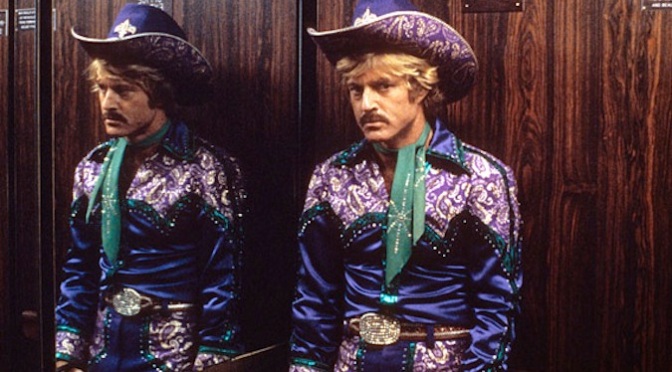
As the Annals of Film History come to resemble the Annals of Film Remakes more and more every day, one might suppose it’s only a matter of time before someone digs up The Electric Horseman and updates it with a modern twist. If we’re going by plot alone, Horseman has in fact already been remade a thousand times; there’s nothing earth-shatteringly original about the concept, or the characters, or the message, or the way the whole thing comes together. It’s very nearly your everyday run-of-the-mill romantic comedy, sharing a great many characteristics with all of those other romantic comedies, except for the fact that the romance outplays the humor at every turn. Horseman‘s a lot more enjoyable if you can manage to ignore genre classifications, or ignore the fact that you loathe country music. I’m happy to be your guide on both.

Mainly The Electric Horseman has something a lot of romantic comedies don’t: Robert Redford. Over the course of seven collaborations, Redford and Sydney Pollack essentially only made two films that weren’t structured around the romance of Redford’s character with a woman smitten by his jawline and just-visible chest hair. Both Jeremiah Johnson and Three Days of the Condor overshadow the likes of Horseman, but the other four romantic films — This Property is Condemned, The Way We Were, Out of Africa and Havana — probably do too. That’s without considering the zillion other films that Redford made in the ’70s, the busiest time in his career.

Continue reading The Electric Horseman (1979)

The Fog (1980)

Hollywood has a thing for remaking anything with John Carpenter’s name on it, even the snoozier stuff like The Fog. It almost never ends well. Whether or not you enjoy early Carpenter fare like Assault on Precinct 13 or Halloween, there’s little doubt that the remakes amount to nothing but unorganized grabastic pieces of amphibian shit. They remade The Thing recently, too, which approaches sacrilege, and they even had the gall to structure the thing (ha!) as a prequel of sorts without bothering to dream up a different title (like Dawn of the Planet of the Thing: Origins). We weren’t fooled: it’s a remake. Just last week a proposed remake of Big Trouble in Little China hit the internet because why the hell not? It’s there, isn’t it? What else are we supposed to do with it? Sit on the couch with Dwayne Johnson right there and everything and just watch it?

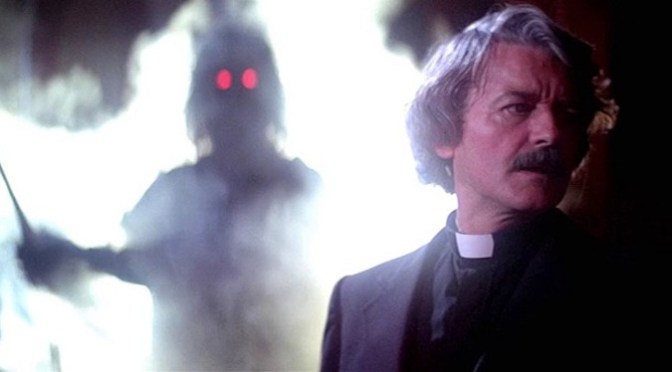
The Fog, Carpenter’s first studio feature after the unexpected success of Halloween, might have been one that could have been improved by a remake. The original contains a great deal of evidence as to why Carpenter’s films seem so remakeable, regardless of whatever the reason is that no one can seem to pull it off. 2007’s Halloween completely missed massive aspects of the original that made it good in the first place, as have most other Carpenter re-dos, but with The Fog there wasn’t much to worry about in that arena. The premise is straightforward and the execution in the original leaves much to be desired, based on a few things we’ll touch on here. But lo and behold: they quite literally hired the dude who directed Blank Check to helm the Fog remake, and the update managed to be so many zillion times worse than the already-not-that-great original. Go figure.

Continue reading The Fog (1980)

Bobby Deerfield (1977)

At least as far as the majority of the American public is concerned, Erich Maria Remarque is one of those authors who only wrote one book. It’s not true, of course, but his seminal All Quiet on the Western Front eclipsed his other work in the same way that Joseph Heller’s Catch-22 and Ken Kesey’s One Flew Over the Cuckoo’s Nest eclipsed everything else they wrote. In some cases this all-encompassing book isn’t even the best work by the given author, and there’s certainly a case to be made for that notion as far as Remarque is concerned. Heaven Has No Favorites, his 1961 novel, was serialized before publication but joined the rest of his works in achieving only minor notoriety. But it’s a hell of a book, heartbreaking and beautifully written even with the knowledge that it’s been translated from German.

And it would be nice to say that Bobby Deerfield yanked Heaven out of obscurity, but it really didn’t. Alvin Sargent (who would eventually win an Oscar for his screenplay for Ordinary People) penned the adaptation of Remarque’s novel, and the treatment soon piqued the interest of Sydney Pollack. By this point Pollack was well-established in Hollywood, having the Robert Redford-starrers Jeremiah Johnson and Three Days of the Condor under his belt, and so the next stop in the life of the script was in front of the on-fire Al Pacino. Pacino was drawn to the role of American F1 driver Bobby Deerfield, saying he identified with his journey more than any role he’d taken to date.

Continue reading Bobby Deerfield (1977)

Backdraft (1991)

I’m thinking of a movie. It came out in 1991. In this movie, a young hotshot investigator is faced with a particularly gruesome series of crimes. Stumped, the investigator seeks the help of a criminal already incarcerated for similar but unrelated crimes. The criminal is clearly a devious maniac, and his help is contingent on a cat-and-mouse game of psychological cabaret. He helps solve things in a roundabout way, but only after the investigator gives up personal feelings about the crimes. This movie features Scott Glenn in a fairly major role.

If you hadn’t seen Backdraft as the header for this review, you might have said The Silence of the Lambs. Either way, you’d be right — all of the above criteria fits with both films, strange as it seems. There’s no shortage of suspiciously-timed blockbusters that have a great deal in common — see Illusionist/Prestige, Tombstone/Wyatt Earp, Truman Show/EdTV, Antz/Bug’s Life, etc. — or just operate on a similar premise or gimmick, like the one-man-in-one-location flicks Buried and 127 Hours. But while Backdraft and Silence of the Lambs operate in fairly different territory, the similarities are far more numerous than those of the kindred spirits listed above. This can only mean one thing: an unfathomable conspiracy, deadly and ancient, marshaled and brought to bear for the purpose of ending civilization as we know it.

Continue reading Backdraft (1991)

Parenthood (1989)

Parenthood might be the first time Ron Howard really showed his talent as a director. Grand Theft Auto and Night Shift were passable as Howard found his directorial voice, and Gung Ho and Willow were larger productions that achieved different levels of success as Howard matured. I’d entertain an argument for Cocoon as the first glimpse of the great director Howard would one day become, mostly for the subtle mix of fantasy, sentimentality, humor and drama. But Parenthood, although admittedly very different, is the better film. With a burgeoning cast that can only be described as an ensemble, Howard’s brilliance lies in making that ensemble feel more like — oh no, he’s going to say it — a family.

There are the young ones — Kevin, Taylor, Justin, Patty, “Cool” and Garry (a pipsqueak Joaquin Phoenix) — each content in their kid ways to run around with head-in-bucket (in Justin’s case) or figure out the square root of 8,649 (in Patty’s case [it’s 93]). There’s Garry’s older sister Julie and her boyfriend/husband Tod. There’s the next generation, the brunt of the Buckman clan led by Steve Martin’s Gil, and the spouses of each Buckman sibling. And then there’s the patriarchal generation, with Grandpa Frank played by the great Jason Robards, utterer of the greatest line in cinema history (from Once Upon a Time in the West — either ya knowhadimean or ya don’t).

Continue reading Parenthood (1989)

Willow (1988)

When Disney purchased Lucasfilm in 2012 the primary news item was very definitely Star Wars and the announcement of a new expansion on the galaxy far, far away. The Force Awakens comes this December, but talk is already turning to Indiana Jones, another Lucasfilm franchise, and the possibility of continuing that as well (because distilling Raiders into Crystal Skull wasn’t enough). What’s next? THX 1138Howard the Duck? Radioland Murders? Perhaps even an original idea? Probably none of those for a few years, while Wars and Jones get the attention they deserve. Eventually, though, they’ll probably remake Willow.

Starring Warwick Davis and Val Kilmer, Willow is a fantasy epic set in what seems to be a mystical land of fairies, witches, warriors and little magicians. Willow Ufgood is our unlikely hero, tasked with the safe passage of a prophesied infant through the dangerous lands outside the borders of his home. He seems like a simpleton, a mere farmer, but there’s a lot more to Willow than meets the eye. Importantly, despite the evil tyranny he encounters in his quest, Willow remains one of the most endlessly optimistic characters in all of fantasy cinema. This made Ron Howard the perfect director at the time to handle Willow’s journey, as his previous Cocoon was similarly steeped in magic and optimism. Davis is instantly iconic as Willow. Meanwhile, Val Kilmer plays a drunk version of Aragorn.

Continue reading Willow (1988)

Gung Ho (1986)

So…is Gung Ho racist, or what? To be sure, far less sympathetic portraits of the Japanese have cropped up in American cinema over the years. This certainly isn’t the not-so-subtle Neimoidian race of The Phantom Menace or the not-even-attempting-to-be-subtle Mr. Yunioshi of Breakfast at Tiffany’s. At the very least Gung Ho is free of that kind of blatant disregard for cultural sensitivity that makes one wonder, with no shortage of slaps to one’s forehead, how the hell some things get greenlighted at all.

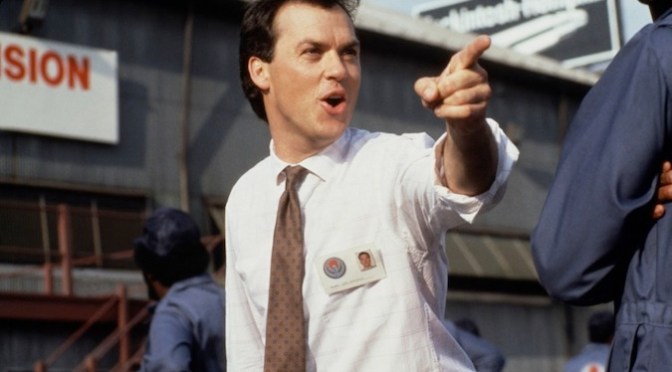
But there is a sneaking suspicion that there’s a cultural illiteracy afoot in Gung Ho, if not a straight-up cultural disregard, and that might be just as bad. Director Ron Howard cast Michael Keaton as the actor rose to fame following Johnny Dangerously and Howard’s own Night Shift, and there’s little blame to place on Keaton here. He’s the lovable doofus that he usually is. Gung Ho sees Keaton’s everyman Hunt Stevenson fighting to save his little Rust Belt town after a Japanese automobile company takes over the local factory. An army of managerial types swoops in from Tokyo and sets about “correcting” the carefree business practices of the American worker. Culture clash certainly ensues — we’re just not sure it’s the kind of clash that Howard and Co. intended.

Continue reading Gung Ho (1986)

Halloween (1978)

Halloween might be the most imitated, riffed-upon, winked-at American horror film in history. To say nothing of multiple novels and comic book series starring the serial killer Michael Myers, the film franchise itself now stands at ten installments, of which — you guessed it! — nine are pretty much crap. Judging by the box office landscape of the next few years, it won’t be long before Halloween 11: We Can Out-Sequel Saw hits a theater near you. But outside of the canon there are hundreds of Halloweens, from subtle copies to straight-up rip-offs, especially with the original being the film that most credit as the start of the slasher genre (“what about Hitchcock?!”).

One case-in-point is It Follows, one of the most recent nods to John Carpenter’s first true horror flick (although we sought out the elements of horror in his feature debut Assault on Precinct 13). The similarities are numerous and unmistakable, from the suburban setting to the shot of the classroom to the sense that this thing is stalking only the protagonist with everyone else standing in as collateral damage. That Michael Myers is a thing or an it — certainly not a him — is made clear by his psychiatrist Sam Loomis, and the idea of the human form as a vessel for something more sinister is also at the heart of It Follows. The music by Disasterpeace, too, is just one more obvious piece of evidence of the influence of Halloween in movies like It Follows; go listen to “Playpen” and try not to picture a flickering jack-o’-lantern against a black backdrop.

Continue reading Halloween (1978)

Assault on Precinct 13 (1976)

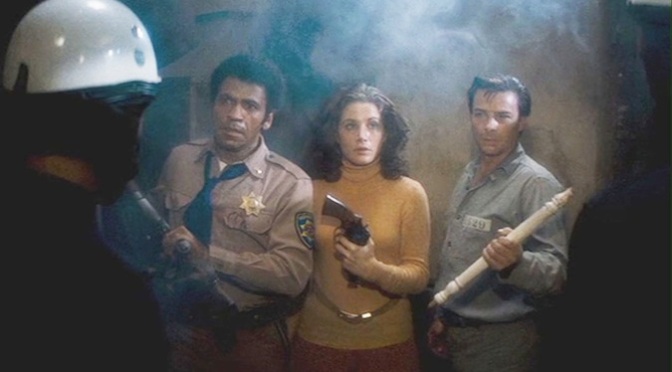
There’s a building on a quiet alley in a rundown part of the city that’s almost abandoned, draped in shadow and disrepair. Inside the building is a collection of individuals from vastly different walks of life. There is a supervising lieutenant freshly assigned to the job. There is a grief-stricken father in the throes of shock after discovering his murdered daughter. There are two dainty secretaries wearing sweaters (one orange, one yellow). There are three hardened criminals, one of whom is sick with a possible virus. Each of the people inside the building is an individual with an individual story. Outside is different. Outside is a creeping evil, a legion of hunters that is nonetheless a single faceless and motiveless mass, no individual stories to be found. The hunt is all.

…sounds like a horror movie, right? Like the kind John Carpenter might make? Even beyond Carpenter, this is not at all an unfamiliar formula for fright-fests — strangers unite against mysterious evil — serving as the entire premise of movies like Cube and Saw. The idea that something lurking out there will inevitably attack each stranger regardless of their differences is an inherently scary notion. And even though Assault on Precinct 13 isn’t necessarily a horror movie, it’s at its most effective when it operates like one.

Continue reading Assault on Precinct 13 (1976)