Category Archives: Director Series

Convoy (1978)

Sam Peckinpah’s penultimate film is Convoy, a Kris Kristofferson vehicle (sorry) about a bunch of truck drivers and their epic run-in with a corrupt lawman. The characteristics it shares with the other films from the late career of Peckinpah are not, unfortunately, anything other than the over-budget, highly confrontational, highly chaotic occurrences typical of the productions of Cross of Iron and The Killer Elite. The one difference in that regard is that Convoy actually did well at the box office, riding on the popular wave of truckerdom started by Smokey and the Bandit the previous year. But the uniqueness of that success is eyebrow-raising, too, for besides a chaotic production Convoy shares very few traits with any other film from Peckinpah’s career.

Kris Kristofferson is the sinewy truck driver known by the CB handle “Rubber Duck”, and his route across Arizona hooks him up with two of his trucker friends and a femme fatale played by Ali MacGraw. Their conflict with Ernest Borgnine’s crooked cop “Dirty Lyle” provides the main clash of Convoy, and the film’s title refers to the miles-long line of trucks that eventually forms in Duck’s wake as he crosses the Southern U.S. The escalation of the convoy itself isn’t too convoluted, which is to say that the pacing of this first chunk of the film is even and sensible. Preexisting animosity between Duck and Lyle leads to a situation of entrapment and extortion, which leads to the trucker retaliation at a diner, which leads to Lyle involving more and more policemen, which leads to the truckers involving more and more drivers. Ali MacGraw is just along for the ride (sorry).
Continue reading Convoy (1978)

Days of Heaven (1978)

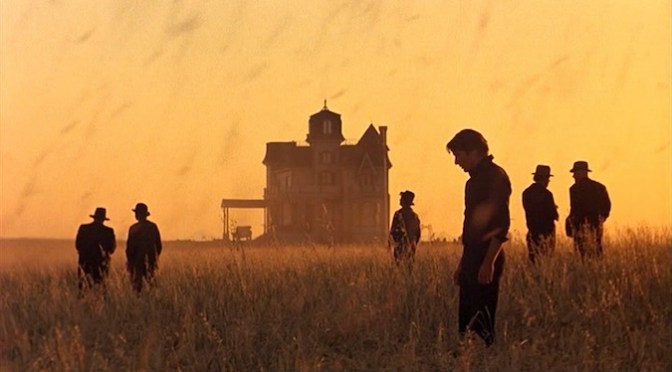
Days of Heaven is that second album that is so hard to make. The album that has so much to live up to; the album that has such large shoes to fill. Days of Heaven, however, does not fall short of its predecessor Badlands – Days of Heaven is Led Zeppelin II to Badlands‘s Led Zeppelin I. Terrence Malick manages to dazzle his audience once again with his patient storytelling and epic imagery.

Taking home the Oscar for Best Cinematography, Days of Heaven was widely considered one of the most visually appealing films to ever be made at the time of its release in 1978. Under Malick’s impeccable direction, Nestor Almendros captures some of the most impressive shots that I  have ever witnessed. One particular scene took my breath away – in which the farmer (Sam Shepard) ignites his entire field of crops causing a massive fire. The screen of my laptop was engulfed in violent flames and I was truly stricken with a brief, but intense, sense of panic as I watched the fire rage.

Continue reading Days of Heaven (1978)

Amores Perros (2000)

Alejandro González Iñárritu wasted no time in putting his ambitions—in the form of non-linear, multidimensional storytelling—on the big screen with his first full-length feature film Amores Perros. The title can be translated two different ways. The literal translation is “Dog Love”, but for those who think that means it is the Spanish version of Must Love Dogs, you will be in for quite a surprise. The second, less literal translation, “Love’s a Bitch”, more aptly captures the essence of the movie, and likely will scare off those hoping for a feel good movie about dogs and John Cusack.

In fact, there are hardly any “feel good” moments in Amores Perros. Rather, the movie focuses on important themes such as the value of companionship, whether it be from family or dogs, and the corruption of this value. Iñárritu achieves the promotion of said themes in an unorthodox but extremely effective manner that involves three seemingly distinct stories told in a fragmented and, at times, non-linear manner. And just to make things even more interesting, Iñárritu opens the film en media res; to be specific, en media of the most important res: the moment that brings the three main stories together.

Continue reading Amores Perros (2000)

Cross of Iron (1977)

If there’s one film in the late career of Sam Peckinpah that stands out among the rest, it’s Cross of Iron. By 1977, Peckinpah was still regarded relatively highly within the American film industry despite the fact that his last few films – Pat Garrett and Billy the Kid, Bring Me the Head of Alfredo Garcia, and The Killer Elite – performed atrociously at the box office. While most Peckinpah purists regard Alfredo Garcia as a violent and uncompromising classic, there’s little doubt that The Killer Elite is one of the weak points in the director’s career. Cross of Iron would be followed by Convoy and Peckinpah’s final film, The Osterman Weekend, but the former of the three is the only one that truly taps into the brutal verve that made the director so sought-after in the first place.

Interestingly – though perhaps not so surprisingly – Peckinpah supposedly turned down offers to direct the King Kong remake (with Jeff Bridges) and the first Superman film, opting for Cross of Iron instead. Hindsight is 20/20, sure, and odds are you’ve heard of King Kong and Superman while the “heroes” of Cross of Iron are difficult to name even after you’ve just watched the film – but one gets the sense that Peckinpah wouldn’t care about that, and would’ve picked Cross of Iron all over again if he were given the choice today. It was the quality of the story that mattered most to Peckinpah, and while King Kong and Superman endure to this day for a variety of reasons it can probably be argued that the strength of their scripts is pretty far down on that list.

Continue reading Cross of Iron (1977)

American Beauty (1999)

Let’s get one thing out of the way right off the bat: Sam Mendes’ directorial debut, American Beauty, is one of the most psychologically engrossing and, admittedly, strange films of all-time. Let’s get another thing out of the way too: Sam Mendes’ directorial debut, American Beauty, is one of history’s greatest films, and is one of the best directorial debuts in recent memory.

Sure, it doesn’t take a movie genius to call American Beauty a great movie. In 1999, the critically acclaimed film collected five Academy Awards: Best Picture, Best Leading Actor, Best Director, Best Writing, and Best Cinematography. On the surface, though, the film’s success seems far-fetched. The plot consists of a creepy middle-aged man fantasizing about his teenage daughter’s best friend, while he struggles with his rather extreme mid-life crisis. That doesn’t exactly sound like the winning formula for a movie. But the beauty of the film lies in its tagline—“look closer”—as both the audience and the characters are encouraged to do as the film progresses.

Continue reading American Beauty (1999)

Badlands (1973)

Terrence Malick’s debut feature film, Badlands, barrages its audience with the near-perfect execution of every aspect of film that one desires. From Malick’s masterful storytelling and characterization to the film’s deep insights on human nature and modern society alike, Badlands is full-on “GO!” for the entire ride. This film is absolutely filled with unexpected escalations and massive character arcs; thus, in respect to the film, this review  must contain spoilers. If you are in the most unfortunate circumstance of not yet having seen this film, I implore you to please discontinue your reading of this review now.

In one of the best performances of his career, Martin Sheen, and the less well known, but greatly talented, Sissy Spacek star in the ninety-four minute thrill ride that is Badlands. Loosely based on the real-life killing spree of Charles Starkweather and Caril Ann Fugate, the film follows Kit (Sheen) and Holly (Spacek), who represent the real couple, respectively. Now if that doesn’t set the scene for sudden escalation, in-depth character development and just the slightest pinch of horror – a.k.a. the makings of an awesome f@#cking movie – then I’m not sure what will. However, their journey starts in the relative calmness of rural Texas. Here, Holly is still a young, innocent girl. A young, innocent girl with a desperately ill mother, suffering from pneumonia in a time and place where modern medicine is not far reaching. Texas becomes the burial ground of Holly’s mother. Texas is where her father is too often reminded of the loss of the love of his life. So, the pair leave Texas, venturing to South Dakota, hoping for a fresh start.

Continue reading Badlands (1973)

Dead Poets Society (1989)

This article first appeared as a part of the Brattle Theatre Film Notes commentary series, presented by the Brattle Theatre in Boston, MA, for a double feature of Dead Poets Society and Good Will Hunting. Slight edits have been made from the original posting.

Robin Williams was an actor who selected his film roles very carefully. Despite his ironclad station as the greatest American comedian of his time, Williams acted in drama nearly as much as he did in comedy. One need only look to the shy Dr. Sayer of Awakenings or to the chilling villains of One Hour Photo or Insomnia to see the acting mastery Williams commanded.

On the surface, John Keating of Dead Poets Society and Sean McGuire of Good Will Hunting are two more of these “serious” roles that broke the mold for Williams the comic. There is no doubt that both helped to establish him as a master thespian regardless of genre. He was nominated for Academy Awards for both roles and won Best Supporting Actor for the latter, beating out the likes of Anthony Hopkins and Robert Forster.

Continue reading Dead Poets Society (1989)

The Mosquito Coast (1986)

In many ways our Director Series on Peter Weir can be seen as an excuse to write about The Mosquito Coast, which is the logical culmination of the “early stage” of the director’s career and gateway to those brilliant films that would follow (though calling that Weir’s “later stage” makes it sound like his directing career is a slowly advancing disease). Coast would follow Gallipoli and The Year of Living Dangerously – two well-received Australian films that helped launch Mel Gibson into superstardom – and Witness, which would prove to be Weir’s first American film. The greatness of Dead Poets Society would follow. It’s The Mosquito Coast, though, that’s arguably the most ambitious of any of these films.

And that’s fitting, because although Gibson’s Guy Hamilton and Harrison Ford’s John Book and Robin Williams’s John Keating could conceivably all be described as “ambitious” in one way or another, it’s Ford’s Allie Fox that allows his ambition to get the better of him. Fed up with just about every aspect of America, inventor Fox uproots everything and takes his family deep into the South American jungle. They make a new home – “home” a term used liberally here – on the Mosquito Coast, where Allie’s latest creation provides something magical for the local population: ice. Helen Mirren and River Phoenix appear as Allie’s wife and eldest son, who essentially allow themselves to be dragged into the jungle by this iceman simply because they love him.

Continue reading The Mosquito Coast (1986)

MASH (1970)

Among plenty of other achievements, MASH is (allegedly) the first major studio film to make use of the word “fuck”. While not necessarily a proven fact depending on your definition of “major studio”, the employment of the word is the perfect illustration of the important and innovative way MASH used dialogue. A large portion of Robert Altman’s filmography is made up of movies that are filled to the brim with sharp wit and fast banter, and MASH is arguably the finest example.

Donald Sutherland stars as Hawkeye Pierce, surgeon in the U.S. Army during the Korean War, prankster and goofball extraordinaire. Hawkeye, along with cohorts that include characters played by Tom Skerritt and Elliot Gould, is a lover of all things mischievous and manages to cause trouble even when he is blissfully unaware of doing so. This is war, of course, so people lose good friends and die themselves during the endless futilities of battle – in a Catch-22 sort of way, MASH uses its relentless humor as a way to illustrate this futility in highly satirical fashion, with Hawkeye and Co. essentially laughing in the face of meaningless death because what else can you do? In a Catch-22 sort of way, it works like a charm.

Continue reading MASH (1970)

Witness (1985)

Peter Weir’s first American film was the Harrison Ford vehicle Witness, released to commercial and critical acclaim in 1985. The Australian director was originally set to make his stateside debut with The Mosquito Coast, but a last-minute loss of financing would leave time for Weir to make a very different kind of picture first.

As a “Harrison Ford movie” — a label which immediately evokes Raiders and Blade Runner — Witness probably falls flat. John Book ain’t an adventurer, an action hero, or a possible cyborg (or is he?) and Witness ain’t a popcorn blockbuster. You can imagine the studio executives wincing as they reluctantly finance something that, frankly, looks excruciatingly boring as an abstract. Man goes to Amish country. Protects small boy. Woohoo.

Continue reading Witness (1985)