Category Archives: Featured

Meet Joe Black (1998)

I don’t exactly have strong feelings one way or the other about Meet Joe Black. Some despise it for being overly long and uneventful, some enjoy it as a meditation on death and love and living a fulfilling life. I’m neutral. Consistently so, in fact: pretty much every single facet of Black lands in a sort of middle ground. The premise? Interesting enough. The writing? Passable. The great Anthony Hopkins? Yes, he’s certainly Anthony Hopkins. The direction is fine, too, from the reliably careful Martin Brest, though this is him turning in his final film before the reliably careless Gigli; shame that every time you think hey, that’s a nice shot the little homunculus in your head whispers don’t forget Gigli. Anyway, I’m aggressively neutral on Meet Joe Black.

Do you want to talk about something else? Have you seen the commercial with the little baby and the car and the thing? Did you know that Rogaine is fatal to cats? Oh, you really came for Meet Joe Black? On purpose? And you haven’t even seen it? Abridged version: everything is starting to die (Anthony Hopkins) or starting to live (Claire Forlani) or Brad Pitt’s hair (Brad Pitt’s hair).
Continue reading Meet Joe Black (1998)

Warrior (2011)

Fun fact: Nick Nolte, of all people, was nominated for an Academy Award for this film.

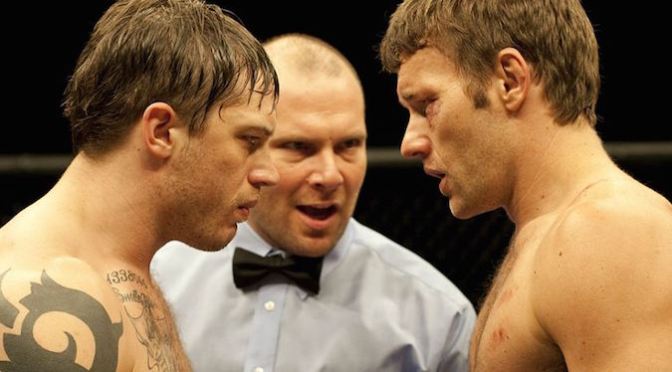
Gavin O’Connor’s Warrior, starring Nolte, Tom Hardy, and Joel Edgerton, is an emotional tale detailing the effects of an alcoholic father on a pair of brothers and how they ultimately overcome the damage done. One aspect of the film I particularly enjoy is the use of mixed martial arts simply as a frame for the telling of the story, rather than as the true focus of the film. Warrior is about family and pain and forgiveness and regret and utilizes the intensity of physical battle to make these themes come across all the more powerfully.  How could one feel Tommy’s (Hardy) mix of confusion and fear more effectively than by watching him punch another man in the face?

Tommy is the most interesting character in Warrior because he, quite clearly, is the most emotionally sensitive; his resentment of his father is immense, the pain he has felt at the death of his mother and his brother-in-arms is excruciating, his confusion about what he should do and where he should go, and the fear caused by this confusion all translate into his ferociousness in the cage. O’Connor’s decision, as screenwrter, to turn in a quiet character in Tommy is brilliant — Tommy desperately wants to be the “tough guy,” despite being deeply affected by the events of his life. He holds his emotions inside, they bubble, and are frighteningly released in the ring. Had Hardy spent the film blabbering, that interesting character would have collapsed completely. Tommy really would be perceived as the “tough guy,” had he not been so introspective and obviously distressed.

Continue reading Warrior (2011)

Back to the Future Part II (1989)

Today is the day, the distant future, to which Marty McFly travels in Back to the Future Part II, hurtling through time with Doc Brown to October 21, 2015. As predicted in the first film, Marty sees some serious shit — hoverboards, Pepsi Perfect, Jaws 19 playing in the local Holomax Cinema. Paradoxically, if Marty were to actually arrive today he’d find Back to the Future Part II re-released in cinemas instead, depicting the story of the day he traveled to October 21, 2015. He’d sit in the theater and have his recent past recounted and his impending timeline spoiled, which is an obvious time-travel no-no. His actions in the future would be influenced by the movie depicting his actions in the future, which would in turn change the 2015-set scenes of BttF2, which would in turn jeopardize Marty’s presence in that very theater, which would in turn jeopardize our ability to hypothesize about Marty’s presence in that very theater, which would in turn [head explodes].

The actual plot of Back to the Future Part II isn’t actually much simpler. If there are Ten Basic Ideas about time travel — meeting yourself, erasing stuff from existence, etc. — then three of them made it into the first movie and all ten of them were crammed into Part II, leaving Part III to differentiate itself by pretty much not being a time travel movie. But simple time paradoxes (paradoxi?) are for wimps — let’s have Michael J. Fox play a billion different roles, including three versions of Marty McFly! So silly!

Continue reading Back to the Future Part II (1989)

Beasts of No Nation (2015)

Beasts of No Nation lives in the space between realism and allegory. Uzodinma Iweala’s original novel approaches that space but seems far less concerned with it, narrated entirely by the young central character, Agu, in his simplistic present-tense dialect. A child soldier in West Africa, Agu’s journey in the novel is one of survival. His family is killed, and to avoid being killed himself he accepts an offer to join the army of the Commandant, a rebel warlord. At first he declares “I am not wanting to fight”; eventually, though, Agu is killing with knives and guns, willfully attacking “enemies”, tearing through his war-stricken country at the whim and call of the Commandant.

Everything about the novel is heartbreaking, but nothing more so than the sense that Agu is too young to realize that his journey across his country is also a descent into hell. The first-person narration is one that nonetheless conveys the bare minimum about Agu’s own thoughts and feelings about his actions, and yet at times it conveys more than enough. “I am liking it” — this is what Agu says about the sound of his knife hitting a woman’s head, about the splashing blood. It’s brutal in how direct it all is, in its impossibility and in its plausibility. Iweala never has to name the West African country or convince us that someone like Agu really exists; Agu very definitely does.

Continue reading Beasts of No Nation (2015)

The Martian (2015)

Hands down, the best movie theater experience I’ve ever had.

Sci-fi royalty Ridley Scott’s’ latest space voyage did not disappoint.  The Martian — starring Matt Damon, Jessica Chastain, Kristen Wiig, Jeff Daniels, Michael Peña, Sean Bean, Kate Mara, Chiwetel Ejiofor, and Donald Glover (holy shit) — epitomizes the term “modern classic.”  It gets its two major themes of unrelenting determination and human bravery across gracefully and without any integrity-damaging clichés, an accomplishment that continuously eludes many filmmakers who embark upon such a journey. That’s the difference between this film and Independence Day, for me (that’s not to say that the latter doesn’t hold a special place in my heart).

I left the theater with the stupidest grin on my face. The film’s humor was the beautiful element that made it exceptional, not only in the simple sense of making the film more enjoyable, but also in the sense that it unquestionably aided Damon’s performance — otherwise, I doubt his sheer optimism would have been nearly as believable.  The humor lightened the mood for us and kept us believing that Mark Watney was going to do the impossible.  Far from falling into the category of comedic-relief-humor, The Martian might actually get nominated for Best Comedy or Musical at the Golden Globes next year.  When Watney practically blows himself up and goes I flying across the hab, I cried with laughter.  When Watney intentionally goes to town with expletives in an inter-planet online chat that is being streamed worldwide, I cried with laughter.

Continue reading The Martian (2015)

Sicario (2015)

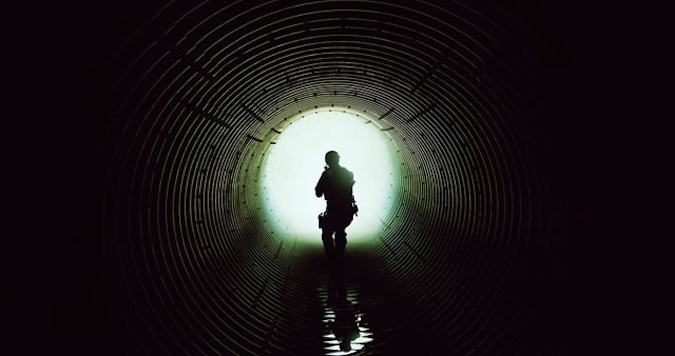
I admit: I was sold early on Sicario. Were you? There’s no shortage of seduction. Emily Blunt leads a stellar cast that includes Josh Brolin and Benicio Del Toro in some of the finest roles of their respective careers; Roger Deakins (blame him for this) is behind the camera, which is hardly ever wrong; and Denis Villeneuve is in the director’s chair, following up on Enemy and Prisoners with another intense thriller. Not completely onboard yet? How about a poster that recalls The Third Man?

The Third Man (1949)
Sicario (2015)
Sicario (2015)

Ah, works every time. Happily, as we sit down in the darkened theater and Sicario (a film which by the way has little to do with The Third Man) begins, it turns out the theme of seduction was at the heart of the film all along.

Continue reading Sicario (2015)

Calvary (2014)

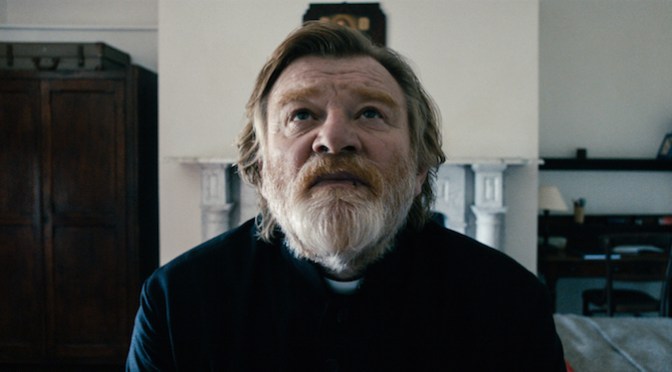
Seeing as I am spending this academic year studying abroad in Ireland, I suppose it would be appropriate to review some good Irish cinema. In the starring role of Father James, the brilliant and wildly underestimated Brendan Gleeson turns in one of his most impressive acting efforts in Calvary, channeling the frustration of a man who’s spent a lifetime actually giving a shit. Sporting a thick reddish-brown mane and sounding his still-thicker brogue, Gleeson covers a great range of emotions, as convincing in his attempts to mold the children of Sligo into proper men and women as he is in sardonically issuing back-handed compliments and even some more blatant insults.

Calvary’s dialogue is probably its strongest suit.  While the film is a clever black comedy with a plethora of lines that are as obscene as they are hilarious, there is also a cloud of seriousness and deep-meaning that hangs over the few players in this small-budgeted indie flick. Every jest is followed closely with an exasperated sigh, telling of the emotionally crippling environment in which these people live.  Where questionable jokes about child molestation are made frequently, there is a great deal of it happening. Where people often contemplate taking their own lives, jokes about such things are tossed around haplessly. So, while the film’s overtones are rather comedic, its undertones are actually quite upsetting. I suppose this is fairly insightful, as people do seem to make light of the real problems they face in order to cope.

Continue reading Calvary (2014)

The World Is Not Enough (1999)

Neal Purvis and Robert Wade co-wrote the scripts for an important chunk of the James Bond franchise, penning everything from The World Is Not Enough to Skyfall. They’ll receive a credit for the upcoming Spectre, apparently advising primary writer John Logan, but the previous five films are pretty much The Wade/Purvis Era while Skyfall might end up marking an overlap with The Logan Era. There are a few stinkers throughout Wade/Purvis, namely two that are regarded among the worst Bond flicks of all time: the Joel Schumacher-esque Die Another Day and the incorrigibly self-serious Quantum of Solace. Odd that one would be too goofy and one not goofy enough. But the other three efforts comprise the real Wade/Purvis Bonds, allowing those other two to just be buffers interspersed between the flicks that actually matter: The World Is Not Enough, Daniel Craig’s introduction in Casino Royale, and the mega-hit Skyfall.

The theory goes that a Bond scribe — at least this particular duo — takes two or three tries to really get it right. Even Ian Fleming only turned out his best Bond yarns after testing the waters with the likes of Live and Let Die and Moonraker. With Wade/Purvis, the tautness of the story is the best evidence to support this theory.

Continue reading The World Is Not Enough (1999)

The Devil’s Double (2011)

Yesterday morning, after I wrote about Moneyball, I went back and looked up the other films from 2011 in my little Film’s I’ve Seen notebook. I don’t actually have a little Films I’ve Seen notebook, but I do have a computer and an uncanny ability, usually, to read the title of a movie or see the poster and recall if I have recently watched it. Sometimes not. Alex Cross? I watched that? But sometimes I manage to remember something I did without even being reminded by a computer that I did it, and watching The Devil’s Double is one of those things.

I don’t know if that thing is a good thing or not, though. The Devil’s Double is definitely memorable, but it lacks the certain whatever that would make it truly unforgettable. Dominic Cooper (Howard Stark from Captain America: The First Avenger/Agent Carter and soon-to-be-star of AMC’s Preacher adaptation) pulls double duty as Uday Hussein (the eponymous Devil) and Latif Yahia (the eponymous Double) in this highly-fictionalized biopic, and he’s the reason the film sticks in your mind at all. Latif, the man forced to become the body double for the sadistic eldest son of Saddam Hussein, is the heart and soul of The Devil’s Double; Uday, heartless, soulless, is the real force of nature within the film.

Continue reading The Devil’s Double (2011)

Me and Earl and the Dying Girl (2015)

Turning a book into a movie is often quite difficult, particularly with the tired old rhetoric that the book is always better than the movie. While this is often the case, it is tough odds to work against for filmmakers. Adapting Jesse Andrews’ novel Me and Earl and the Dying Girl into a motion picture also certainly had its own unique challenges. For starters, the book is fantastic, setting the bar rather high for the movie. Secondly, and more problematic, was the brevity of the book. MEDG is a book that can be easily read in one day. Not only that, but most of the text is dedicated to the oftentimes strange personal thoughts of the narrator and protagonist Greg Gaines. Plot-wise, I thought making a full-length film would be a stretch. Additionally, I was not exactly sure how they would go about stepping into the mind of Greg.

But, after winning both the Grand Jury Prize and Audience Award at Sundance and receiving generally high praise from critics, I figured that director Alfonso Gomez-Rejon had a found a way to work through these supposed problems and I decided to give it a watch, with an open mind that it just might be better than the book (oh, the humanity).

Continue reading Me and Earl and the Dying Girl (2015)