Category Archives: Featured

Black Mass (2015)

Part of me viewed Black Mass as a critic. I took into consideration the actors, the script, the staging, pacing, etc. What about character arcs? What about historical accuracy? You know: the usual. I considered some of the things that usually pop up on the imaginary checklist (like how many trailer-worthy zingers will we endure?) and a few that were more specific to this film (like will Johnny Depp’s makeup look as bad as it did in the set photos?); I considered that I’d have to play the game where you try to compress and bury all of those checklistable points so that you can actually watch the movie. I considered Out of the Furnace, the last film by Black Mass director Scott Cooper, and the frustrating way in which that film tried and nearly succeeded in being an epic like The Deer Hunter. Somehow, one of Furnace‘s major flaws seemed to be that it was only almost that kind of movie, something that attempted an ambitious feat but failed to stick the landing.

But despite a sneaking suspicion regarding that last point Black Mass is a hell of a lot more enjoyable than Out of the Furnace or even Crazy Heart, Cooper’s first two films which both touted incredible performances but misplaced directorial style, and that’s probably because the other part of me viewed it as a Bostonian. The Globe‘s Ty Burr says it best in his review: “For worse and for worser, James “Whitey” Bulger is a son of Boston, and moviegoers here will react differently to Scott Cooper’s film than they will in Seattle, Dallas, or Dubuque.” That was inescapably true for last night’s Boston Common screening, wherein the feeling was that everyone in the theater was already familiar with what was unfolding up on the screen.

Continue reading Black Mass (2015)

Pumpkinhead (1988)

Pumpkinhead doesn’t give a shit about your morals. He doesn’t really give a shit about anything, granted, and in true creature feature fashion the gory B-flick Pumpkinhead is more concerned with dreaming up gross ways for a pack of teenagers to bite it than with deriving any message out of the bloodshed. Oddly enough, though, there’s a distinct resistance to the crowdpleasing moments of heroism that usually typify late-’80s schlock-fests of this sort, which is evidence to the claim that somebody cared about something, which in this context is actually high praise.

Why, you ask, would the demonic Pumpkinhead be so prized within this ostensible Innocents vs. Monster tale? Why would we root for him instead of the terrified cabin-dwellers? Why would Pumpkinhead win? Simple: he’s Motherf*cking Pumpkinhead.

Continue reading Pumpkinhead (1988)

Shame (2011)

It’s just a shame that this film wasn’t a bit better.  I’m not saying I hated or even disliked Shame, but it had the potential to be a great film that handles an issue that is rarely discussed and is entirely taboo.  One thing, for sure, that impressed me about Shame was the way that it made me actually feel the shame and remorse and immense self-loathing that Brandon experienced on an hourly basis.  That was powerful, and I mainly attribute that to the sheer talent of one of my favorite actors, Michael Fassbender.  In his second collaboration with the talented Steve McQueen, Fassbender is almost frightening.  When he attacks his visiting sister in nothing but a bath towel (one that is starting to fall down, at that) and begins screaming in her face, I genuinely felt like he might have lost his mind.  His rage, which clearly stems from his own unimaginably great disappointment in and repulsion of himself, is fairly constant and, while far less intense than that of his later performance as a plantation owner in McQueen’s follow-up film 12 Years A Slave, is shocking.

At the same time, Fassbender is also wise to portray Brandon thoroughly enjoying the acts that ultimately lead to his frustration.  This is vital to his performance because it is clear that the film is attempting to show that sex addiction is, in fact, an addiction.  It is an affliction, much like alcoholism or drug addiction.  Brandon is not a freak, he’s not a pervert…he is suffering.  But, as all addicts do, Brandon enjoys doing these acts while he is doing them.  Just because a cocaine addict might desperately want to stop using the drug, this doesn’t mean that he will suddenly no longer enjoy cocaine when he does use it.  In order to achieve the goal that this film is trying to accomplish, Fassbender needs to be as dead-on as possible.  He nails it.

Continue reading Shame (2011)

Moonraker (1979)

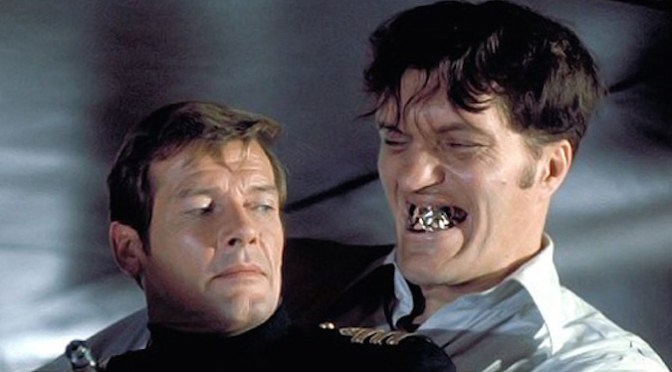
Ah, Moonraker. Shall I compare thee to another Bond film? Thou art more absurd and more simplistic. Sometime too seriously does Bond brood, and often is his complexion covered in facepaint like in Octopussy. And every fair from fair sometime declines, by chance or waning box office returns on the Dalton Versions. But your eternal ridiculousness shall not fade, Moonraker, nor will your incorrigible fan service be overlooked, so long as men can breathe or eyes can see — so long lives this and this gives life to thee…or, well, not exactly life, per se, but at the very least a juvenile rundown of Bond henchmen.

Jaws bites stuff. It’s sort of his thing. He chomped his way through The Spy Who Loved Me and was meant to die at the end of that film, but apparently test audiences preferred an ending where Jaws survives to bite another day. That might not necessarily have meant that audiences wanted to see Jaws again in the very next Bond outing, but see him they did. Consistently. I mean really, he’s in like every scene simply because.

Continue reading Moonraker (1979)

Deception (1992)

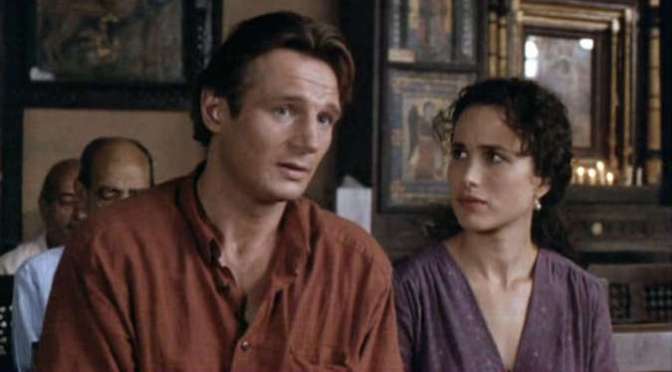
Okay. I just put on Deception, streaming on Netflix. Looks and sounds fairly enticing in an early-’90s Juror/Basic Instinct/Malice sort of way. It’s got Liam Neeson and Viggo Mortensen, both of whom I’m eager to see in a movie together, and Andie MacDowell, whom I really know nothing about. I’ve seen Groundhog Day and Four Weddings and a Funeral, so maybe it will be interesting to see her in a drama. The poster has moody lighting and Neeson is standing behind MacDowell in a subtly menacing way, suggesting that Deception is a cat-and-mouse game of, well, deception.

Okay! This sounds pretty exciting! Let’s get this movie started!

…….wow. Did David Lynch direct the credit sequence? That wasn’t very intense at all — oh, but I get it, I’m being deceived.

Continue reading Deception (1992)

Regarding Henry (1991)

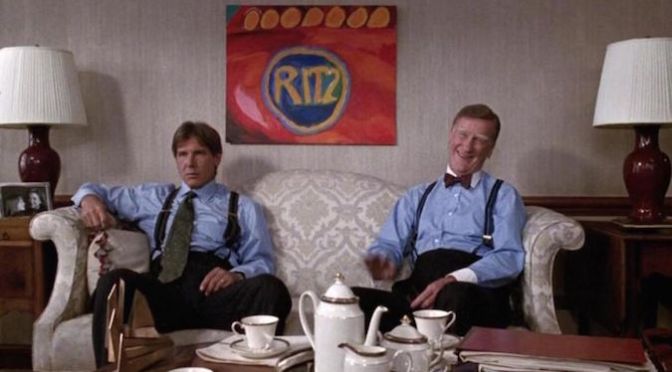
The upcoming Star Wars movie won’t mark the first time Harrison Ford and J.J. Abrams have crossed paths. As the 1980s became the 1990s and Harrison Ford traded in Han Solo, Deckard and Indy for a string of lawyers, doctors, politicians and playboys, the young writer Jeffrey Abrams was just getting his start. His first singlehanded script was Regarding Henry, a story about a heart-of-ice lawyer who is irrevocably changed by a horrific accident, and he scored big time with Ford and director Mike Nichols coming on board to bring his script to the screen.

Thankfully, even though Ford’s ’80s history is repeating itself with returns to Star Wars, Blade Runner and possibly Indiana Jones, Abrams has matured out of his Regarding Henry self and doesn’t appear to be looking back. A solid cast and crew does not a solid movie make, and Henry is far more by-the-numbers than you might expect from the Ford/Nichols/Abrams triumvirate. There must have been something in the water in Hollywood in the ’90s, as Henry takes a prominent station in the decade’s prized Overly-Emotional Tearjerker Oscar-Bait category.

Continue reading Regarding Henry (1991)

White God (2014)

One of the most egregious snubs in the history of the Academy of Motion Picture Arts and Sciences concerns last year’s Best Actor trophy, and no, it has nothing to do with Leonardo DiCaprio. Eddie Redmayne walked away with the Oscar for his turn as Stephen Hawking in The Theory of Everything, and indeed his performance was groundbreaking and heartfelt. But it pales in comparison to the tour de force delivered by Body, the Hungarian star of Kornél Mundruczó’s White God, in his role as the tortured, tragic, life-loving, revenge-seeking, slobber-mouthed Hagen. Due respect to Redmayne, but Body’s performance is simply one of the most emotional and drool-covered performances in years.

As a young actor Body was met with obstacle after obstacle as he tried to make ends meet while pursuing his craft. He auditioned for some of the most iconic roles of our time and even received a callback for The Beast from The Sandlot, but the dude who played Mr. Mertle claimed Body was “impossible to work with” and cited the Hungarian-English language barrier as a primary qualm. He was an extra in Air Bud: Seventh Inning Fetch but soon disowned the film and distanced himself from the creative vision of the entire Air Bud series. Body struggled to be taken seriously as an actor, forced to take work in Iams commercials and as a busboy of sorts in the alley behind an L.A. hotspot.

Continue reading White God (2014)

The Man with the Golden Gun (1974)

After dragging Sean Connery back one last time for Diamonds Are Forever, the hunt was on for a new Bond that would be so kind as to stick around for more than one movie. That meant the first movie starring this new Bond would have to be really good; instead, it was Live and Let Die. No more Connery to be found here, sadly, but also no more world domination plots or supervillain nutjobs — just drug trafficking and regular nutjobs. Live and Let Die is weird, sure, but it’s not good weird. The film is too weak and Roger Moore is too clueless for any of the weirdness to cut through the muck. But the follow-up The Man with the Golden Gun is weird, is good weird, and may in fact be the best weird you’re going to find in the entire Bond franchise.

The film was more or less pronounced Dead On Arrival. As Moore’s second outing, The Man with the Golden Gun continued to fail to live up to any of the Connery Bond films. You name it, the critics decried it: weak plot with low stakes; weak dialogue; weak delivery of that dialogue, particularly from Moore’s Bond; weak Bond girl Mary Goodnight; stupid, unimaginative gadgets like a flying car; stupid, unimaginative inclusion of that fat sheriff from Live and Let Die; and, most damning of all, the simple and nearly indescribable fact that something about this doesn’t feel like a Bond movie. “Maybe enough’s enough,” wrote one critic, which is a funny thing to read with Spectre, the 24th film in the series, being released this year. Nowadays we know that it doesn’t matter how terrible Bond gets, or how many films in a row are stinkers, or how many miscast actors are handed the license to kill. There will always be another Bond flick, another ten, until the time comes to cast an invading alien as 007 (coming to zombie-infested theaters everywhere).

Continue reading The Man with the Golden Gun (1974)

Saturday Night and Sunday Morning (1960)

Did you know that Albert Finney was young once? Weird, right? He occupies such the Old British Guy post nowadays that his Young British Guy seems like a completely different actor. Time, of course, has a bit to do with that, as Finney’s had a long career full of great roles (Murder on the Orient Express), not-so-great roles (Looker) and, at present, increasingly smaller roles than he deserves (Skyfall). But it’s not just the passage of time that makes a return to Saturday Night and Sunday Morning, a film I first saw in college, a bit of a jarring experience. That’s because the difference isn’t so much Old British Guy vs. Young British Guy at all — it’s Old, Lovely British Guy vs. Young, Dickhead British Guy.

Come on, you say, that’s simplifying it a bit too much. It certainly is. Finney’s Arthur Seaton, the prototypical angry young man at the center of Saturday Night and Sunday Morning, in fact has more than a few responses to such “insults” that approach perfection here. His entire social stance is a refutation of the notion that you or I or Doreen (Arthur’s girlfriend) or Brenda (Arthur’s other girlfriend) or anyone else would presume to know the first thing about him. A bit from his famous soliloquy:

Mam called me barmy when I told her I fell off a gasometer for a bet. But I’m not barmy — I’m a fighting pit-prop that wants a pint of beer, that’s me…but if any knowing bastard says that’s me I’ll tell them I’m a dynamite dealer waiting to blow the factory to kingdom come. I’m me and nobody else. Whatever people say I am, that’s what I’m not. Because they don’t know a bloody thing about me.

Continue reading Saturday Night and Sunday Morning (1960)

Straight Outta Compton (2015)

I think it is fair to assume almost every college student under the age of 21 has belted (or at least disgruntledly murmured) the words “Fuck Tha Police.” Straight Outta Compton puts the phrase in a more important context, believe it or not (what’s more important that one’s passionate lust for underage drinking, right?). Starring O’Shea Jackson, Jr. (Ice Cube-incarnate) and a band of eerily-similar-looking-to-the-real-life-people-they-portray and actually quite gifted actors, Straight Outta Compton tells the story of the famously infamous revolutionary rap group N.W.A.

The first hour/hour-thirty of the film immerses the audience in the world of late ’80s Compton, California. It’s a rough world, of course, filled with drugs and violence, but it is not necessarily filled with bad people. This is an unfair world, where the people put in charge of protecting those who live in it, are, in fact, a significant source of pain and distress. The misguided thoughts and actions of many members of the Los Angeles Police Department led directly to a sense of great tension and justified rebellion.

Continue reading Straight Outta Compton (2015)