Category Archives: Film Review

White God (2014)

One of the most egregious snubs in the history of the Academy of Motion Picture Arts and Sciences concerns last year’s Best Actor trophy, and no, it has nothing to do with Leonardo DiCaprio. Eddie Redmayne walked away with the Oscar for his turn as Stephen Hawking in The Theory of Everything, and indeed his performance was groundbreaking and heartfelt. But it pales in comparison to the tour de force delivered by Body, the Hungarian star of Kornél Mundruczó’s White God, in his role as the tortured, tragic, life-loving, revenge-seeking, slobber-mouthed Hagen. Due respect to Redmayne, but Body’s performance is simply one of the most emotional and drool-covered performances in years.

As a young actor Body was met with obstacle after obstacle as he tried to make ends meet while pursuing his craft. He auditioned for some of the most iconic roles of our time and even received a callback for The Beast from The Sandlot, but the dude who played Mr. Mertle claimed Body was “impossible to work with” and cited the Hungarian-English language barrier as a primary qualm. He was an extra in Air Bud: Seventh Inning Fetch but soon disowned the film and distanced himself from the creative vision of the entire Air Bud series. Body struggled to be taken seriously as an actor, forced to take work in Iams commercials and as a busboy of sorts in the alley behind an L.A. hotspot.

Continue reading White God (2014)

The Man with the Golden Gun (1974)

After dragging Sean Connery back one last time for Diamonds Are Forever, the hunt was on for a new Bond that would be so kind as to stick around for more than one movie. That meant the first movie starring this new Bond would have to be really good; instead, it was Live and Let Die. No more Connery to be found here, sadly, but also no more world domination plots or supervillain nutjobs — just drug trafficking and regular nutjobs. Live and Let Die is weird, sure, but it’s not good weird. The film is too weak and Roger Moore is too clueless for any of the weirdness to cut through the muck. But the follow-up The Man with the Golden Gun is weird, is good weird, and may in fact be the best weird you’re going to find in the entire Bond franchise.

The film was more or less pronounced Dead On Arrival. As Moore’s second outing, The Man with the Golden Gun continued to fail to live up to any of the Connery Bond films. You name it, the critics decried it: weak plot with low stakes; weak dialogue; weak delivery of that dialogue, particularly from Moore’s Bond; weak Bond girl Mary Goodnight; stupid, unimaginative gadgets like a flying car; stupid, unimaginative inclusion of that fat sheriff from Live and Let Die; and, most damning of all, the simple and nearly indescribable fact that something about this doesn’t feel like a Bond movie. “Maybe enough’s enough,” wrote one critic, which is a funny thing to read with Spectre, the 24th film in the series, being released this year. Nowadays we know that it doesn’t matter how terrible Bond gets, or how many films in a row are stinkers, or how many miscast actors are handed the license to kill. There will always be another Bond flick, another ten, until the time comes to cast an invading alien as 007 (coming to zombie-infested theaters everywhere).

Continue reading The Man with the Golden Gun (1974)

Saturday Night and Sunday Morning (1960)

Did you know that Albert Finney was young once? Weird, right? He occupies such the Old British Guy post nowadays that his Young British Guy seems like a completely different actor. Time, of course, has a bit to do with that, as Finney’s had a long career full of great roles (Murder on the Orient Express), not-so-great roles (Looker) and, at present, increasingly smaller roles than he deserves (Skyfall). But it’s not just the passage of time that makes a return to Saturday Night and Sunday Morning, a film I first saw in college, a bit of a jarring experience. That’s because the difference isn’t so much Old British Guy vs. Young British Guy at all — it’s Old, Lovely British Guy vs. Young, Dickhead British Guy.

Come on, you say, that’s simplifying it a bit too much. It certainly is. Finney’s Arthur Seaton, the prototypical angry young man at the center of Saturday Night and Sunday Morning, in fact has more than a few responses to such “insults” that approach perfection here. His entire social stance is a refutation of the notion that you or I or Doreen (Arthur’s girlfriend) or Brenda (Arthur’s other girlfriend) or anyone else would presume to know the first thing about him. A bit from his famous soliloquy:

Mam called me barmy when I told her I fell off a gasometer for a bet. But I’m not barmy — I’m a fighting pit-prop that wants a pint of beer, that’s me…but if any knowing bastard says that’s me I’ll tell them I’m a dynamite dealer waiting to blow the factory to kingdom come. I’m me and nobody else. Whatever people say I am, that’s what I’m not. Because they don’t know a bloody thing about me.

Continue reading Saturday Night and Sunday Morning (1960)

Straight Outta Compton (2015)

I think it is fair to assume almost every college student under the age of 21 has belted (or at least disgruntledly murmured) the words “Fuck Tha Police.” Straight Outta Compton puts the phrase in a more important context, believe it or not (what’s more important that one’s passionate lust for underage drinking, right?). Starring O’Shea Jackson, Jr. (Ice Cube-incarnate) and a band of eerily-similar-looking-to-the-real-life-people-they-portray and actually quite gifted actors, Straight Outta Compton tells the story of the famously infamous revolutionary rap group N.W.A.

The first hour/hour-thirty of the film immerses the audience in the world of late ’80s Compton, California. It’s a rough world, of course, filled with drugs and violence, but it is not necessarily filled with bad people. This is an unfair world, where the people put in charge of protecting those who live in it, are, in fact, a significant source of pain and distress. The misguided thoughts and actions of many members of the Los Angeles Police Department led directly to a sense of great tension and justified rebellion.

Continue reading Straight Outta Compton (2015)

The Man from U.N.C.L.E. (2015)

It’s fairly easy to spot a Guy Ritchie flick, and in his most recent movie The Man from U.N.C.L.E. a few of his trademark flourishes find their best use yet. Henry Cavill and Armie Hammer fill the suits first worn by Robert Vaughn and David McCallum in the ’60s television show and globetrot around the Mediterranean attempting to out-spy one another. There are three or four plots going on at once — one’s a crusade to stop a maniacal heiress from obtaining a nuclear weapon, one’s a love story, one’s a hopeful reunification of father and daughter —and so Ritchie’s penchant for hand-holding and retreading ground we’ve already covered is actually quite useful at times.

Mostly, though, the moderately bogged-down plot is just kind of there; the style, the mood, the unending suaveness of the two leads — that’s really what counts in Ritchie’s Man from U.N.C.L.E. There are some slick sequences that don’t make you forget the plot but make you simply not care about it, sequences that lose you, purposefully and gleefully, in the zippy catchiness of it all. There are some slow bits and, again, the retreading of information gets tedious as it does in other habitual instances throughout Ritchie’s filmography. But mostly this movie is all about the flow, and even if the scene-by-scene progression isn’t flawless the pacing within the scenes themselves is fantastic.

Continue reading The Man from U.N.C.L.E. (2015)

Face Off: The Voices (2014) and Kingsman: The Secret Service (2014)

Motion State Face Offs pit two films, franchises, or television series against each another for no reason other than because we can.

There are ostensibly only a small handful of things that The Voices and Kingsman: The Secret Service have in common. Both are 2014 releases with a satirical vibe that sometimes plays as downright cartoony. Both are Rated-R violent. Both played on a recent transatlantic flight that I took. They’re both movies, too, and both star actors and actresses and have titles made up of letters. The fact that Voices and Kingsman both exist is their greatest commonality, although it’s not necessarily something you’re particularly happy about once you realize that all of these other really good movies — hey, they exist too.

And therein lies the actual thread linking Voices to Kingsman. The former stars Ryan Reynolds as a meek little manchild with an odd little habit of talking to his pets. He hears their voices in his head, and he and his cat and his dog have some rollicking conversations. Oh, yeah, and he also has a penchant for killing people and chopping them up, too. Kingsman is a spy flick that might be a spy spoof, following a young lad named Eggsy as he’s initiated into a secret service of super-suave sleeper scouts. Taron Egerton plays Eggsy, but the show is stolen by his mentor figure Galahad, played by Colin Firth. In both cases we have pretty solid cast at hand. And in both cases nearly every single one of them is slumming it.

Continue reading Face Off: The Voices (2014) and Kingsman: The Secret Service (2014)

Adventureland (2009)

Adventureland represents everything I pray my first months as a college graduate do not include, although worse things than bro-ing out with Ryan Reynolds and having Kristen Stewart fall madly in love me could go down.

Jesse Eisenberg, the unexpected hero of Adventureland (expected hero, really) portrays a less asshole-ish version of his Mark Zuckerberg in The Social Network, pulling out all the nerdy stops, including but not limited to: an immensely awkward and unfailing stammer when speaking to any remotely attractive woman, a less-than-flattering Jew-fro, and a borderline translucent complexion (admittedly much like my own).  Kristen Stewart is…well, Kristen Stewart, bringing the exact same mannerisms and monotone speech that she brings to every other film she’s been in. Last but not least, Ryan Reynolds plays the classic douche.  Did I mention that Adventureland takes place in the ’80s?

Continue reading Adventureland (2009)

Beginners (2010)

Is Ewan McGregor just awesome, or what?  He truly brings his A-game to every role, and he refuses to shy away from anything, whether it seems too “out-there” or taboo or even if it seems like a risky film that could damage his career if it fails.  I love this about him; I respect this about him.  In a recent interview promoting the recent latest blockbuster Focus, Will Smith spoke about his career and said that in previous years, he had been overly concerned with making sure that his movies were hugely popular and that they made a lot of money.  If they weren’t, he felt like he had failed.  Now, he has let go of this obsessive, limiting mindset and has decided that he is more interested in creating.  The beauty of the art of acting, of exploring the human mind by diving into and becoming someone other than yourself is his newfound passion.  I think it is evident that Ewan McGregor shares this passion.  Examining the list of characters he has played, I believe it must be that he delves into the bodies and minds of these vastly different people because he is unsure who he is himself.  I tend to really enjoy watching films with actors who I see this in; Beginners is one of them.

Beginners is really a simple film. The film takes place over three distinct time periods and flips back and forth between them, but this is not confusing, nor meant to be, and there are no grand action sequences or diabolical twists.  This film is simple, it’s about people, it’s about life and everything, every emotion rather, that comes with it.  We see sadness and happiness, of course.  We see sympathy and confusion, we see love.  We see it all.  Yet, this is still a simple film.  There are a hand-full of characters, mostly quite likable, and we get to watch their lives as they are for about a month. Oliver (McGregor) has been through a bit of a rough patch: he lost his mother to cancer; immediately after, his father tells him he is gay; he watches him fall in love with a younger man; and then he watches his father, too, die of cancer.  Oliver does not struggle with coming to terms with the fact that his dad is gay, but with the idea that his childhood was a ruse, a lie, it occurred under false pretenses.  Oliver struggles not with the fact that his dad loves a man, but that his dad loves any person other than his mom.  To make matter worse, he is hurt by seeing his father loving a man his own age and feeling as though his father loves this man more than he loves him.

Continue reading Beginners (2010)

Inception (2010)

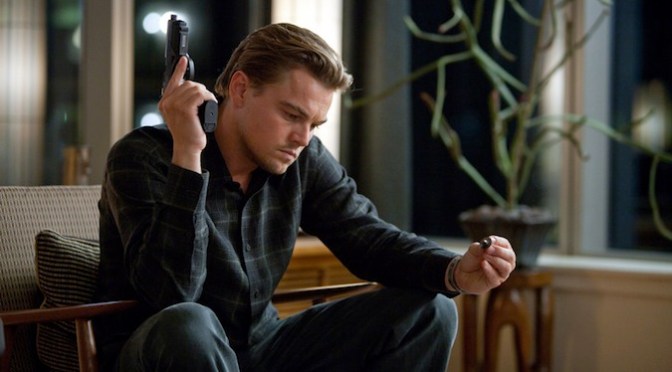
Inception. Five years after seeing the 2010 Nolan mega-hit in theaters, I still asked myself whether or not the top stopped spinning. For a long time, I couldn’t accept the fact that one of the most ingeniously crafted movies of all time would end so ambiguously. There had to be something else there, some other hint to what is really going on at the end.

After some time, however, I grew complacent and rested on logic. Having seen the movie dozens of times, I saw little that pointed towards Cobb (Leonardo DiCaprio) still being in a dream at the end. Moreover, the top is clearly wobbling, and, generally, tops, like dreams, do not regain stability after they start to collapse.

Continue reading Inception (2010)

Focus (2015)

There was a time when I’d never met a movie about con artists that I didn’t like. You name it: the almighty Sting, the classic you-didn’t-even-know-this-was-a-con Usual Suspects, George C. Scott’s The Flim-Flam Man; modern takes like Matchstick Men, Catch Me If You Can, American Hustle; the super-rewatchable original Italian Job and the super-rewatchable remake Ocean’s Eleven. Some of these — like, say, The Spanish Prisoner — technically aren’t that great as far as cinema is concerned. Maybe that’s part of what’s so damn endearing about them: they’re movies, not films, which means they could conceivably appeal to just about anyone because style and fun outweigh technique and competence. I think I was just fine with that for a while, and I might still be.

But I also remember taking issue with Christopher Nolan (you: “who the hell are you to challenge Christopher Nolan?”; me: “I have as many Oscars as he does“) when he made the following comment about heist movies in an LA Times interview while filming Inception:

I originally wrote [Inception] as a heist movie, and heist movies traditionally are very deliberately superficial in emotional terms…they’re frivolous and glamorous, and there’s a sort of gloss and fun to it. I originally tried to write it that way, but when I came back to it I realized that — to me — that didn’t work for a film that relies so heavily on the idea of the interior state, the idea of dream and memory. I realized I needed to raise the emotional stakes.

Continue reading Focus (2015)