Category Archives: Film Review

Ex Machina (2015)

There’s this dude Nathan. He’s one of the few dudes onscreen in Ex Machina, the directorial debut of 28 Days Later and Sunshine scribe Alex Garland. Nathan is a walking paradox, even in the most perfunctory surface-level characterization of him as a hard-drinking frat boy who also happens to be a veritable technological genius. Caleb, his temporary intern of sorts, at one point compares him to Mozart — likely the first time a Mozart figure has ever spent so much time on abs and forearms. This straightforward incongruity in Nathan would only work with the right actor in his shoes, and Oscar Isaac is the right actor. A force in Inside Llewyn Davis and A Most Violent Year, Isaac is utterly convincing throughout Ex Machina. Nathan drains bottles of beer and vodka, yells at his maid, passes out drunk, wakes up to lift weights and beat his punching bag, and soon starts in on the beer and vodka again — and yet he’s always the smartest guy in the room by a longshot.

That somewhat superficial contradiction (or, for the purposes of a review of a film about artificial intelligence: that skin-deep, cosmetic, inorganic contradiction) is only the beginning of Nathan. Isaac is joined by Domhnall Gleeson as Caleb, the timid young coder brought to Nathan’s underground tech lair as ostensible winner of a contest to take part in a secret experiment (Isaac and Gleeson are also both in The Force Awakens later this year, which is doubly exciting after seeing Ex Machina). Together they deliberate Ava, Nathan’s advanced A.I. that not only walks exactly like a human and talks exactly like a human but thinks exactly like a human, too. What that means, exactly, is exactly what Ex Machina probes. Maybe. Spoilers follow.

Continue reading Ex Machina (2015)

Skokie: Invaded But Not Conquered (2013)

I spent an hour and a half on an online chat module last night with a Verizon guy named Sandeep, desperately trying to restore some suspiciously evaporated TV channels to my service. We did the typical dance around the issue for some time before actually starting in on solving it, and the overly-formal customer service lingo that obviously came off of a laminated index card really only extended the process. Our conversation ended as follows:

Sandeep: You are a valued customer.

Me: Thank you.

Sandeep: I sincerely hope your sirvice [sic] is now satisfactory.

Me: Thank you.

Sandeep: Do you have any further questions?

Me: Have you seen the new Star Wars trailer?

The other reason this took so long was that most of my attention was on Skokie: Invaded But Not Conquered, the documentary airing on one of the channels that didn’t decide to spontaneously vanish. I’m ashamed to say I really had never heard of the fanatic Frank Collin or the “Skokie Affair”, despite any knowledge of American neo-Nazi groups and other various followers of the American Nazi Party’s George Lincoln Rockwell. Collin was partly that — a follower of Rockwell’s — and partly an attention-seeking egomaniac with a knack for societal parasitism. In Skokie, Illinois, he found what he perceived to be the ideal host.

Continue reading Skokie: Invaded But Not Conquered (2013)

Skyfall (2012)

For such a successful franchise of movies, there is no denying that of the 23 James Bond installments, a handful of the movies are nothing special on their own. That is to say, strip away the Bond allure and you’re left with a lot of movies that probably resemble a 2014 Kevin Costner film (3 Days to Kill, Jack Ryan: Shadow Recruit… you get the picture). But the most recent entry Skyfall certainly does not fit into this category of Bond movies. In many ways, Sam Mendes’ first Bond movie is not a typical Bond film; making it not just a great James Bond movie, but a great movie in general.

Mendes gives the viewer this sense early when Q says to Bond — but really to the audience as a sort of aside — “what did you expect, an exploding pen?” It’s Mendes way of saying, “what did you expect, a typical Bond movie?” In the case of Q, what he gives Bond — a fingerprint encoded gun — is even better. And in the case of Mendes, what he gives the viewer is also far better.

Continue reading Skyfall (2012)

Casino Royale (2006)

Of the three Daniel Craig Bond films, two have been received with applause from audiences and critics alike. One of the two is Casino Royale, Craig’s debut as 007. Royale has changed the game as far Bond films go. No more (completely) preposterous gadgets or (literally) impossible feats are featured in this film. No more corny lines and no more maniacal, manacle-wearing, super-genius super-villains. Martin Campbell’s Casino Royale is rooted in reality. Of course, there is some stuff that might seem somewhat far-fetched, but you just don’t have yourself a Bond film without at least a splash of absurdity.

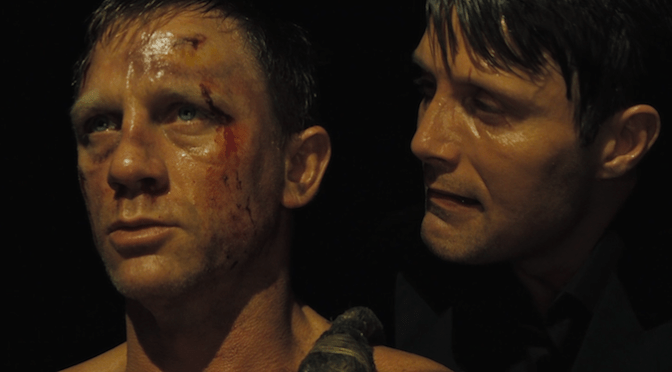
Daniel Craig is stupendous in this film. He fully embodies the perhaps overly confident, womanizing alcoholic who, at the same time, wears a badge of courage and integrity at (almost) all times. Craig portrays the smoothest Bond I have ever seen. I know what you’re thinking…probably screaming, actually. Connery will always be Bond, no one is saying otherwise. At the same time, Craig, in my most humble opinion, one ups him in the “I’m the coolest dude on planet Earth” department. It’s everything from the way he carries himself to the timing and delivery of his lines (every one of which hits perfectly). What is most notable, though, is the dark side that Craig brings to the timeless character. His orphanage is addressed in the film, the emotion behind his first kill is evident, and Bond drinks with a purpose throughout Royale. Craig makes it all work so well, from the stern look in his eyes as he races through the Miami Airport to the sarcastic smirks he makes at Le Chiffre (Mads Mikkelsen) from across the poker table.

Continue reading Casino Royale (2006)

The Hudsucker Proxy (1994)

The Coen Brothers’ filmography seems to alternate between “beloved” and “pretty much unknown.” For every Fargo and Big Lebowski there’s a Man Who Wasn’t There and A Serious Man. Nonetheless, it’s this writer’s opinion that each one of their movies is carefully crafted to near-perfection. (Okay, the jury’s still out on Ladykillers and Intolerable Cruelty. ) Of course, if I hold all their movies in such high esteem, what’s the point of a review? Well, because first of all I want you to know that The Hudsucker Proxy exists. And secondly because it deserves as much analysis as any of their other films.

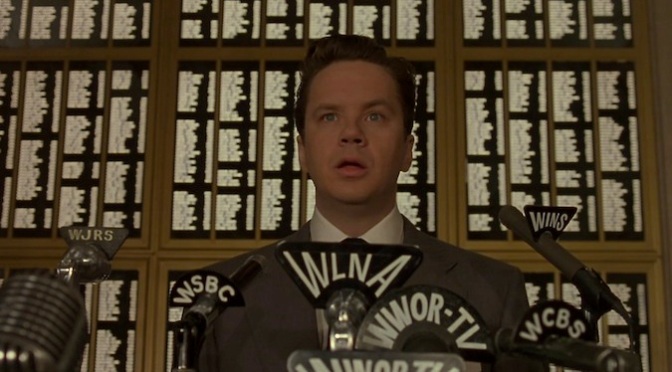
In a hyper-Art Deco 1930s Manhattan, Waring Hudsucker (Charles Durning), president of Hudsucker Industries, has flung himself off the top floor of the downtown headquarters. With company stocks about to go public, the board of directors, led by Sydney J. Mussburger (Paul Newman), plots to depress stock prices by hiring an incompetent president as a scapegoat and then buying back the company. That incompetent proxy turns out to be oblivious business student Norville Barnes (Tim Robbins). But that’s only the beginning of the Coens’ madcap screwball parody that satirizes every rung of the workforce ladder, from the mailroom grunt to the head honcho. Continue reading The Hudsucker Proxy (1994)

Desperado (1995)

As an avid guitarist, there’s a special place in my cold and shriveled little heart for the opening credits scene of Desperado. There are hundreds of popular movies about guitarists, some of which are really great (like Sweet and Lowdown and School of Rock) and some of which are really not (like Rock Star and Crossroads…wait, that’s the Britney Spears one). In the pantheon of Guitar Flicks — which, by the way, should totally be a genre on its own — Desperado might be close to the top, but it certainly isn’t the best movie available. Still, there’s something unique about the way Robert Rodriguez treats the guitar, and something especially mystical about that credit sequence.

Rodriguez’s entire Mexico Trilogy follows the same guitar-playing assassin, and there are probably arguments to be made for Desperado not even being the greatest entry in its own trilogy. While 1992’s El Mariachi was definitely improved upon in subsequent entries with the recasting of Antonio Banderas as El, Rodriguez’s debut feature still plays well as a standalone opener and a part of the larger trilogy. It’s without a doubt the most “realistic” depiction of a guitarist (at least at the beginning), and El’s attempt at finding a gig in the local saloon is probably one of the most gratifying scenes for any musician who’s spent time attempting the same.

Continue reading Desperado (1995)

It Follows (2015)

It’s cool that It Follows is getting the hype it’s getting. A lot of it is overboard, of course, as tends to happen sometimes when one good review snowballs until such claims as “It Follows is the best American horror film in decades” become commonplace. I’m all for lionizing good indie flicks, but it’s also important to let the thing stand alone for a while too, right? Anyway, that said, yes: It Follows is damn fine cinema. Technically a 2014 release, the film is just now gaining traction through an extended cinematic run.

Writer/Director David Robert Mitchell has a premise that nearly defies explanation because of its simplicity: there is this thing, slow-moving but not dumb, and if it’s “passed” to you then it will follow you. It can look like anyone, even someone you know. If it catches you it will kill you. Respite only comes from passing it along to someone else, and even then you’re still only next in line. That’s simultaneously an awesome premise — elementally terrifying in how simple it is — and yet one that’s been done a thousand times before. “Slow-moving thing inexplicably stalks people” is a staple of the horror genre, from Halloween (which we’ll discuss in a moment) to Alien (which we’ll discuss in another moment). Most “horror” flicks nowadays are really just slasher flicks with that premise mixed in. Thankfully, though, even though the premise of It Follows has been done before, it’s never been done quite like this.

Continue reading It Follows (2015)

Kidnapping Mr. Heineken (2015)

It’s actually borderline impressive how dull Kidnapping Mr. Heineken ends up being. The true story of the capture, ransom and eventual release of beer mogul Freddy Heineken is a harrowing one. Heineken was one of the richest men in the Netherlands when he was kidnapped. He was held for weeks in a brilliantly-constructed soundproof cell that probably inspired that twist from Denzel’s Inside Man. His ransom was the largest ever paid for an individual, and his captors evaded police for weeks following their release of Heineken. The media had an absolute field day with the entire affair, but the personal motives on the part of the captors are interesting as well.

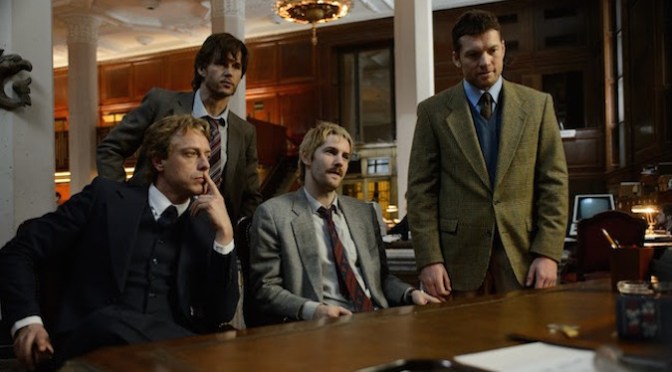
As a film, though, pretty much all of that falls flat. Jim Sturgess plays the ringleader and de facto mastermind Cor Van Hout, flanked by Sam Worthington’s Willem and Ryan Kwanten’s Cat, and each actor does fine with the part allotted to them. Anthony Hopkins is the veteran and obvious draw in the part of Freddy Heineken. Finally, director Daniel Alfredson is an intriguing choice as well, having previously helmed the original Millennium Trilogy before David Fincher took over for the American version of Girl with the Dragon Tattoo.

Continue reading Kidnapping Mr. Heineken (2015)

The Insider (1999)

A smash cut can be a beautiful thing. It can also be a broadly-defined thing, somewhat unfortunately, which means I have to reel you into a conversation about Michael Mann’s The Insider by providing a narrowed definition of smash cut. Excited yet? The added problem, of course, is that one of you damn dear readers will no doubt have the time to point out precisely where I’m mistaken in my definition, holding my hand and stating that, no, that’s not a smash cut, that’s a match cut, and that one over there is a jump cut, and over there is…my, oh my! Is that a Dutch angle shot in its natural habitat?

Anyway, the thing I’m thinking of might not even qualify as a smash cut, but for now that descriptor will have to suffice. Mann loves an extreme close-up, especially in his earlier works like Heat (I’m thinking of that early bouncing shot of Val Kilmer), and in his follow-up The Insider we probably get closer to the facial pores of Russell Crowe and Al Pacino than we’ve ever been before. But there are a few close-ups not of faces but of objects, inserted for a second or a half-second right smack in the middle of a scene, and those cuts are what I’m talking about. They smash to the forefront when you’d least expect them, these otherwise uninteresting objects. Why does Mann shove these in so boldly, and how does he get it to work so damn well?

Continue reading The Insider (1999)

Top Five (2014)

You have to marvel at Top Five, the third and best feature directed by Chris Rock, because it occupies what good ol’ Dave Matthews might call The Space Between (right now you’re saying this motherf*cker just referenced Dave Matthews in a review of a Chris Rock movie — you’re damn right). There’s the in-betweenness of the genre itself, which like main character Andre Allen keeps toggling from comedy to drama and back again. Even within the more likely genre of the two — comedy, for those of you who’ve never heard of this “Chris Rock” fellow — there’s the sense that the movie is stuck in the middle between the comedy we expected and the comedy we didn’t. Rock, after all, made his directorial debut with Head of State, and it’s pretty clear that with Top Five he’s partly digging stuff like that instead of just doing it all over again.

Mostly, though, the tightrope walking in Top Five occurs in the dialogue. Andre’s a has-been comedian, known to the masses for playing Hammy the Bear in three Hammy movies, and as of now he’s trying to break into more serious roles (like the leader of the Haitian Revolution in his new movie Uprize). He’s also trying to stave off his alcoholism, and Top Five provides a nice link between Andre’s sobriety and his ability to be funny. So the dialogue reflects this in the obvious way, in the events of the script and the plot points and such, but it also reflects this in the way it seems by turns well thought-out and yet totally spontaneous.

Continue reading Top Five (2014)