Category Archives: Film Review

Django Unchained (2013)

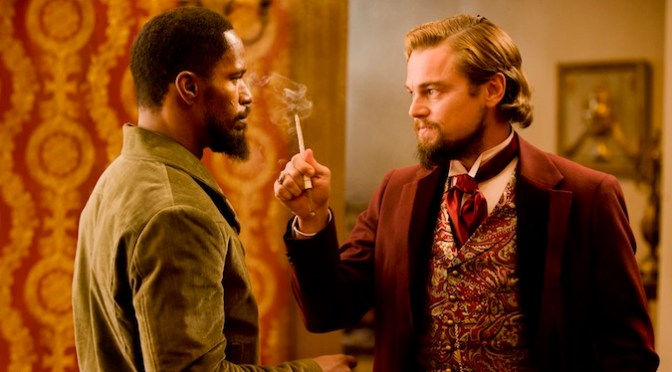
Nothing says “happy holidays” like an incredibly violent, utterly vulgar, yet strangely comedic look at slavery and racism in the Antebellum South. Quentin Tarantino’s latest effort has garnered exceptional critical support, seeming to morph together styles and tones from three of his previous cinematic achievements: Reservoir Dogs, Kill Bill, and Inglourious Basterds. The scope of the film is quite epic, occurring over months in various Southern states, yet it in no way takes itself too seriously. Instead, Django is extremely humorous and several of its minute details, when given closer examination, actually seem rather bizarre, almost finding itself belonging to the Wes Anderson genre of film. While dealing with a very serious topic and maintaining an ethically appropriate opinion of said topic, Djano truly reels in its audience with its Oscar-winning dialogue and impeccable acting. The film may seem controversial to some, but anyone really paying attention will easily be able to understand the stance the film is taking.

The film has a subtle but significant Reservoir vibe to it. The plot is intricate and well thought-out; dramatic irony (when one or more characters are aware of something that others are not privy to) is abundant; and there is even a particular scene in Django that is a directorial parallel to a different scene in Dogs. Let’s discuss the similarity in complexity of the plot. These movies are no rivals to Inception when it comes to complex storytelling, nor are they trying to be, but they do certainly contain these types of elements. Dogs places a police officer undercover in the mafia, thus tricking the mafiosos into believing that he is one of them. Django places an African American in the fourth largest slave plantation in Mississippi, posing as an expert in the well-regarded field of Mandingo fighting; in front of Leonardo DiCaprio, no less. This similarity simultaneously explains both the intricacy of the plot and the abundance of dramatic irony. And then there are the scenes using the slow-motion walk. If you do not recall what I am talking about, you now have an excuse to go rewatch these fantastic films.

Continue reading Django Unchained (2013)

My Left Foot (1989)

Calling Daniel Day-Lewis the greatest cinematic actor of all time certainly isn’t a stretch, and his performance in Jim Sheridan’s My Left Foot is the reason why. Day-Lewis plays Christy Brown, an Irishman born with cerebral palsy. The only control Brown has over his body is his left foot. However, he uses this one appendage to achieve fame as both an artist and a writer. Throughout the film and in real life, Brown works through the adversity of his condition as well as the poverty of his large family. The movie is set mostly as a flashback; Christy’s life unfolds as his nurse, Mary Carr (Ruth McCabe), reads his autobiography while at a charity event with him.

The decision to set the movie as a flashback was a solid one as it shows the progress Christy makes in so many regards to arrive to the fame that lands him at the charity event. Also, the film does not focus much on the actual writing of the autobiography. Rather, the focus is more on his art. Thus, seeing his life through his own writing highlights his talent as a writer while also providing an appropriate backdrop for his story.

Continue reading My Left Foot (1989)

The Great Waldo Pepper (1975)

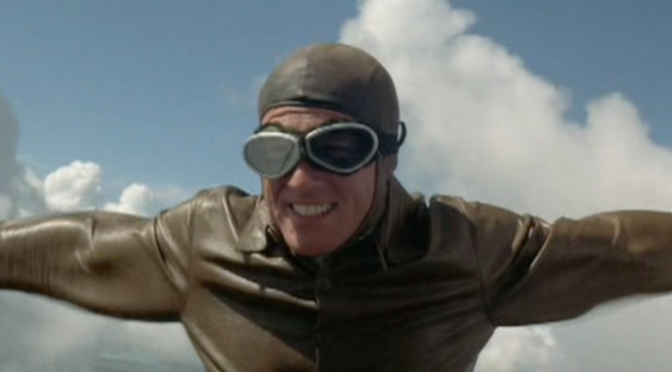
If Robert Redford is the best model of the American Dream in all its smiling, handsome glory (and I think he is), then he must also be its most effective destroyer. Through characters like the Sundance Kid (Butch Cassidy and the Sundance Kid) and Jay Gatsby (The Great Gatsby) who turn themselves into legends, and Bob Woodward (All the President’s Men) who turns politicians into criminals, Redford has made his career a mission to demystify the neatly packaged illusion of American exceptionalism. Yet I don’t think either of those crushes The Dream as brutally as The Great Waldo Pepper does, leaving it burning in the wreckage of a monoplane. And that’s saying something for a movie as lighthearted as this one.

It’s 1926 in down-home Nebraska, and all that’s left of World War I are the daredevil pilots who duke it out in barnstorming competitions right over our heads. Simple Midwesterners search the skies at the sound of a biplane engine while J.P. Sousa-style marches signal the arrival of our hero, Waldo Pepper. There’s only one problem–Pepper is a liar and a cheat. He never fought against the notorious Ernst Kessler in the war (he didn’t fight at all on account of his being a flight instructor), but he’ll say he did if it gets him an easy buck (on account of his being poor and desperate). But despite being a great storyteller and showman, Pepper is actually the real deal. He’s “Great,” not because he’s got money like Gatsby, but because his flying skills are (nearly) unmatched (that pesky Kessler is still alive after all). In this day and age, though, where almost every man and his grand-pappy seems to have a plane, Pepper’s gotta find a way to stand out. Continue reading The Great Waldo Pepper (1975)

The Interview (2014)

By now it’s clear that the magnitude of the turmoil surrounding The Interview is vastly disproportionate to the actual strength of the film itself. It’s frustrating, certainly, that this is the movie at the center of everything. Still, the American film industry is a weird beast. In nearly every form — be it Jaws or Sharknado — it’s been a cultural behemoth that reaches pretty much every corner of the globe. Here’s Commentary‘s Abe Greenwald on the current state of all of that in the wake of the movie getting yanked from theaters:

Hollywood movies are a monolithic U.S. export that have served to plant American notions of freedom and unbridled possibility in the minds of untold millions. From now on, filmmakers will think twice before crossing the next paranoid despot. That’s tragic.

That’s no doubt an important point, and probably the point of greatest significance that will ever be associated with a movie starring Seth Rogen. Is that a completely credible fear, though? Amidst the larger concerns of global politics, should we be worried about the “tragic” future of our movies? This piece will wrap up briefly with more thoughts on this. For now, though, let’s shelve the real-life cyberwar fallout discussion and just talk about The Interview.

Continue reading The Interview (2014)

It’s a Wonderful Life (1946)

The holiday season is filled with food, family, presents, and, of course, movies. Most of the movies people routinely watch during the holiday season include such classics as Frosty the Snowman, Rudolph the Red-Nosed Reindeer, The Santa Clause, and even Elf. These Christmas movies are exactly that: novelty movies made just for the 25 days leading up to the holiday. Hardly any of these movies hold any weight as great films outside of the holiday season. However, Frank Capra’s It’s a Wonderful Life does what these other movies could not by transcending the Christmas movie genre and becoming a classic film in its own right.

The 1946 movie, which is based on the 1943 short story “The Greatest Gift”, tells the story of George Bailey (Jimmy Stewart) which takes place in the form of flashbacks at the beginning of the film so that his guardian angel Clarence (Henry Travers) can understand the man he has been called on to help. It is clear from the beginning that the only thing that outweighs George’s lofty ambitions is his true care for everyone around him. At a young age, he saves his younger brother Harry from drowning and keeps his boss, pharmacist Mr. Gower — who is distraught after receiving news that his son had died in World War I — from accidentally delivering poison pills.

Continue reading It’s a Wonderful Life (1946)

Stay (2005)

It’s impossible to properly discuss Stay without discussing the ending. The movie depends on the last five minutes if it stands any chance of holding together. This, right off the bat, should be a bad sign. The Sixth Sense is a strong film even without the iconic (now cliché) twist, and 21 Grams (hell, any Iñárritu pic) features enough compelling drama to keep us interested until it all ties together at the end.  But Stay feels more like an exercise than a fully fleshed out story, and as anyone who doesn’t love getting high and watching Waking Life knows, that just won’t cut it. Nonetheless, Stay is a movie worthy of analysis. It’s just that you gotta get through the first sitting first. If you’re anything like me, you’ll probably experience five steps of emotion that are not unlike going on a hot date. Allow me to explain.

Continue reading Stay (2005)

Rampage (1987)

Did you finish listening to Serial yet? No? If not, never fear — as beautifully maniacal as it would be to just insert Serial spoilers into random film reviews, there is in fact a higher purpose to my evoking the super-popular This American Life spinoff podcast. That purpose is twofold, and the first is to highly recommend Wesley Morris’s piece “Wrestling With the Truth: The True Crime of Foxcatcher and Serial” over at Grantland. Morris is about as good as it gets these days in film criticism. Also, here is our own, lesser review of Foxcatcher from the New York Film Festival.

The second purpose in bringing up Serial is to talk about movies like William Friedkin’s Rampage. There are a thousand movies like this. There’s a twisted, blood-drinking serial killer named Charles Reece on the loose at Christmas who breaks into people’s homes and kills entire families. He’s caught, eventually, and put on trial to receive the death penalty. The prosecutor, played by Michael Biehn, is a man of high morals. His fight to convict the killer is a fairly personal one, because flashes of his own wife and son keep cropping up in his mind every time he reviews the case at hand. If this sounds a lot like Manhunter, well, that’s because it’s a lot like Manhunter.

Continue reading Rampage (1987)

The Hobbit: The Battle of the Five Armies (2014)

So I missed the first ten minutes of The Hobbit: The Battle of the Five Armies. The theater I go to is called Legacy, and — wouldn’t you know it! — there’s a similarly-named theater in Indiana, a state in which I do not live. The online purchasing mix-up was doubtless part of a North Korean ploy. After considering flying to Indiana to catch a movie I barely wanted to see, I opted instead to just jump into a showing that was already underway. It’s ten minutes, I thought, and this is a Peter Jackson movie.

So I’m waiting for Smaug to come out and breathe his fiery breath onto the poor Laketownians, but first it seems there’s a weepy scene between Luke Evans’s Bard and some other Laketownians. I try to ease into my seat and into the flow of the movie, but it’s instantly confusing. Is this a flashback? It’s only been ten minutes, so what could these people have to be weepy about so soon?

Continue reading The Hobbit: The Battle of the Five Armies (2014)

Braindead (1992)

Now that The Hobbit: The Battle of the Five Armies, a.k.a. the “Defining Moment” of the Lord of the Rings saga, is nearly upon us, it’s time to acknowledge that this series has been the longest con in cinema history. Peter Jackson has pulled the wool over our eyes, and it’s about time someone blew the whistle. He’s not the David Lean of fantasy he’s made us all believe him to be. No, Peter Jackson, ladies and gentlemen, is the sick freak behind slapstick zombie horror Braindead.

Dead Alive, as it’s known (or not known) in the States, isn’t even his most deranged work–just wait till you see Meet the Feebles. But it does have the infamous reputation of being the most violent movie ever made. Obviously, Jackson had greedily set out to make a name for himself right from the beginning, though it wasn’t “Lord CG-Crowds” or “Sir Most-Number-of-Endings-Crammed-Into-One-Film” just yet. The fact is, before cannibalizing Lean, Jackson had latched onto the coattails of the Masters of Horror.

Continue reading Braindead (1992)

The Imitation Game (2014)

There is a scene in The Imitation Game where a young Alan Turing is introduced to a book of codes and cyphers by his classmate and friend Christopher. The significance of this moment is obvious (Look, it’s the exact moment Alan Turing became the Alan Turing we all know!!!). But Graham Moore’s script plays this moment as a different kind of discovery. There’s no glint in Alan’s eye as he catches a glimpse of a future in which he fathers computer science while cracking the Nazi’s Enigma code, wins the war, and is later played beautifully by Benedict Cumberbatch. Instead,  Alan recognizes a comparison between cyphers and the way people talk. Turing, who is thought to have had Aspergers Syndrome, cannot process metaphors and irony because of his extreme literalism. The concept of coded communication gives him a better understanding of how people don’t say what they mean and don’t mean what they say. This, not his mathematical genius, is his gateway into code-breaking, and it’s one of many beautiful nuances in the film.

Unfortunately, the rest of The Imitation Game, like Turing, is overly formulaic. The film adapts Andrew Hodges’ biography, Alan Turing: The Enigma, about the mathematical savant who was the biggest contributor to deciphering Nazi communications with his cryptanalytic machine. This true story could have been an otherwise simple and inspiring tale about an extraordinary Brit, alongside the likes of The Theory of Everything and The King’s Speech, if it weren’t for one major tarnish. In 1952, Turing was convicted of indecency (read: homosexual acts) and made to take hormone treatments in place of a prison sentence. He killed himself two years later. This understandably requires a different kind of film.

Continue reading The Imitation Game (2014)