Category Archives: TV Review

Jessica Jones – Season 1

What do you want out of a superhero show? There’s no shortage, of course — you’re getting superheroes whether they’re what you want or not. They’re everywhere. Shakespearian actors are nudging each other out of the way for the chance to play a purple-faced mind-controller. At least kids across America are thankful that there’s something to be for Halloween besides Harry Potter. Heck, even the Academy Awards are doling out statuettes for superheroism (although there’s something special about Birdman winning Best Picture, as if the Academy were trying to fight back). There’s no way around it: the increasingly staggering numbers of superflicks hitting theaters over the next half-decade can now be measured in metric shit-tons. The only thing more tiresome than the parade of superheroes is the commentary about how the parade of superheroes is so tiresome.

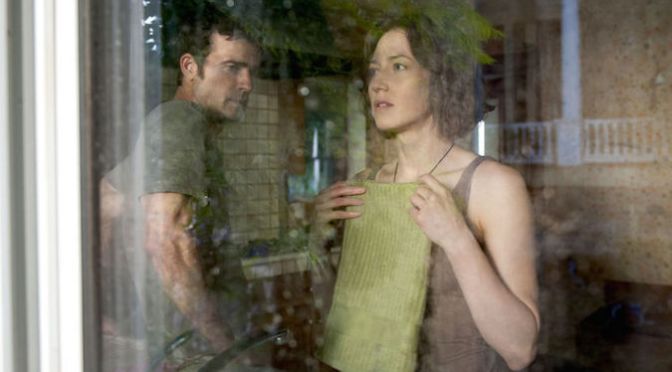
And, yeah, the shared universe gripes/laudations are just as stale, but here we are. Marvel in particular has reached the point where they seem to want it both ways: they want their superheroes to be intricately connected to every other superhero and yet be distinctly standalone. And, yeah: Jessica Jones. The latest entry in Marvel’s grand scheme has more inherent push/pull to the interconnectedness thing than any other installment in the Marvel Cinematic Universe, and that includes the Netflix predecessor Daredevil. On one hand Jessica is about as far away as you’re gonna get from Captain America, and maybe that marks trouble for an inevitable crossing-of-paths — either the dark tone of Jones would be compromised to accommodate Cap or the other way around.

Continue reading Jessica Jones – Season 1

The Leftovers 2.5 – “No Room at the Inn”

Ah, Matt Jamison. He’s not the main character of The Leftovers. He’s not the one most directly affected by the Sudden Departure, nor is he the one who’s lived most nobly in its wake, nor is he a handsome shining studly hero with a constant grimace (see: Kevin Garvey; John Murphy). But anyone who’s seen last season’s “Two Boats and a Helicopter” knows that Matt Jamison was the most passionate character in the whole of the show, the most tragic, and now that we’ve had another Matt-centric episode in “No Room at the Inn” it’s safe to say that those characteristics carry over into the second season.

We’ll talk about the cyclical writing involved in Matt’s stories, but first: Christopher Eccleston. There’s a lot of strong acting in The Leftovers, with Kevin Carroll’s John Murphy being the particular standout in season two. Eccleston is the veteran to Carroll’s newcomer, but the scenes between the two of them in “No Room” absolutely crackle. And for the duration of the episode Eccleston exudes an easy sense of identification with his character; he’s so natural as Matt that if more people watched The Leftovers Eccleston might stop being “the guy from Doctor Who” and start being “the guy from The Leftovers“.

Continue reading The Leftovers 2.5 – “No Room at the Inn”

The Leftovers 2.4 – “Orange Sticker”

Last night The Leftovers rickrolled everyone. I can’t exactly put my finger on whether that makes me ecstatic or annoyed, but I’m quite sure it’s the former. More importantly, “Orange Sticker” got back to Storyline A of the second season after a brief detour with last week’s “Off Ramp“. The Murphy Family seems to be fully driving the show now, sort of an odd thing considering we weren’t even aware of their existence in The Leftovers for the entirety of the first season. But their presence was noticeably missed in “Off Ramp”, and the events in Jarden now seem to have the cosmic weight of significance while the Mapleton subplot is just that: sub.

And more important still is that Nora and Kevin entered into respective character arcs that will drive their own actions in the coming episodes. “Axis Mundi” and “A Matter of Geography” caught back up with the Misplaced Mapletonians (great band name), but “Sticker” really took the opportunity to push forward. The episode began with an overlap of the conclusion from both of those first two episodes, making this the third time we’ve seen the earth-shaking occurrence that seemed to pluck Evie Murphy from existence. Interesting that there’s so much overlap this season — come to think of it, we’ve spent less than two hours with the Murphys as we approach the midway point of the season — and yet it still feels consistently fresh. This time the earthquake and the aftermath is seen from Nora’s point of view.

Continue reading The Leftovers 2.4 – “Orange Sticker”

The Leftovers 2.3 – “Off Ramp”

The episodic nature of a show like The Leftovers could be its downfall. Take Tommy and Laurie Garvey, the only two familiar faces in “Off Ramp”, and consider that a) we’ve seen a lot of their respective stories, from backstories to experiences at the moment of the Sudden Departure to their lives in the aftermath, and then consider b) that the episodes featuring them almost always seem like weaker entries. Why? Lost-style episodes on single characters aren’t inherently weak, and in fact “Two Boats and a Helicopter” (about Matt Jamison) and “Guest” (about his sister Nora) were two of the best episodes of the first season of Leftovers.

But Lost still had its dreaded Sun episodes, or its Shannon/Boone episodes, or a f*cking Rose & Bernard episode right in the middle of a major action arc, and that last example gets to the heart of the problem: some great characters just slow the action down. Tommy and Laurie always kind of did that in the first season, involved with their little cults of various ilks and mindsets, and we always had to cut away to get to them. Cutting away, of course, implies that the stuff we actually care about will be waiting when we get back. It’s not that Tommy or Laurie walked on screen and sucked the life out of the show, but even in their best moments the structure was such that you’d still be waiting to cut back.

Continue reading The Leftovers 2.3 – “Off Ramp”

The Leftovers 2.2 – “A Matter of Geography”

Let’s state up front that “Axis Mundi” is a hell of a season premiere. It’s utterly disorienting in the best way possible, fresh and yet eerily familiar, pushing The Leftovers into uncharted territory. If the premiere boldly goes where no Leftovers has gone before, then “A Matter of Geography” is the return to Earth, the necessary where-are-they-now refresher that connects the seasons in a narrative sense.

It’s not anywhere near as strong as “Axis Mundi”, but “Geography” is still a highly emotional hour. There’s a niggling sense that the cliffhanger at the end of “Mundi” won’t be revisited for a few more weeks, as “Geography” takes us back to Mapleton and next week’s episode looks to be dealing with the New York town as well, reconnecting with Laurie and Tom Garvey. But there’s more than enough in “Geography” to touch on in the lead-up to that final scene, which mirrors the final scene from the premiere but adds a completely new dimension to it.

Continue reading The Leftovers 2.2 – “A Matter of Geography”

The Leftovers 2.1 – “Axis Mundi”

If 2% of the world’s population — call it roughly 140 million people — suddenly vanished one day, the world would change, right? Everything would be different, right? Religion would be shaken for some, as we saw last season on The Leftovers in the third episode “Two Boats and a Helicopter“. Grief, as a concept, would take on a new complexity as in “Guest“. Heck, even the ATF would necessarily expand to become the Bureau of Alcohol, Tobacco, Firearms, Explosives and Cults (obviously). Three years after the Sudden Departure, Carrie Coon’s Nora Durst lives her life (again, in “Guest”) in what appears to be a normal way: she goes to the grocery store and takes the trash out. But Leftovers unveils something underneath those trips to the grocery store and to the trash barrel, betrays a world changed but changed only beneath the business-as-usual facade.

I expect as much to be the case with Jarden, Texas, a town that miraculously was unaffected by the Departure. All 9,261 citizens of the town were “spared”, turning Jarden into a mecca for those believing it to be the only safe haven on the planet. It’s now billed as Miracle National Park, and tourists flock by the thousands to breathe the air of the place that God saved. The change of location from Mapleton, NY, works on several levels, providing more than fresh faces and fresh challenges. The sparing of Jarden is no more explicable than the Departure everywhere else, and thus we get a fresh take on the world of The Leftovers as well, one where the whole business of “not knowing” is framed as a positive thing instead of a tragic thing. In Mapleton everyone asked what happened, and we talked about how Leftovers will never actually answer that question. Here, in Jarden, whoever asks what happened is met with a chorus of justifications from God saved us to stop asking and just be thankful.

Continue reading The Leftovers 2.1 – “Axis Mundi”

The Leftovers 1.10 – “The Prodigal Son Returns”

Sometimes drama is hard. Part of the reason why people are throwing around phrases like The Golden Age of Television is because great drama often implies a certain longevity, a depth not only of feeling but of space and time as well. Rust Cohle’s True Detective arc spans more than a decade, and we’re allowed insight into that arc for eight hours rather than for the limited runtime of a film. Walter White’s (d)evolution is likewise more effective for the time it takes building itself. In the coldest sense television allows what comic book chronology allows, simply more, and thus more of a compounding effect in the later hours or later seasons. True Detective and Breaking Bad are intense in their final sequences mostly due to brilliant writing, brilliant directing, brilliant acting — nothing replaces storytelling (preach!) — but partially due to what came before.

And yes: sometimes drama is easy. Fabricated drama isn’t hard to find. Heck, take Best Picture winner Argo, which climaxes with a harrowing scene at the airport where the heroes are really just standing in a room sweating as to whether they’re about to be let out of the country or not. Quick cuts are made to the drama, vehicles holding the bad guys hurtling along the tarmac. It’s all spiced up, and usually when you have to spice up your scene with cuts to action that simply happen faster and faster as the music plays faster and faster — well, maybe there’s another way to extract drama, a less easy way, an infinitely more effective way. Argo is hardly the worst example. The cringeworthiest one that leaps to mind is all the extraneous shit going down at the end of The Amazing Spider-Man 2, because Spidey battling his enemy isn’t enough. And Spidey battling two enemies isn’t enough. And Spidey battling two enemies while a hospital full of people is in danger and a plane full of people is about to crash isn’t even enough, so throw Gwen Stacey in there. There we go: amazing.

Continue reading The Leftovers 1.10 – “The Prodigal Son Returns”

The Leftovers 1.9 – “The Garveys at Their Best”

“The Garveys at Their Best” is probably the most illuminating episode of the first season of The Leftovers, and had it been placed at the beginning where it belongs chronologically it might have heightened the impact of a lot of the symbolism that came in the first eight hours. Pure benefit of the doubt dictates that The Leftovers is playing the long game, see, and so this is still the beginning. Fair enough, and the rewatchability factor is not to be discounted either. But those who claim the series is often purposefully obscure or figurative for the sake of being figurative can probably point to “Garveys” as evidence of that, and despite the realizations that come about during the episode there are just as many new questions.

Set in the few days leading up to the Departure, “Garveys” is the first look at “normal” life in The Leftovers aside from the season-opening scene in the grocery store parking lot and a brief swath of “Two Boats and a Helicopter” depicting Matt Jamison’s horrific personal experience on October 14th. Having an entire episode follow the main characters of the show in their day-to-day lives provides a huge amount of context for the often-questionable ways in which the same characters conduct themselves in the Brave New post-Departue world, and it also betrays the fact that pre-Departure life was possibly not as “normal” as everyone might like to believe.

Continue reading The Leftovers 1.9 – “The Garveys at Their Best”

The Leftovers 1.8 – “Cairo”

The question of protagonist Kevin Garvey’s sanity was first raised in the pilot, wherein he may or may not have fired his gun at a pack of wild dogs. The second episode “Penguin One, Us Zero” seemed to look on uncaringly as poor Kevin lost his shit over a disappeared bagel. Since then he’s inexplicably lost track of a closet full of white shirts, tethered a dog to his fence without any recollection of doing so, and crusaded across Mapleton to find a stolen baby Jesus doll. After all of that it’s still not exactly clear what’s eating Kevin Garvey, nor is it even clear whether he is or is not crazy. Moreover, it’s not clear how Kevin losing his sanity ties in to the greater themes of The Leftovers.

“Cairo” changes all of that. Crazy is a strong word, but Kevin’s definitely not A-OK upstairs. Clear is a strong word, too, so perhaps we should state that the clarity we get on Kevin’s mental state and how that mental state ties into the grander schemes of the series isn’t exactly a straightforward answer. But Kevin’s sleepwalking comes with serious bouts of amnesia, and he often wakes up to find he’s done something questionable — like tying a dog up in the yard — during his waking slumber. In “Cairo”, he gets downright violent, so much so that the part of himself that he never remembers becomes something that he doesn’t want to be a part of himself at all.

Continue reading The Leftovers 1.8 – “Cairo”

The Leftovers 1.7 – “Solace for Tired Feet”

Solace indeed. The first half of the rookie season of The Leftovers hurtles forward at breakneck speed, propelled by a whole lot of pain, a whole lot of angst, a whole lot of doom and gloom, and just a little tiny bit of hope. It’s fairly characteristic, actually, for an intense episode of this show to contain one small but valuable nugget of joy within the dark folds, although I’m not sure the darkest episode “Gladys” had anything of the sort. “Guest“, the sixth and best episode of the season, showed Nora more broken and identityless than she’s ever been — and yet her connection with Wayne (“Will I forget them?” “Never.“) was one of the most life-affirming moments in the entire season. Her brother Matt endured a series of cruelly hellish occurrences in “Two Boats and a Helicopter“, and yet his win at the roulette table probably elicited a smile as large as his out of most viewers. The previous episode “Penguin One, Us Zero” showed us just how tragic it could be to lost your bagel, and then it showed us just how exhilirating it can be to find it again.

So “Solace for Tired Feet” is just that: a breather. It’s not built with such intentionality, of course, and if anything it’s structured as a set-up to the final stroke of the season. “Tired Feet” says here is where everyone is, here is where they seem to be headed, and here is how they are all connected. The first two points are necessary to orient us towards the end of the season’s arc, but it’s the third point — the ways in which all of the characters are connected — that’s most impressive in this otherwise slow hour. To boot, instead of a full episode of straight-up intensity, “Tired Feet” provides a blend of hopefulness, revelation, and some intriguing Lost-style question marks.

Continue reading The Leftovers 1.7 – “Solace for Tired Feet”