Film & TV News: March 2

News

– The legendary Leonard Nimoy passed away this week, spawning many a Star Trek marathon. We’ll have a logical time in his honor.

– Denis Villeneuve, auteur behind the dark and moody Enemy and the dark and moody Prisoners, is being touted as the director for the likely dark and moody Blade Runner sequel. It’s a weird prospect having Villeneuve direct such a massively commercial movie, but then again it’s kind of a weird prospect doing a Blade Runner sequel at all.

– Leonardo DiCaprio joined The Crowded Room, in which he’ll play a man with 24 different personalities. We don’t know much about the story, but it’s an awesome title at any rate.

Continue reading Film & TV News: March 2

We Own the Night (2007)

There are obvious similarities between James Gray’s third film We Own the Night and his first two features Little Odessa and The Yards, and they’re mostly positive points. All three are New York crime dramas that focus on families straddling the moral wires of right and wrong, all have strong supporting characters, and all have a good handful of unique and intense action scenes. Considered side-by-side We Own the Night might be the “glossiest” of the three, lacking some of the grit of Odessa and Yards but also lacking some of the exciting virility Gray brought to those films. Still, the result is a more-than-passable NYC crime story.

The premise is highly familiar, and that alone may relegate Night to the rung below the likes of the arrestingly deviant Little Odessa. Joaquin Phoenix and Mark Wahlberg play Bobby and Joey, brothers on opposite sides of the law, the former owner of a seedy drug-fueled nightclub and the latter a golden boy NYPD officer. The events that bring them together aren’t altogether unfamiliar either. The big bad Russian drug dealer Vadim frequents Bobby’s place, so Joey (for some strange reason) believes his estranged brother to be the only person in the entire packed nightclub who can inform on him. Vadim (for some strange reason) suddenly puts an inordinate amount of trust in Bobby, letting him in on a secret to which only his most trusted henchmen are privy. If this all sounds disappointingly typical for an opposite-sides-of-the-law drama, that’s because it is.

Continue reading We Own the Night (2007)

JCVD (2008)

All of the Oscar hubbub surrounding Birdman got me thinking about JCVD, a movie built on a somewhat similar concept. You might superficially call this “a comeback movie”, if you think of Michael Keaton’s Birdman role in the same way most think of Mickey Rourke’s revitalization in The Wrestler. This might be the comeback of Jean-Claude Van Damme, action hero of the ’90s, star of movies with such vague titles that his name is printed in larger font on the posters, one-time king of both the roundhouse kick and the action flick box office.

But JCVD is set up like Birdman in another way, and after a certain point it’s not really a comeback film at all. The Muscles from Brussels stars as himself, or at the very least a tired and nearly washed-up version of himself, broke and embroiled in a custody battle for his young daughter. He’s still acting in the same films he’s always been acting in, but nowadays the passion seems sucked out of the entire process. The first long shot of JCVD follows Van Damme as he does an action sequence from his latest film, directed by a kid who doesn’t give a shit about Van Damme, and that opening shot tells two stories at once. It tells the story of the film-in-the-film, in which Van Damme’s hero saves a hostage from an army of faceless henchmen. But it also tells the actor’s story, Van Damme visibly going through the motions to get the film done instead of actually living through the thrill of the action. Every punch and jab and dive is perfect, exactly where it should be, and because of that it’s the most unexciting action sequence ever filmed.

Continue reading JCVD (2008)

Better Call Saul 1.4 – “Hero”

S’all good, man. Our lovable lawyer Jimmy McGill states categorically that he’s “no hero” during the third episode “Nacho“, and a large part of the fourth episode “Hero” seeks to play with that assertion. It also seeks to play with our expectations (much as I despise the phrase “play with our expectations”) about Jimmy’s transformation into Saul, revealing more about his past in the process.

The set-up for most of the episode is Jimmy’s purchase of a brand-spanking-new billboard advertising his fledgeling firm. He buys a new suit (the exact same suit his rival Hamlin wears) and creates a new logo (very nearly the exact same logo as the logo of Hamlin, Hamlin and McGill). He almost dyes his hair but decides to just photoshop the hairdo on the billboard picture instead. And when disaster strikes, our hero springs into action in what ends up being exactly what we’d expect from him — old dog, old tricks, new suit and haircut.

Continue reading Better Call Saul 1.4 – “Hero”

It Happened One Night (1934)

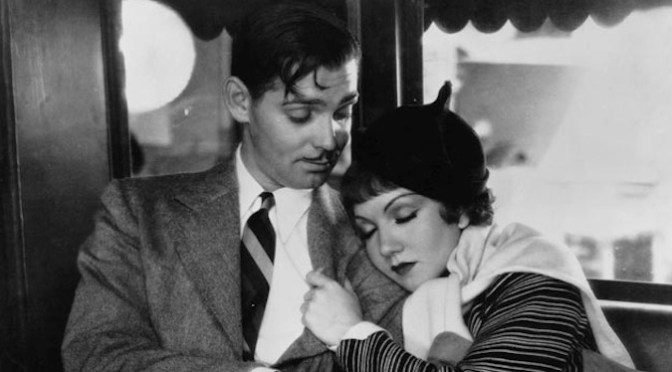
Boston’s Brattle Theatre screened a new restoration of the Frank Capra classic It Happened One Night this past weekend, fittingly coming on the eve of the 87th Academy Awards — Night was the first film to win Oscar’s Big Five, taking Best Picture, Director, Actor, Actress and Screenplay in the face of strong competition from the likes of The Thin Man. The restoration improved the quality of the original not by colorizing it or replacing the deleted scene where Clark Gable’s Peter discovers a magical portal to the planet Zaferonz (you didn’t hear about that?), but simply by touching up the considerable damage to the original print.

Scripts from this era of American film are always fascinating, mostly because they’re so different from today’s scripts. It Happened One Night falls only a handful of years after talkies came about, but the ensuing decade would typify a dedication to screenwriting that’s much rarer these days. It’s why I adore films like The Big Sleep, and it’s largely why It Happened One Night remains such an endearing version of a very familiar story.

Continue reading It Happened One Night (1934)

Birdman (2014): Riggan the Supernova

Our Take Two column offers second opinions and alternative angles on films and TV series reviewed elsewhere on Motion State. Head here for our original review of Birdman.

There’s a story about these guys, Jack and Murray, who head out to the countryside to visit The Most Photographed Barn in America. They follow the signs and arrive at the barn site, finding a visitor center, an observation deck, droves of people with cameras, the actual barn up on a little rise. “No one sees the barn,” Murray notes. “Once you’ve seen the signs about the barn, it becomes impossible to see the barn.” Jack says nothing as more tourists arrive, snap pictures, buy postcards. Murray continues. “We’re not here to capture an image, we’re here to maintain one,” he says. “Every photograph reinforces the aura.”

That story is from White Noise by Don DeLillo, an author who largely concerns himself with the same exploration of modern celebrity at the heart of Iñárritu’s Best Picture-winning Birdman. And that aura, so built up around the little red barn that the mass awareness begins to eclipse the individual identity, is not at all unlike the celebrity in which Michael Keaton’s actor Riggan Thomson finds himself trapped. The “public Riggan” — an image maintained in tabloids and represented by the superhuman Birdman — is so overwhelming that it obscures the real Riggan, the artist beneath the public persona, threatening to further that obscurity by tempting Riggan with Birdman 4. Plenty of films address Hollywood and modern celebrity in this way, and we’ll mention a few more from this past year in a moment. It’s Riggan, though, who most fully and tragically shows how impossible it is for an artist to escape the machinery of fame.

Continue reading Birdman (2014): Riggan the Supernova

Film & TV News: February 23

News

– Oscars went to Eddie Redmayne for The Theory of Everything (Best Actor), Julianne Moore for Still Alice (Actress), and Birdman for mostly everything else. A huge fist pump goes to Whiplash for winning three out of their five nominations, including a long overdue acting award for J.K. Simmons. All in all, a fairly good year for movies.

-It turns out Neill Blomkamp actually is directing a new Alien movie, not just Instagramming it. Thoughts?

-After shitting on him a little bit in last week’s news roundup, Kodi Smit-McPhee got cast in X-Men: Apocalypse as the supercool mutant Nightcrawler. We’ll have our apology ready for when he nails it.

-Happily, The Man in the High Castle got picked up by Amazon for a full first season; sadly, Niko and the Sword of Light did not.

Continue reading Film & TV News: February 23

The Red Road 1.1 – “Arise My Love, Shake Off This Dream”

Though True Detective devoured nearly all of last year’s television glory, the SundanceTV series The Red Road deserves mention in the same breath. Massively overlooked but strong enough to be renewed for a second season (which premieres April 2015), the show centers on a small New Jersey town in the foothills of the Ramapo Mountains. Decades of rough history between the town locals and the Lenape Native American tribe begins to flare up again, and two men — Officer Harold Jensen (Martin Henderson) and ex-convict Phillip Kopus (Jason Momoa) — become wrapped up in the middle.

Created by Aaron Guzikowski (writer of Prisoners), The Red Road brings that rough history into the present in a way that few series dare. At times it’s made explicit, especially in scenes recounting the death of Harold’s brother-in-law as members of the Lenape tribe (maybe even Kopus himself) stood by. Those scenes are compelling, but it’s the mysterious, unseen aura of Us vs. Them that really gives The Red Road serious clout, vibing uneasily in every sequence. Is it racism? Or is it simpler, illogical and obdurate hatred, free of any and all motivation, free as a virus in the mountainside community?

Continue reading The Red Road 1.1 – “Arise My Love, Shake Off This Dream”

Adaptation. (2002)

I have no idea who Charlie Kaufman is. I’m aware that he’s a screenwriter, that for a while he was known mostly as “the Being John Malkovich guy”, that he’s forayed into directing, and that he’s the esteemed subject of this Writer Series (one lucky guy). I’ve seen his movies, read his scripts, watched his interviews. I’ve done all of that all over again. I could zip over to Almighty Wikipedia and tell you his middle name and age and birthplace and favorite Dr. Seuss book (probably Hop on Pop), but the point is that when the only access point to a person is their art, it’s difficult to say you really know that person at all. In much the same way that a picture of a person is not, in fact, the real person, poring over an artist’s work hardly gives any insight at all to what kind of person they really are.

…that’s the easy answer, at least, and it’s one of many possible answers to the fantastic knit ball of questions that is Kaufman’s second collaboration with director Spike Jonze. The beautiful, prismlike nature of Adaptation. really can’t be overstated: dynamic and poignant, sensible and absurd, heartbreakingly sad and riotously funny. It respects and follows a certain structure while simultaneously succeeding in not giving a single shit about structure, consequently managing to start at the literal beginning of time and nonetheless distilling those billions of years into a single keystroke.

Continue reading Adaptation. (2002)

Better Call Saul 1.3 – “Nacho”

Money makes people do crazy things. Though “Nacho” was ostensibly a slower episode than “Uno” and “Mijo“, the third hour of Better Call Saul took a deeper look into the good and the bad inside Jimmy McGill. The Kettleman Family, who are at this point kind of like Breaking Bad‘s Elliott and Gretchen in the way they relate to the larger plot, not only drew out this dark side/light side conflict in Jimmy but will almost certainly continue to do so in the upcoming episodes.

And as usual, a lot of that conflict and drama was implied or depicted through action. Allowing his conscience to get the better of him after accidentally imparting the knowledge of Nacho’s plan to rob the Kettlemans to his friend Kim — a new character and seeming love interest — Jimmy anonymously tips the unwitting family off to Nacho’s plan. But none of this is painfully obvious until it happens, and the expected epiphanic conscience-awakening moment is played down in favor of a more methodical and strangely exciting sequence.

Continue reading Better Call Saul 1.3 – “Nacho”

Never judge a book by its movie