Big Eyes (2014)

Big Eyes is about a fringe artist whose Gothic work about depressed, child-like characters becomes wildly popular, copied, and commercialized until it’s rendered a caricature of itself. And no, it’s not Tim Burton’s autobiography. It’s the bizarre true story of Margaret and Walter Keane and the fortune they made in the 1960s on paintings of children with, you guessed it, big eyes. Still, it’s not hard to analyze Burton’s attraction to this story. Each new movie “from the mind of Tim Burton” seems to parody his own aesthetic, turning it into a brand more than an auteur’s style. It would be far too easy  to say that Walter represents the big, money-hungry studios and Margaret is Tim, just victims of their own popularity.  But this is a movie that deserves to stand alone–and after Dark Shadows, I’m sure Burton wants it that way.

The audience might already be familiar with the weird 1970 court case in which Margaret sued Walter for slander while he stubbornly insisted that he was the original artist. But Big Eyes sheds light on the couple’s even weirder marriage. Margaret originated her iconic wide-eyed waifs when she was just a modest painter selling portraits on the street. But it was Walter who took credit for her work and turned them into a massively lucrative venture by selling cheap posters to the general uncultured public. The art world turned up their noses and scoffed, of course, but, as Walter passionately declares, the world is built on the lowest common denominator. Continue reading Big Eyes (2014)

The Andromeda Strain (1971)

“I never went in much for science fiction,” says a microbiology specialist near the beginning of The Andromeda Strain. His colleague, another world-renowned scientist, agrees, “Nor do I.” They’re on their way to the tiny, isolated town of Piedmont, Arizona, where the entirety of the population has suddenly and inexplicably dropped dead. A military satellite has dropped to Earth around there, and so the scientists are sent in to determine whether this contagion is the work of an alien virus or extraterrestrial organism. But they don’t get too carried away with this notion. They’re men and women of disciplined learning, after all, and their aim is to employ clear reason and decisive investigation to make sense of the disaster.

In a way, this exchange is a pretty perfect representation of many of the works of the late Michael Crichton. To most, Crichton is a genre writer (to most, actually, he might just be “the Jurassic Park guy”); that genre is science fiction, evidenced by Park and The Lost World, Westworld, Sphere, Timeline, Prey, and a few others. Crichton’s written plenty of thrillers outside the realm of science fiction, too, stories concerning train robbers and Japanese corporate espionage and pirates and eco-terrorism. But these never fully eclipsed Crichton’s reputation as a sci-fi guy, and whether he was writing prose or scripts his fascination with technological advancement always managed to shine through.

Continue reading The Andromeda Strain (1971)

Guardians of the Galaxy (2014)

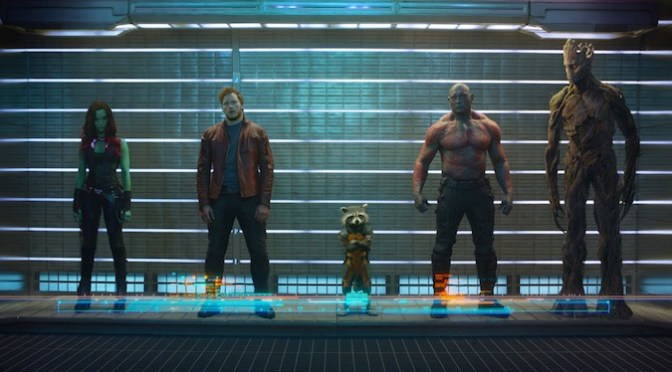
Chris Pratt dominated 2014. From reprising his role as the lovable Andy Dwyer on the hit comedy Parks and Recreation to his starring roles in blockbuster smashes The LEGO Movie and Guardians of the Galaxy, which will garner the attention of this review, he seemed to be everywhere you looked. While I assert that Pratt was at his best in Guardians, his attempts at seriousness in various parts of the film felt a bit like he was trying too hard. But, his first scene in the film was absolutely brilliant, as he gets a little funky and sings into a space rat as though it were a microphone. This scene sets the stage for the tone of the remainder of the film: a collection of comical ridiculousness that you simply can’t take your eyes off of.

Guardians is a borderline Star Wars spoof, while at the same time paying all due respect to it. The genius of the film is found in the clever dialogue that evidences this point. One scene that comes to mind in particular is the one in which all the guardians decide to fight together against Ronan, all standing up to somehow state their dedication to the cause. Bradley Cooper’s hilarious Rocket comments, “Great. Now we’re all standing. A bunch of jackasses standing in a circle.” While the mocking of the cliché trope that is standing up to display emphasis is something I found to be tremendously clever, I also recognized the themes, such as devoting oneself to a just cause regardless of the dangers attached to doing so, that are so similar to those of the original Star Wars trilogy. Thus, Guardians is a sort of revitalized Star Wars reboot that stresses humor over drama but nevertheless paints a potent emotional portrait when it needs to, despite Pratt’s overacting at times. In addition, the film resolves itself in an incredibly familiar way. A band of outlaws come together to save the galaxy and are rewarded with impunity and heralded as heroes by the galactic authorities. Sounds a lot like A New Hope to me. To take it one step further, I honestly wouldn’t have been disappointed had this film instead been titled Star Wars: Episode VII – The Force Awakens.

Continue reading Guardians of the Galaxy (2014)

Agent Carter 1.1 – “Now is Not the End”

Marvel’s Captain America spinoff Agent Carter premiered tonight in two parts, bringing Hayley Atwell’s ’40s can-do spy Peggy Carter to the small screen. If your barometer for the show is the other Marvel Cinematic Universe cable tie-in Agents of S.H.I.E.L.D., then you’ll probably be pleasantly surprised by the quality of Agent Carter and the willingness of the show to shed those ties to the larger MCU. If your barometer is a true 1940s spy serial, you might be just a tad disappointed.

Peggy first appeared in Captain America: The First Avenger (set during WWII, when Peg has a passionate fling with Steve Rogers) and popped up again in The Winter Soldier (set in the present day, so Peggy’s old as hell). Agent Carter takes place immediately following the war, and scenes from First Avenger kickstart the pilot episode and continue to frame Peggy’s loss after Cap plunged into the ice at the end of that film. Squeezing Chris Evans into your show without actually paying to cast him, or creating a new contract or convincing him to film new scenes? Nice, Marvel.

Continue reading Agent Carter 1.1 – “Now is Not the End”

The Quick and the Dead (1995)

A quick glance at Sam Raimi’s filmography shows a greater preoccupation with iconography than with originality. He’s retread the old “cabin in the woods” and “superhero origin” tropes three times over (four if you count Darkman), yet, Robert Frost be damned, it has made all the difference. Through Evil Dead and Spider-Man, Raimi has evaded the title of “hack” to become both an auteur and blockbuster filmmaker, which is no easy feat when you’ve made Spider-Man 3. He manages to inject adrenaline and humor into genres that would die of exhaustion under any other director’s hand. As for The Quick and the Dead, the Western genre has only benefited from the Raimi treatment.

The Quick and the Dead reminds us of familiar Western figures straight away: the blind shoeshine, the bumbling barkeep, the merciless sheriff, the one-eyed ex-convict, and a flamboyant assortment of gunslingers. Of course it wouldn’t be a Western without the nameless hero, and fortunately we have Sharon Stone to give us an emotional anchor as The Lady amid a grotesque cast of caricatures. She arrives in town to exact revenge on the sheriff for the murder of her father, but gets roped into a quick draw dueling competition before she can do the deed. Continue reading The Quick and the Dead (1995)

The Affair 1.4

There were a couple new story elements and plot revelations in the fourth hour of The Affair, but like the third episode this one didn’t have nearly the same degree of crackle-and-pop as the opening segments. Let’s hope that’s not a new trend, and let’s dive right into episode four.

I’m somewhat surprised it’s taken me this long to mention any parallels to True Detective, as the structure alone is pretty much identical to that of The Affair – future-set interrogations framing a series of flashbacks that may or may not be true, an overbearing sense that the past and the present are linked by something we viewers just can’t grasp yet, etc. Now, though, the comparison is both unavoidable and deeper than the structure. The fifth episode of that first season (“The Secret Fate of All Life”) is the first time that the verbal recounting of the old case by Matthew McConaughey’s Rust Cohle is in direct conflict with what we’re actually seeing. Likewise, the memories of Noah and Alison are now starting to seem more and more dubious (or are they? Dun dun dun).

Continue reading The Affair 1.4

Django Unchained (2013)

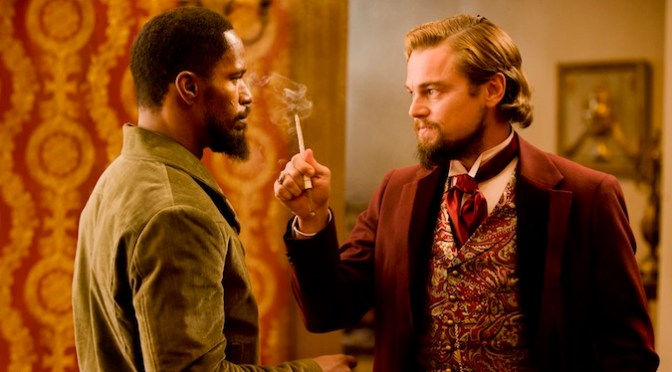
Nothing says “happy holidays” like an incredibly violent, utterly vulgar, yet strangely comedic look at slavery and racism in the Antebellum South. Quentin Tarantino’s latest effort has garnered exceptional critical support, seeming to morph together styles and tones from three of his previous cinematic achievements: Reservoir Dogs, Kill Bill, and Inglourious Basterds. The scope of the film is quite epic, occurring over months in various Southern states, yet it in no way takes itself too seriously. Instead, Django is extremely humorous and several of its minute details, when given closer examination, actually seem rather bizarre, almost finding itself belonging to the Wes Anderson genre of film. While dealing with a very serious topic and maintaining an ethically appropriate opinion of said topic, Djano truly reels in its audience with its Oscar-winning dialogue and impeccable acting. The film may seem controversial to some, but anyone really paying attention will easily be able to understand the stance the film is taking.

The film has a subtle but significant Reservoir vibe to it. The plot is intricate and well thought-out; dramatic irony (when one or more characters are aware of something that others are not privy to) is abundant; and there is even a particular scene in Django that is a directorial parallel to a different scene in Dogs. Let’s discuss the similarity in complexity of the plot. These movies are no rivals to Inception when it comes to complex storytelling, nor are they trying to be, but they do certainly contain these types of elements. Dogs places a police officer undercover in the mafia, thus tricking the mafiosos into believing that he is one of them. Django places an African American in the fourth largest slave plantation in Mississippi, posing as an expert in the well-regarded field of Mandingo fighting; in front of Leonardo DiCaprio, no less. This similarity simultaneously explains both the intricacy of the plot and the abundance of dramatic irony. And then there are the scenes using the slow-motion walk. If you do not recall what I am talking about, you now have an excuse to go rewatch these fantastic films.

Continue reading Django Unchained (2013)

My Left Foot (1989)

Calling Daniel Day-Lewis the greatest cinematic actor of all time certainly isn’t a stretch, and his performance in Jim Sheridan’s My Left Foot is the reason why. Day-Lewis plays Christy Brown, an Irishman born with cerebral palsy. The only control Brown has over his body is his left foot. However, he uses this one appendage to achieve fame as both an artist and a writer. Throughout the film and in real life, Brown works through the adversity of his condition as well as the poverty of his large family. The movie is set mostly as a flashback; Christy’s life unfolds as his nurse, Mary Carr (Ruth McCabe), reads his autobiography while at a charity event with him.

The decision to set the movie as a flashback was a solid one as it shows the progress Christy makes in so many regards to arrive to the fame that lands him at the charity event. Also, the film does not focus much on the actual writing of the autobiography. Rather, the focus is more on his art. Thus, seeing his life through his own writing highlights his talent as a writer while also providing an appropriate backdrop for his story.

Continue reading My Left Foot (1989)

The Great Waldo Pepper (1975)

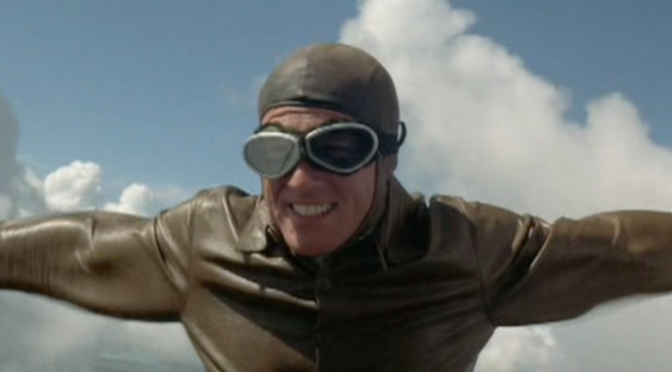
If Robert Redford is the best model of the American Dream in all its smiling, handsome glory (and I think he is), then he must also be its most effective destroyer. Through characters like the Sundance Kid (Butch Cassidy and the Sundance Kid) and Jay Gatsby (The Great Gatsby) who turn themselves into legends, and Bob Woodward (All the President’s Men) who turns politicians into criminals, Redford has made his career a mission to demystify the neatly packaged illusion of American exceptionalism. Yet I don’t think either of those crushes The Dream as brutally as The Great Waldo Pepper does, leaving it burning in the wreckage of a monoplane. And that’s saying something for a movie as lighthearted as this one.

It’s 1926 in down-home Nebraska, and all that’s left of World War I are the daredevil pilots who duke it out in barnstorming competitions right over our heads. Simple Midwesterners search the skies at the sound of a biplane engine while J.P. Sousa-style marches signal the arrival of our hero, Waldo Pepper. There’s only one problem–Pepper is a liar and a cheat. He never fought against the notorious Ernst Kessler in the war (he didn’t fight at all on account of his being a flight instructor), but he’ll say he did if it gets him an easy buck (on account of his being poor and desperate). But despite being a great storyteller and showman, Pepper is actually the real deal. He’s “Great,” not because he’s got money like Gatsby, but because his flying skills are (nearly) unmatched (that pesky Kessler is still alive after all). In this day and age, though, where almost every man and his grand-pappy seems to have a plane, Pepper’s gotta find a way to stand out. Continue reading The Great Waldo Pepper (1975)

The Interview (2014)

By now it’s clear that the magnitude of the turmoil surrounding The Interview is vastly disproportionate to the actual strength of the film itself. It’s frustrating, certainly, that this is the movie at the center of everything. Still, the American film industry is a weird beast. In nearly every form — be it Jaws or Sharknado — it’s been a cultural behemoth that reaches pretty much every corner of the globe. Here’s Commentary‘s Abe Greenwald on the current state of all of that in the wake of the movie getting yanked from theaters:

Hollywood movies are a monolithic U.S. export that have served to plant American notions of freedom and unbridled possibility in the minds of untold millions. From now on, filmmakers will think twice before crossing the next paranoid despot. That’s tragic.

That’s no doubt an important point, and probably the point of greatest significance that will ever be associated with a movie starring Seth Rogen. Is that a completely credible fear, though? Amidst the larger concerns of global politics, should we be worried about the “tragic” future of our movies? This piece will wrap up briefly with more thoughts on this. For now, though, let’s shelve the real-life cyberwar fallout discussion and just talk about The Interview.

Continue reading The Interview (2014)

Never judge a book by its movie