Indiana Jones and the Kingdom of the Crystal Skull (2008)

Indiana Jones and the Kingdom of the Crystal Skull has no shortage of detractors. Whenever a beloved film or film series receives a new treatment or installment, most people – myself included – are bound to vocalize their qualms. We said why can’t they leave well enough alone? We said why does everything have to be CGI? With the fourth Indy flick, we said a whole bunch of stuff that shouldn’t be reprinted. So yeah: Crystal Skull is the weakest Indiana Jones for a few reasons. But let’s find something nice to say about it for a change, shall we?

Harrison Ford returns to one of his most famous characters after a quarter-century hiatus (he appeared in one or two movies in the meantime) and most of the old crew returns with him: Steven Spielberg directs from a story by George Lucas, composer John Williams scores the film, and Karen Allen revives the role of Marion Ravenwood. Cate Blanchett plays (ahem, overplays) the primary antagonist Dr. Irina Spalko, and the best things about her are her hair and her name. Among the other new additions to the Indy legend is the consistent use of CGI, which was used sparingly in the first three adventure films in favor of practical effects. It feels at times as if somebody wanted to cram as many CG shots into this thing as possible, and many of those instances are very unfortunately unconvincing. Also: aliens.

Continue reading Indiana Jones and the Kingdom of the Crystal Skull (2008)
American Beauty (1999)

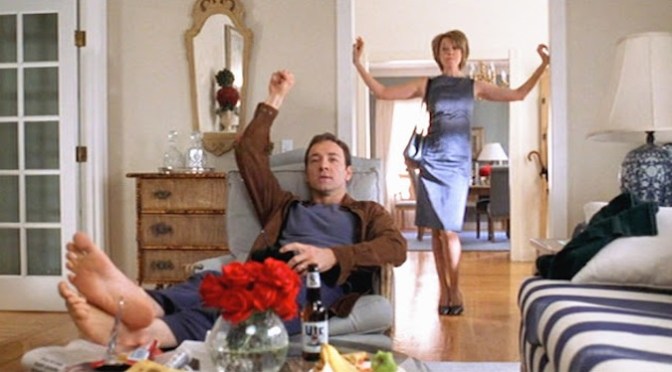
Let’s get one thing out of the way right off the bat: Sam Mendes’ directorial debut, American Beauty, is one of the most psychologically engrossing and, admittedly, strange films of all-time. Let’s get another thing out of the way too: Sam Mendes’ directorial debut, American Beauty, is one of history’s greatest films, and is one of the best directorial debuts in recent memory.

Sure, it doesn’t take a movie genius to call American Beauty a great movie. In 1999, the critically acclaimed film collected five Academy Awards: Best Picture, Best Leading Actor, Best Director, Best Writing, and Best Cinematography. On the surface, though, the film’s success seems far-fetched. The plot consists of a creepy middle-aged man fantasizing about his teenage daughter’s best friend, while he struggles with his rather extreme mid-life crisis. That doesn’t exactly sound like the winning formula for a movie. But the beauty of the film lies in its tagline—“look closer”—as both the audience and the characters are encouraged to do as the film progresses.

Continue reading American Beauty (1999)

The Spanish Prisoner (1997)

Most everybody loves a good con movie. While the thrill of the illegality of it all – the curiosities, the impossibilities, the big reveal – is ostensibly what makes heist flicks appealing, the fact that everything about the crime subgenre seems so damn stylish is probably more of a reason to keep making films about con artists (and more of a reason to keep watching them). The Sting remains the ultimate con movie, super stylish from start to finish, and everything that followed owes a great deal to that film. But even recent takes like Inception and American Hustle breathe new life into the idea by inhabiting a distinct aesthetic niche.

This is taking the long way around the barn to say that David Mamet’s The Spanish Prisoner, through it is very much a part of the aforementioned genre, is a surprisingly and suspiciously unstylish little film. It’s extremely well-written, as is almost everything Mamet touches, but it’s noticeably devoid of any of the visual trickery or larger-than-life characters that we might expect. This isn’t necessarily a bad thing, but it does mean that The Spanish Prisoner promises a lot in the first act and doesn’t quite deliver on that promise when all is said and done.

Continue reading The Spanish Prisoner (1997)

Badlands (1973)

Terrence Malick’s debut feature film, Badlands, barrages its audience with the near-perfect execution of every aspect of film that one desires. From Malick’s masterful storytelling and characterization to the film’s deep insights on human nature and modern society alike, Badlands is full-on “GO!” for the entire ride. This film is absolutely filled with unexpected escalations and massive character arcs; thus, in respect to the film, this review  must contain spoilers. If you are in the most unfortunate circumstance of not yet having seen this film, I implore you to please discontinue your reading of this review now.

In one of the best performances of his career, Martin Sheen, and the less well known, but greatly talented, Sissy Spacek star in the ninety-four minute thrill ride that is Badlands. Loosely based on the real-life killing spree of Charles Starkweather and Caril Ann Fugate, the film follows Kit (Sheen) and Holly (Spacek), who represent the real couple, respectively. Now if that doesn’t set the scene for sudden escalation, in-depth character development and just the slightest pinch of horror – a.k.a. the makings of an awesome f@#cking movie – then I’m not sure what will. However, their journey starts in the relative calmness of rural Texas. Here, Holly is still a young, innocent girl. A young, innocent girl with a desperately ill mother, suffering from pneumonia in a time and place where modern medicine is not far reaching. Texas becomes the burial ground of Holly’s mother. Texas is where her father is too often reminded of the loss of the love of his life. So, the pair leave Texas, venturing to South Dakota, hoping for a fresh start.

Continue reading Badlands (1973)

Legends of the Fall (1994)

A defense of Legends of the Fall? Really? Is this really what the world needs? Shouldn’t this space be used for something more worthwhile, like an examination of Renée Zellweger’s face? Is a treatise on Battlefield Earth up next? Lest there be any doubt: Legends of the Fall is a deeply, deeply flawed movie full of stiff writing, stiff acting, and a healthy dose of that cringeworthy unexplainable badness reserved for a particular class of film (though, no, not as bad as Battlefield Earth). It’s unbearably soapy, it’s long, and we’re expected to take ridiculously sappy scenes like this with utter seriousness:

Ah, man hugs. Can we ignore stuff like this? Should we? Maybe not. But still, somehow, inexplicably, in spite of stiff writing, stiff acting, unbearable soapiness, absurd sequences like the one above – in spite of all that, Legends of the Fall is one of the most epic standalone sagas ever filmed.

Continue reading Legends of the Fall (1994)

Dead Poets Society (1989)

This article first appeared as a part of the Brattle Theatre Film Notes commentary series, presented by the Brattle Theatre in Boston, MA, for a double feature of Dead Poets Society and Good Will Hunting. Slight edits have been made from the original posting.

Robin Williams was an actor who selected his film roles very carefully. Despite his ironclad station as the greatest American comedian of his time, Williams acted in drama nearly as much as he did in comedy. One need only look to the shy Dr. Sayer of Awakenings or to the chilling villains of One Hour Photo or Insomnia to see the acting mastery Williams commanded.

On the surface, John Keating of Dead Poets Society and Sean McGuire of Good Will Hunting are two more of these “serious” roles that broke the mold for Williams the comic. There is no doubt that both helped to establish him as a master thespian regardless of genre. He was nominated for Academy Awards for both roles and won Best Supporting Actor for the latter, beating out the likes of Anthony Hopkins and Robert Forster.

Continue reading Dead Poets Society (1989)

Transformers: Age of Extinction (2014)

Transformers: Age of Extinction is simply awful. There is no use in saying it any other way. There’s hardly any use in reviewing the thing at all, really. By some sick twist of fate a recent transpacific flight held only a handful of movies in store, all of which I had seen with the exception of Age of Extinction. I read the safety instruction card first, and you know what? I’d rather review the f*cking safety instruction card.

As far as safety instruction cards go, I found this one (for a Boeing 777) to be colorful and well-mapped out. The characters fasten their seatbelts, make sure their seats recline and their tray tables go up and down, switch off their iPods. They take note as to whether they are seated in an exit row. Disaster strikes. They enter a variety of brace positions and assist small children with their oxygen masks before adjusting their own. What is this disaster? The safety instruction card leaves this ambiguous. This is the world we live in: anything could strike at any moment. We must be prepared.

Continue reading Transformers: Age of Extinction (2014)

The Assassination of Jesse James by the Coward Robert Ford (2007)

Casey Affleck presented a screening of The Assassination of Jesse James by the Coward Robert Ford at the Brattle Theatre in Boston last night, on hand for a Q&A following the film. Though Assassination is still sadly much more of an “obscure” offering – at least in terms of films starring Brad Pitt – it nonetheless remains a fascinating character study of both a young man and his mythical idol.

Robert Ford joins the James Gang alongside his brother Charlie at a time when Jesse James has already achieved infamy through his brazen robberies and brutal murders. Bob is only nineteen years old at this point (although he “feels older”), and his fascination with the gang is a mixture of childish wonder, starstruck glee, and perhaps a hint of inflated self-importance. He believes he’s destined for “great things”, by which he really means he believes himself to be a worthy follower of Jesse or even one who could take his place. As his place in the gang is solidified over the course of the film and his presence at Jesse’s side becomes more and more common, Bob’s perception of his onetime hero begins to deteriorate.

Continue reading The Assassination of Jesse James by the Coward Robert Ford (2007)

Olive Kitteridge 1.1 – “Pharmacy”

We’re getting to the point where anything produced by HBO is pretty much guaranteed to be a worthwhile watch. A history of cutting funding for the likes of Deadwood, Rome and even The Wire at one point shows the premium service isn’t afraid to ditch something they’re not 100% confident in, no matter how good the early episodes are. Olive Kitteridge, of course, isn’t really a show – the four-hour miniseries spanned two nights earlier this week and will probably play on a loop for the next week, but after that no más. Still, the HBO association is evident in a high production value and a deep care taken with the characters and material that few other channels can afford to provide.

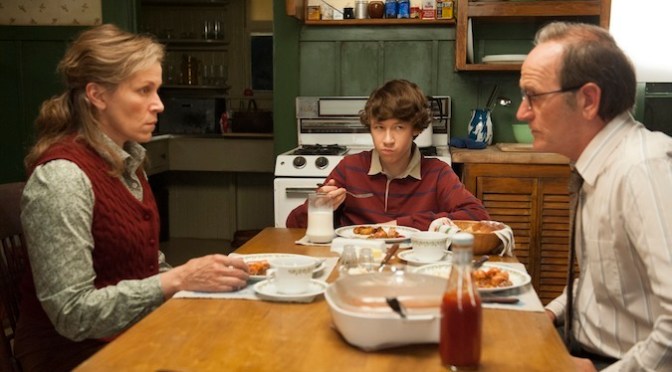
Frances McDormand plays the titular Olive, aging middle-school teacher in smalltown Maine, mother of a bratty son and wife of an irrepressibly optimistic husband (played by the always-brilliant Richard Jenkins). We meet Olive as she walks through the forest, gray ratty hair stemming out from her pale skull, and she calmly lays out a picnic blanket and removes a loaded gun from her coat. We suddenly backtrack to twenty-five years earlier, but the tone is set in that initial sequence: Ollie is unhappy, gazing longingly at the gnarled branches reaching toward the hazy sky, and maybe we’re about to see why.

Continue reading Olive Kitteridge 1.1 – “Pharmacy”

Interstellar (2014)

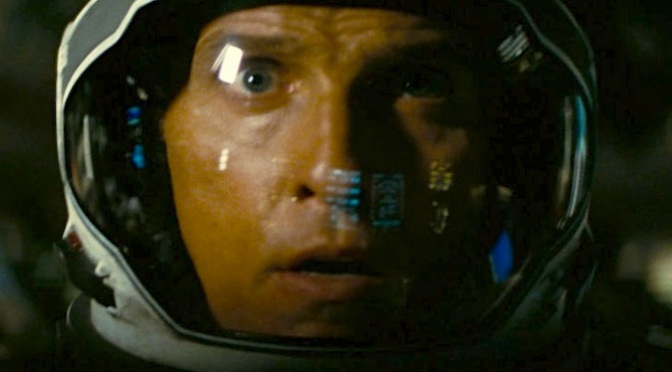
With brand-new releases the tendency is usually to shy away from spoilers in reviews, and those potential spoilers can be especially sensitive with a long-anticipated film like Interstellar (“I waited two years for this and find out the night before that [censored] is really [censored] the whole time??”). I respect reviewers who are able to provide an accurate representation of a film without divulging any/many of its secrets, but I’ve never been one of them. I can tread lightly, sure, but to really talk about a movie like Interstellar there are important plot points that need to be laid out in the open. Just the fact that we have a three-hour movie with a two-minute trailer means that the film holds vast sequences, settings, and even actors that you couldn’t possibly expect, and it’s partly those revelatory realms that we’ll be dealing with here. Consider yourself warned.

Now: let’s talk about ghosts.

Continue reading Interstellar (2014)

Never judge a book by its movie