

 You’d certainly be forgiven for thinking Alita: Battle Angel to be a new movie by James Cameron. It gives off his scent in more ways than one, but primarily in the union of completely gangbusters special effects and a completely lackluster script. Cameron’s credited as a producer, though, not that the title of “producer” can actually ever have one single definition. Based on the manga series Battle Angel Alita, the film adaptation is in actuality directed by Mexico Trilogy and Sin City helmer Robert Rodriguez, the guy who once claimed his approach as “Mariachi-style” — in which “creativity, not money, is used to solve problems.” There’s an immediate discordance between that approach and the mere notion of James “Titanic” Cameron, and Alita very clearly exhibits the latter’s big-budget sensibility at the expense of an underdog’s incumbent creativity.
Which is a shame, because that’s ostensibly what Alita is about. The title character (played by Rosa Salazar) is a spunky cyborg with a mysterious past, brought back to life by kindhearted scientist Ido (Christoph Waltz) in a war-torn world all but discarded by the elite who reside on a giant floating city in the sky. “Lower” and “upper” class are literalized, and promise of ascension to that higher world is enough leverage to get anyone to do anything. The setup is nearly verbatim to that of Elysium, with an impending reckoning between the rough-and-tumble Earth-dwellers and those nasty domineers above. But the reckoning never happens, despite a colossal amount of exposition pointing in that direction, and apart from a useless cameo (more on that in a second) we never even glimpse one of those nasty domineers.






 The superhero genre is not, in fact, a genre. Adapting comics to film has become a billion-dollar industry in the past decade, and the movies comprising that industry have certainly been typified by a familiar formula. Marvel movies are with few exceptions fun but mostly mindless. DC movies are with few exceptions Marvel movies with all the fun wrung out. Those exceptions usually end up being the best of the bunch, but the point is that the “superhero genre” — while technically an applicable term for things grouped by subject matter — is more a “superhero formula” applied across genres. There’s action-thriller, action-comedy, action-adventure, sci-fi action…heck, when’s someone gonna make a superhero rom-com or a superhero road trip flick? Or a super-workplace melodrama devoid of any action whatsoever?
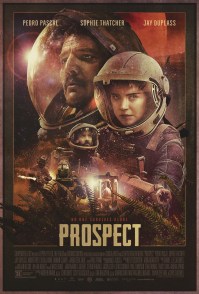 Detail is king in Prospect, the debut feature from writing/directing duo Christopher Caldwell and Zeek Earl. There’s little to latch onto in the opening minutes that could be called “familiar” outside the general setup: two human characters, father and daughter, in a ship floating through space. But the young girl is writing in an alien language, her father is administering a strange drug, and the process they both engage with to launch their pod down to the surface of a nearby planet is about as complicated as the entire mission in First Man. There’s a device that the father holds in place and continuously winds like it’s a jack-in-the-box, though its purpose is never actually articulated.
 Art ages. The second a book hits the shelf, a movie hits the cinema, a painting hits the exhibit or a song hits the radio, that art is in some ways locked into that time period forever. Maybe as time passes that art ages poorly and is sentenced to oblivion — like, say,
  Motion State Review