
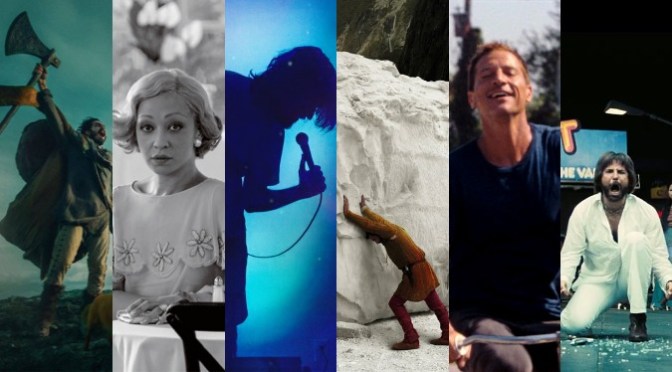
Another weird year for cinema means another caveat-laced Best Of list, something just south of comprehensive, perhaps, largely due to a significant scaling-back of my usual moviegoing frenzy. I like to think I saw all the big blockbuster stuff in the cinema — as opposed to on the couch — like Dune, Last Night in Soho, No Time to Die, a few Marvel flicks, etc. And a few of the “smaller” films that actually made my Top Ten were also experienced out in the wild, which I’m thankful for, not that this ultimately had much bearing on how good or bad the film actually was.
Fact remains that I saw fewer movies this year than I usually do, so this Best Of list does not reflect Ryusuke Hamaguchi’s Drive My Car, Joachim Trier’s The Worst Person in the World, Apichatpong Weerasethakul’s Memoria, Celine Sciamma’s Petite Maman, Mike Mills’s C’mon C’mon, Steven Spielberg’s West Side Story, Guillermo del Toro’s Nightmare Alley, Joel Coen’s Tragedy of Macbeth, Sian Heder’s CODA, Julia Ducournau’s Titane, and a bunch of other films that would likely upset the following rundown. Still, from what I did see, here are the ones that moved me the most.
And as always, please remember to visit our Support Film Art page, aimed at encouraging relief to local arthouse theaters.

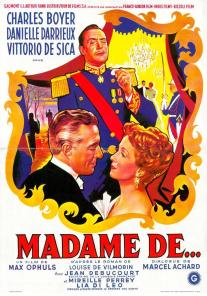 The Earrings of Madame de… is the English-language title for Madame de…, as it was released in France, which heralds the heart-shaped diamond jewelry — not its owner — as the star of the film. The earrings do indeed play a major role, significantly altering the lives of those who possess them, seemingly propelled by their own willpower from one owner to another and back again. With a pinch more malice this would be The Lord of the (Ear)rings, a fantasy tale about tempting jewelry that instills a deadly pride in those who dare purport to wield such power. But the passionately humanist Max Ophüls ensures that this is always really the story of Madame de…, not simply of her diamonds, and the themes of pride and ownership don’t necessarily involve the earrings at all.
 Rather than a standard film review, we’ve been compiling a visual glossary of likely inspirations in Paul Thomas Anderson’s 2012 film The Master. Huge props go to


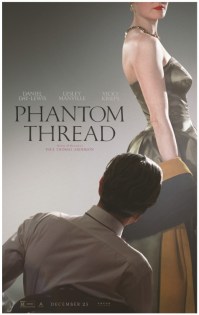 Early on in Phantom Thread I started thinking about the miniaturized nature of certain segments in the cinema of Paul Thomas Anderson. At the top of this latest film we see Reynolds Woodcock’s morning routine, clearly practiced to the point of automation, nearly mechanical, though the whole scene lasts less than thirty seconds. He shaves, he slicks his hair, he pulls on his big winecolored socks, his pants. And that’s it. The dressmaker is dressed. One might expect a little more extravagance from a film that’s ostensibly about high-end style and tailored beauty, no?




 Motion State Review