
All posts by hangmantitan

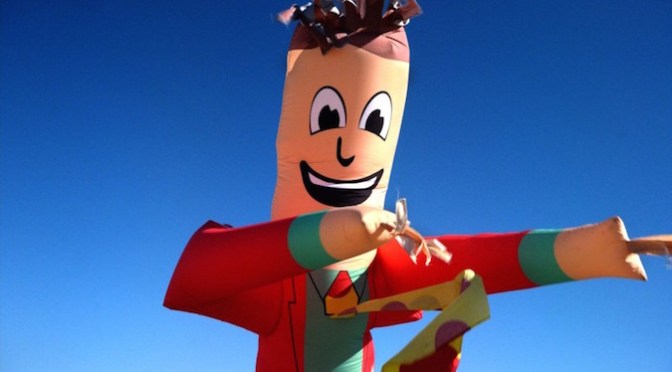
Better Call Saul 2.7 – “Inflatable”

I knew while reviewing “Bali Ha’i“, last week’s episode of Better Call Saul, that I’d be eating my words not long after the following episode hit the airwaves. “Bali Ha’i” wasn’t at all a bad episode; on the contrary, it was full of tension and character development and that special Saul mix of humor and meaningful symbolism. But for the first time the Jimmy McGill storyline felt like second fiddle to the Mike Ehrmantraut storyline, mostly because the latter was about a highly personal slow-boil turf war and the former was about a file audit at a law office. Doesn’t take much to discern which one of those will be more gripping.

“Inflatable” did much more than put the focus back on Jimmy. After a cool flashback cold open showing some of the elements of the youthful genesis of Slippin’ Jimmy, “Inflatable” finally seemed to push Jimmy over the invisible threshold at the heart of the series itself. The conceit was always this: we watch Jimmy become Saul. In the same way that Walter White’s Mr. Chips becomes Scarface, Jimmy’s sensibilities are leading him toward a particular version of himself. One could argue that “Inflatable” is the episode where Jimmy finally becomes Saul.

Continue reading Better Call Saul 2.7 – “Inflatable”

Better Call Saul 2.6 – “Bali Ha’i”

For a minute there I forgot that Better Call Saul‘s main character was not in fact Mike Ehrmantraut, nor any of the other characters dominating the landscape of “Bali Ha’i”. Jimmy McGill is here, yes, and he’s probably got more time on screen than in the phenomenal preceding episode “Rebecca“. He has a nifty little cold open highlighting the fact that he’s the kind of guy who’s more comfortable in his shitty little office than he is in his cushy new digs. He pulls another barroom short con with Kim, as in “Switch“, and the two have a meaningful make-up session after weeks on the rocks. The end of the episode belongs to Jimmy, too, as he attacks his stupid little cupholder with a tire iron in order to finally make room for his travel mug.

But for what might be the first time since the beginning of the series, the A Storyline felt like the B Storyline and vice versa. Shifting from Mike to Jimmy, frankly, felt like downshifting. Partially this is because of where we are in the second season of Saul, coming off a solid mid-season episode and entering that spate of hours tasked with setting up the final few. Last season we had “Five-O” in this slot, which in fact had a grand total of one scene with the esteemed soon-to-be Mr. Goodman. The rest of that episode was about Mike.

Continue reading Better Call Saul 2.6 – “Bali Ha’i”

The World According to Garp (1982)

The name “George Roy Hill” might not be a household name here in 2016, but if the man himself doesn’t ring a bell you probably still know his films. Butch Cassidy and the Sundance Kid and The Sting are his best, riding high on the indomitable pairing of Robert Redford and Paul Newman. That pair would be separated for Hill’s ensuing films The Great Waldo Pepper and Slap Shot, both of which are well-crafted if not ultimately as powerful as those other two. The one that might throw you for a loop is The World According to Garp, a film from late in Hill’s career starring Robin Williams in his first dramatic role.

…that phrase doesn’t mean what it did back then, though, because “Williams in a dramatic role” isn’t as much of a novelty nor is it even something that seems worthy of being highlighted today. Dead Poets, One Hour Photo, Good Will Hunting, Awakenings and Fisher King let Williams be Williams — not merely Comedic Williams or Dramatic Williams — and despite the films themselves being best suited to the “Drama” category at your local rental store you probably don’t think twice about the star being a guy who most consider to be one of the funniest ever to walk the planet.

Continue reading The World According to Garp (1982)

Better Call Saul 2.5 – “Rebecca”

Better Call Saul talks to itself. In this YouTube video about the various callbacks to Breaking Bad throughout the companion series Saul, showrunner Peter Gould refers to the “encyclopedia” of the world — the people, places, items, songs, sayings and histories of Bad and Saul — and there’s no doubt it’s an interesting way to craft a serial. We talked about the “slavish devotion to itself” present in both series in our review of this season’s opener “Switch“, but that phrase somehow makes it seem like a negative thing. So: Better Call Saul talks to itself. It talks to Bad, bringing back characters and diners and trinkets galore, but midway through the second season it’s able to turn heel and talk to itself as well. In “Rebecca” Jimmy returns to the courthouse where he spent his public defender days — seen largely in “Uno” and “Mijo” — and his return highlights both the ways in which he’s changed and the ways in which he hasn’t.

But Saul talks to us, too, and that can be a mark of a great show. Without being condescending or hand-holdy in the least, Saul pivots outward every now and then and asserts something that’s not exactly a callback or an easter egg per se; more of a cue, visual or otherwise, that acknowledges something that only the viewers would be able to appreciate. The people in the show may realize that there’s a connective thread running from the Salamancas to Mike Ehrmantraut to Saul Goodman and beyond, but there are other things that only the people outside the show would appreciate.

Continue reading Better Call Saul 2.5 – “Rebecca”

Gods of Egypt (2016)

For a long time now the internet has been a halcyon refuge for those steadfast in the belief that opinions can be equated with facts. Prior to the actual release of Gods of Egypt the film was subjected to the fervor whipped up by the fact that the cast was almost entirely white, and before you could say CGI sphinx most had written off GoE as a waste of time. In what may have been a heartfelt apology or one driven entirely by a marketing scramble to save face, director Alex Proyas publicly stated that they dropped the ball on the whole diversity thing. #EgyptSoWhite persevered as if Proyas had stayed silent because, hey, it’s the internet. No well-meaning statement is going to stopper a good ol’ fashioned media frenzy.

After GoE came out, though, the film was subjected to another kind of criticism, this time whipped up by the notion that the movie was actually really bad. Ah, the internet. Proyas responded, as Proyas seems wont to do. Here is his post from his Facebook in near-entirety, edited only slightly for length:

Continue reading Gods of Egypt (2016)

Jumpin’ Jack Flash (1986)

If you want to make an omelette, the saying goes, first you have to make a remarkably unexceptional non-starter featuring Whoopi Goldberg as a tech whiz embroiled in an espionage scandal. Apparently people actually like Jumpin’ Jack Flash, judging by the surprising number of nostalgia-fueled pieces about Whoopi’s young comedy days, but apart from an amusement with her indomitable ‘tude I can’t imagine why. You can just watch The View if you’re into Whoopi’s ‘tude, right? Unless you prefer a different kind of supporting cast, essentially one made up not of has-beens but of not-yets.

One such not-yet was behind the camera in the form of Penny Marshall, one day destined to direct the likes of Big, AwakeningsA League of Their Own and more alongside her numerous TV credits. Jack Flash is the transition piece from the Laverne & Shirley days (she was Laverne) and also serves as her first real foray into feature filmmaking. As is the case with many such transitions, Jack Flash is really only noteworthy in a retrospective review of a one-day-great director. Another Happy Days-related alum leaps to mind in the form of Ron Howard, who would find great success behind the camera but not before making his first movie Grand Theft Auto.

Continue reading Jumpin’ Jack Flash (1986)

Better Call Saul 2.4 – “Gloves Off”

IGN said it best: Better Call Saul has high stakes, and yet somehow they’re mostly personal stakes. Yes, Mike’s storyline finds him embroiled in a dangerous and deceptive feud between Nacho and Tuco, wherein the stakes are most certainly life-and-death. Obviously Mike’s personal experiences and outlook play into his actions (more on that later), but when juxtaposed against Jimmy’s it’s clear that Mike deals with a lot of external factors in the form of predictable people. Tuco will kill Nacho someday, so Nacho takes the initiative to kill him first. Tuco will take the bait Mike lays out for him, and the police will arrive at around the time Mike intends them to arrive. Mike says to Nacho “Your Tuco Salamanca problem goes away,” with such certainty that before the plan is put into effect we’re already pleased with the result.

Jimmy’s side of the series is a little different, not because the people he’s surrounded by are any less predictable but because each of them is most concerned with their own personal reputation. If Mike fails there’s a distinct possibility it will end his life; if Jimmy fails it will end his career. Actually, “failing” to Jimmy now seems synonymous with “following all of the rules”, which would in fact result in him keeping his job, which everyone but Jimmy would likely deem “succeeding”. Saul asks us to see his side of things while positing that he’s the one who’s backwards, and never was that more clear than in “Gloves Off”.

Continue reading Better Call Saul 2.4 – “Gloves Off”

From Hell (2001)

Executing a Writer Series on Alan Moore would seem especially self-defeating. The idea is possibly even offensive to the man himself, he having gone to great lengths to distance himself from the film adaptations of his comics. He’s had his name stricken from credits and movie posters, declined any input or involvement throughout production and beyond, and even claims to have never seen any of the film versions of his stories. Furthermore, the dude literally writes comics in such a way that they are inherently resistant to any other medium. He doesn’t do this just to be a jerk, but rather to show what comics can do that other mediums cannot.

And From Hell is the perfect example of that, both in its original comic form and in comparison to the 2001 Hughes Brothers film. Most know Moore for his most popular works Watchmen and V for Vendetta, for his brilliant Batman/Joker book The Killing Joke, for creating original characters like John Constantine and breathing new life into previously-thought-useless ones like Swamp Thing. If you’ve read From Hell, though, you know what Moore is truly capable of as a writer.

Continue reading From Hell (2001)

Secret in Their Eyes (2015)

Among the many films that slipped through the cracks last year was Secret in Their Eyes, a remake of the 2009 Argentinian Oscar-winner of the same name. Actually, the original is El secreto de sus ojos, which a sane person might translate as THE Secret in Their Eyes, but even inclusion of the the makes for a clunky title. See, it’s not that each eye has a secret or anything — that would be Secrets, plural, in Their Eyes. Obviously the title tells us that there is a single secret, okay, and it’s in multiple eyes. Or maybe just one eye per person. The major reason this film failed at the box office and slid under the radar of pretty much everyone is that the title fails to delineate exactly which eyes we’re dealing with here.

Maybe it’s a part of the long game, though, this being the start of a new shared-universe franchise or something. Next up is Secret in Their Left Eyes, follow by Right, followed of course by Left v. Right: Dawn of Secret. Each of those would be hard-pressed to be a bigger waste of time than this film, and the possibilities really are endless if your only criteria for titling a major motion picture starring three Hollywood A-listers is “must contain words”. As Louis C.K. said about parents being giving free reign to name their babies whatever the hell they want: shouldn’t there be at least a couple of rules? What’s that you say? The Elements of Style came out in 1920?

Continue reading Secret in Their Eyes (2015)

Kiss of the Spider Woman (1985)

In the wake of the 88th Academy Awards we’ve arbitrarily decided to revisit the Year in Film of three decades ago, reviewing a selection of films that were either honored at the 58th Oscars, snubbed, or overlooked altogether. Out of Africa was the major winner that year, scooping up seven trophies, but of course the question everyone always asks after the Best Picture mic drops is whether or not the winner is deserving. Spotlight, more of a traditional cinematic experience than the likes of The Revenant, was a mild surprise to don this year’s crown. If we dispense with the niceties, we might say that Spotlight — though undoubtedly a strong film about a powerful true tale, well-crafted, well-acted, well-received — simply isn’t a cinematic experience on par with Revenant. And if we did the same 30 years ago we might find a similar scenario with Kiss of the Spider Woman.

Every once in a while a movie rears its head from the past and simply begins, production credits appearing and giving way to the title, the opening credits, the first scene, and off to the races. Nowadays it’s far more common to preface all of that with casting news, screener reviews, trailers, trailers for the next trailers, interviews with the stars wherein the plot of the movie is dissected before the film is even released, etc. Rarely do we get to experience a movie as is, shorn of all the machinery. For me, Kiss of the Spider Woman was one such rarity. I knew the title and knew that William Hurt won an Oscar for his role, and that’s it. Hitting play was in the grandest sense a leap into an unknown territory of infinite possibility, even if in the quotidian sense it was just something to do on a lazy late Wednesday evening.

Continue reading Kiss of the Spider Woman (1985)