All posts by hangmantitan

True Detective 2.6 – “Church in Ruins”

Like this season’s third episode “Maybe Tomorrow“, “Church in Ruins” did something important: it peeked out, briefly and with clear purpose, and tried to put forth something that we’d never seen from the series before. This is essentially the equivalent of inching the shower curtain open just enough to reach your arm through to grab your towel before the cold air comes rushing in — again: brief, purposeful, a foray into something different characterized with intent on avoiding that something different. I could continue to over-convolute this line of thinking, but, hey, if you’re entertainments of the more Byzantine variety, I give you True Detective.

“Maybe Tomorrow” was packed with humor, and it was the type of humor that ‘Tec had never engaged in until that point. “Church in Ruins” was a milestone of sorts, too, but far more difficult to pin down. Yes, there are way more going-ons in Season 2 as compared with Season 1 — cadres of tough-looking supporting characters in slim-fit suits, piles of dead bodies with/without eyes, hooker parties, gambling addictions, custody battles, missing blue diamonds, etc. etc. etc. You’d be forgiven for rewatching an episode or two out of confusion. But, really, the confusion one might have felt after “Church in Ruins” likely had nothing to do with what just happened and more to do with the weird way in which it all went down.
Continue reading True Detective 2.6 – “Church in Ruins”

True Detective 2.5 – “Other Lives”

“Other Lives” wasn’t so much a reboot as a remake, not so much starting fresh as simply starting from the beginning all over again. Following the massive, civilian-offing Heat-esque shootout at the end of last week’s episode “Down Will Come“, all four of this season’s protagonists find themselves down a few rungs on the Ladder of Success. Worth noting, though, that only Ray Velcoro has an arc that’s really worth investing in — and only Ray seems to realize what the Ladder of Success actually is. When Frank Semyon states that he thought being poor was behind him in “Down Will Come”, Ray shakes his head: “That shit never leaves you,” Ray says, “no matter how much money you make.” The sentiment is carried through when Frank, offering Ray a job, encourages him by saying that “a little rage can go a long way.” Ray, of course, even though he knows the answer, asks the question out loud: “A long way to where?”

And even though he knows the answer, he takes Frank up on his offer in the weeks following the harrowing gun battle. It’s now been three months since the murder of Ben Caspere. Ray has straight-up quit the Vinci P.D., Ani was removed from the special investigation and demoted to the evidence closet in the basement during the Internal Affairs probe into her sexual misconduct, and Paul has taken a job at an insurance company that he hates. Frank has moved out of his palatial brood-pad into a more modest Glendale brood-pad, still struggling to clamber back up to the “peak” he felt he’d achieved just before Caspere died with Frank’s money in his pocket. And all in all we’re back where we were during the premiere episode “The Western Book of the Dead“, seemingly no closer to catching Caspere’s killer.

Continue reading True Detective 2.5 – “Other Lives”

Focus (2015)

There was a time when I’d never met a movie about con artists that I didn’t like. You name it: the almighty Sting, the classic you-didn’t-even-know-this-was-a-con Usual Suspects, George C. Scott’s The Flim-Flam Man; modern takes like Matchstick Men, Catch Me If You Can, American Hustle; the super-rewatchable original Italian Job and the super-rewatchable remake Ocean’s Eleven. Some of these — like, say, The Spanish Prisoner — technically aren’t that great as far as cinema is concerned. Maybe that’s part of what’s so damn endearing about them: they’re movies, not films, which means they could conceivably appeal to just about anyone because style and fun outweigh technique and competence. I think I was just fine with that for a while, and I might still be.

But I also remember taking issue with Christopher Nolan (you: “who the hell are you to challenge Christopher Nolan?”; me: “I have as many Oscars as he does“) when he made the following comment about heist movies in an LA Times interview while filming Inception:

I originally wrote [Inception] as a heist movie, and heist movies traditionally are very deliberately superficial in emotional terms…they’re frivolous and glamorous, and there’s a sort of gloss and fun to it. I originally tried to write it that way, but when I came back to it I realized that — to me — that didn’t work for a film that relies so heavily on the idea of the interior state, the idea of dream and memory. I realized I needed to raise the emotional stakes.

Continue reading Focus (2015)

True Detective 2.4 – “Down Will Come”

Aside from Flags of Our Fathers, “Down Will Come” featured more flags and/or fathers than you’re likely to see in a given hour of televised entertainment. The stars and stripes are littered throughout the Vinci P.D. precinct, various apartments, random billboards (and last week’s episode “Maybe Tomorrow“, which aired one day after the Fourth of July, even had an American Sniper billboard). One of the many, many (many, many, many) guys that Frank Semyon tries to squeeze for extra cash has a little lawn flag sticking out of the pencil holder on his desk. There’s more national imagery in “Down Will Come” than any episode of the second season so far, but at least it’s more subtle than earlier lines like We were working for America, sir, which just land with a leaden and damn-near unpatriotic thud.

But far more interesting are the father-son (or -daughter, in Ani’s case) dynamics packed into the fourth hour, which begins with Semyon and his wife griping over their lack of offspring. Jordan proposes adoption, Frank scoffs at the idea of raising someone else’s sinner child; Jordan insinuates she might not be able to have children after “the operation”, Frank suggests more tests; ultimately, Frank pushes the issue off because of all of the other stuff he has going down at warp-speed, kicked off by Caspere’s murder and the sudden dissolution of his once-stable empire. Frank’s the kind of guy who needs his empire to sprawl, he needs land, he needs people to know his name, he needs legacy that lasts and refuses to be satisfied until he has it in full. Ironic, then, that a guy obsessed with his own empire can’t figure out what every emperor before him has discovered: those one-off kings who had no offspring to carry on their names? Those guys who stood in as buffers between one massive dynasty and the next? History isn’t so kind to those guys.

Continue reading True Detective 2.4 – “Down Will Come”

Goodfellas (1990)

What’s your favorite shot from Goodfellas? I know, I know. It’s like asking which of your children you love the most. The sheer rewatchability of the seminal mafia film is largely due to the intimate composition of each shot, the flow of one into the next, the exhilarating pace of it all. Goodfellas arguably has more flashy camerawork than any other Martin Scorsese film, but it never feels out of place or discordant with the story. It helped that the Director of Photography was the legendary Michael Ballhaus, a cinematographer who worked frequently with Scorsese. In fact, it helped that pretty much everyone on the production was at the top of their game.

So the time has come: the pick of the litter, the crème de la crème, the nonpareil of Goodfellas shots. There’s the slow-mo Tommy Gun shot, the red-lit trunk shot, the explosion as Young Henry dashes into the foreground. There’s The One Where Samuel L. Jackson’s Stacks Gets Shot Out of Nowhere. Guns are pointed directly at the camera twice, and either time could qualify for short odds in this cinematography round robin.

Goodfellas (1990)
Goodfellas (1990)
Goodfellas (1990)
Goodfellas (1990)

There’s the Vertigo shot, one of the more drawn-out examples of Alfred Hitchcock’s famous camera trick:

Continue reading Goodfellas (1990)

Absence of Malice (1981)

The story of Paul Newman’s 1981 film Fort Apache, The Bronx is far more interesting than the film itself. When Newman suited up as a police officer in the South Bronx for a film about his ongoing fight for justice in the toughest neighborhood in the city, the context was a little too close for comfort: in the nine months preceding the filming of Fort Apache, at least twelve unarmed black and Puerto Rican individuals were killed by police officers throughout NYC (this is 1981, the most violent year of A Most Violent Year). The staunch opposition to the film saw massive protests, riots, a lawsuit and the formation of the Committee Against Fort Apache, all geared toward the halting of a film that many perceived to be defamatory and racist. Fort Apache got made, but it was one of the more dangerous film productions in the city’s history.

Newman himself got a big slice of Defamation Pie, too, courtesy of The New York Post. After reading the printed “facts” that Newman claimed were nothing of the sort, the actor accused the paper of “irresponsible journalism” and eventually referred to the Post as a “garbage can”. The paper ran a piece called “What Paul Didn’t Tell Us About Fort Apache” in the days following, and the dispute went in circles from there — people blamed the filmmakers for racism and defamation, Newman blamed the newspapers for false reporting and defamation, and film critics blamed Fort Apache, The Bronx for being kind of a shitty movie anyway. Paul Newman felt strongly about the journalistic integrity issues he encountered, and ultimately his extremely charitable history and consistent care for the underprivileged outweighed anything the Post said about him.

Continue reading Absence of Malice (1981)

True Detective 2.3 – “Maybe Tomorrow”

A lot of the critical flak directed at the second season of True Detective has to do with the bottomless angst in which all of the main characters are mired. There’s certainly a lot of brooding, a lot of staring, a lot of heavy breathing. Nary a smile. The premiere dealt with child abuse, suicide and rampant prostitution (not to mention murder) and the second episode “Night Finds You” left a main character lying flat with a point-blank shotgun blast in his chest. Below is a picture of my family gathered to spend time together and enjoy this wholesome television — after that are spoilers for the third episode “Maybe Tomorrow”.

"Turn it up, son! I don't want you to miss any of the exposition in this scene at the fertility clinic!"
“Turn it up, son! I don’t want you to miss any of the exposition in this scene at the fertility clinic!”

Continue reading True Detective 2.3 – “Maybe Tomorrow”

Don’t Look Now (1973)

1973 was a hell of a year at the movies. Bruce Lee kicked ass in Enter the Dragon, Roger Moore debuted as Bond in Live and Let Die, and smalltown California got its romantic due in American Graffiti. There was Sydney Pollack‘s The Way We Were, Sam Peckinpah‘s Pat Garrett and Billy the Kid, Robert Altman‘s The Long Goodbye. Martin Scorsese and Terrence Malick announced themselves as filmmakers to be reckoned with upon the respective releases of Mean Streets and Badlands, and Michael Crichton made cinematic history with technological advances in Westworld. Then there’s The Sting, which I’m always willing to defend in a battle to the death as Greatest Film Ever. But these are more than just great movies — these are unique and fresh-seeming efforts, influential to this day because they all pushed the envelope.

And though the horror genre received more than a few landmark films that year — The Exorcist, The Wicker Man, etc. — Nicholas Roeg’s grief-stricken terror Don’t Look Now might be the scariest. It’s certainly the most engrossing. Envelope-pushing apparently wouldn’t cut it for Roeg and Company, as the incredibly intense Venice-set thriller does more to explode the envelope into a zillion tiny bloodstained pieces. The story follows John and Laura Baxter (Donald Sutherland and Julie Christie) in the months following the accidental drowning of their daughter Christine. Paralyzed by anguish, the couple retreat to Venice. Soon, they encounter a pair of women claiming to have a connection to the deceased Christine.

Continue reading Don’t Look Now (1973)

Point Blank (1967)

Parker is many different people at the same time. He’s a lover, a hater, a criminal, a vigilante. He’s driven by greed, but then he doesn’t care about money. He’s driven by revenge, but then he doesn’t seem to know when he’s gotten it. In John Boorman’s Point Blank, Parker’s not even Parker — he’s “Walker”, a change made for reasons unknown. Lee Marvin is the man in the role for this go-round, but again, Parker’s never the same guy twice. Marvin was only the first to walk in Parker’s shoes (park in Walker’s?), followed over the years by Jim Brown (Parker changed to “McClain”), Robert Duvall (“Macklin”), Peter Coyote (“Stone”), Mel Gibson (“Porter”) and Jason Statham (finally, just “Parker”). Technically, there are as many Parkers as there are James Bonds.

One of the few people who rival the bank-robbing Parker in terms of crisis of identity is Parker’s real-life creator Donald E. Westlake. Westlake has more than a hundred books — hardboiled crime novels, comic capers, science fiction yarns, nonfiction, biographies and, oh, let’s not forget: porn — to his credit, very few of which are actually published under his name. Westlake had no fewer than seventeen pseudonyms over the course of his lengthy writing career. Curt Clark, Tucker Coe, Barbara Wilson, Judson Jack Carmichael — they’re all Westlake, though none of them are.

Continue reading Point Blank (1967)

True Detective 2.2 – “Night Finds You”

As we ventured in our review of last week’s pilot episode “The Western Book of the Dead“, the structure of the second season does indeed come into slightly sharper focus in the second hour “Night Finds You”. This installment echoed some of the weaker points of the previous one, including a whole lot of exposition and a whole lot of angsty brooding. And what’s up with the melancholy bar singer? How about a hosting a karaoke night instead? Or bring in Figrin D’an and the Modal Nodes, liven the place up a bit. Velcoro and Semyon could be use some groove. Spoilers follow for the second episode “Night Finds You”.

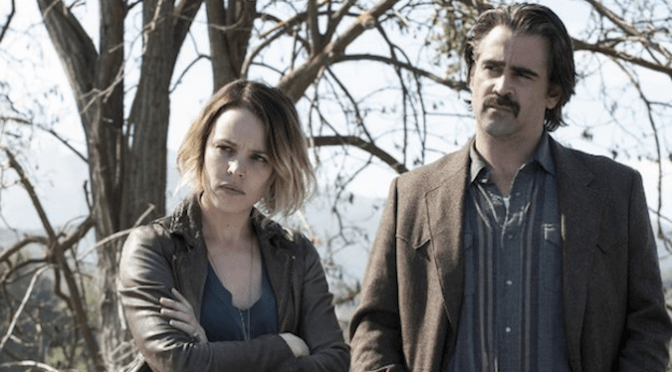
Aside from all of that, there were a handful of exciting things that occurred in the second hour. Some of these things were pure True Detective. I suppose I never quite realized how much of the first season took place in a moving vehicle, but it felt fitting to see Colin Farrell’s Ray Velcoro and Rachel McAdams’s Ani Bezzerides exchange trailer-worthy capsule philosophies as they traversed the post-industrial Vinci (His: “My strong suspicion is we get the world we deserve”; Hers: “I don’t distinguish between good and bad habits”). The starting point of their relationship is characterized by mistrust and conscious deception, as both are informed about the other during individual briefings at the start of the episode. Ani learns that Ray is rumored to be a bent cop, while Ray is more or less tasked with seeing that the investigation goes nowhere. The pair use the car ride to “get to know each other”, which in True Detective means testing the other for weak spots, for betrayals, and eventually for a point on which an alliance might be formed.

Continue reading True Detective 2.2 – “Night Finds You”