Category Archives: Festival Series

Mistress America (2015)

The good part about studying abroad in Palma de Mallorca, Spain is the warm weather, the beaches, the paella, and so on. The bad part is that pretty much all of the movies are dubbed in Spanish (tough trade off, huh?); as tempting as it has been to see, say, The Martian or Spectre in dubbed Spanish, I have decided to pass.

However, this past weekend, I had the unique opportunity of actually seeing a movie in English at the ever-prestigious Evolution International Film Festival in Mallorca (slowly becoming the new Cannes). With my busy schedule of doing Spanish things, I only could go to the final movie: Mistress America.

Continue reading Mistress America (2015)

Beasts of No Nation (2015)

Beasts of No Nation lives in the space between realism and allegory. Uzodinma Iweala’s original novel approaches that space but seems far less concerned with it, narrated entirely by the young central character, Agu, in his simplistic present-tense dialect. A child soldier in West Africa, Agu’s journey in the novel is one of survival. His family is killed, and to avoid being killed himself he accepts an offer to join the army of the Commandant, a rebel warlord. At first he declares “I am not wanting to fight”; eventually, though, Agu is killing with knives and guns, willfully attacking “enemies”, tearing through his war-stricken country at the whim and call of the Commandant.

Everything about the novel is heartbreaking, but nothing more so than the sense that Agu is too young to realize that his journey across his country is also a descent into hell. The first-person narration is one that nonetheless conveys the bare minimum about Agu’s own thoughts and feelings about his actions, and yet at times it conveys more than enough. “I am liking it” — this is what Agu says about the sound of his knife hitting a woman’s head, about the splashing blood. It’s brutal in how direct it all is, in its impossibility and in its plausibility. Iweala never has to name the West African country or convince us that someone like Agu really exists; Agu very definitely does.

Continue reading Beasts of No Nation (2015)

Steve Jobs (2015)

97% of Steve Jobs is nearly perfect. Much like the products borne of the man’s unparalleled creative vision, everything in his latest biographical film is optimized, streamlined, rounded when the edge should be rounded, sharp when the edge should be sharp, forward-thinking, life-changing, and pitched to be perfect. The performances are subtle and explosive, depending on which character you’re dealing with. The drama is heavy-duty; the comedy is excitingly witty. The pacing of the whole film is breathless. And the writing — whew, the writing — Aaron Sorkin has probably never been this good or done this much with a film script. This is ostensibly The Social Network 2.0, a story about a genius/jerk who defined the times for the rest of us, except Steve Jobs has a richer character in the driver’s seat.

And in comparing the two, that leftover 3% only becomes all the more glaring. The structure of the film is unique, built over three days in history: the launch of the Macintosh in 1984, the launch of the NeXT computer in 1988, and the launch of the iMac in 1998. The aforementioned breathlessness of the film is derived from setting each episode immediately before these launches, as that’s probably the most stressful and nerve-wracking collection of hours in any product launcher’s life. No different in Steve Jobs. Jobs needs everything to be perfect, every address to start exactly on time, every personal grievance from his staff and family (of which there are many, and between which the words staff and family mean less and less) to be voiced and dealt with. “It seems like five minutes before every launch, people go to a bar and get drunk and decide to air their grievances,” says Jobs.

Continue reading Steve Jobs (2015)

Miles Ahead (2015)

The 53rd New York Film Festival came to a close Saturday night with the world premiere of Miles Ahead, Don Cheadle’s longtime passion project about the late great Miles Davis. An actor of Cheadle’s caliber attached so fully to a single film might be a rarity, and in this case it’s the lead role, the directing, and the writing that all fall in the man’s wheelhouse…and he co-produced and wrote original music for the film. And he was in Avengers: Age of Ultron just a few months back.

Interestingly, the similarities between the vigilante War Machine and the musician Miles Davis make it evident what Cheadle saw in both charac…just kidding. Miles Ahead is the best thing Cheadle’s done since Hotel Rwanda, or at the very least the most substantial role since then, and thus an overdue reminder that Cheadle is a fantastically likable leading man. He’s likable even when he’s playing Davis at his lowest point, a five-year creative drought fueled by cocaine and loneliness that makes up the majority of Miles Ahead, and through all the stubbornness and figurative horn-tooting (sorry) Cheadle still conveys the fact that Davis was overflowing with passion for his art. It’s fitting that the actor, who took eight years to craft Miles, matches the musician in passion for his own art.

Continue reading Miles Ahead (2015)

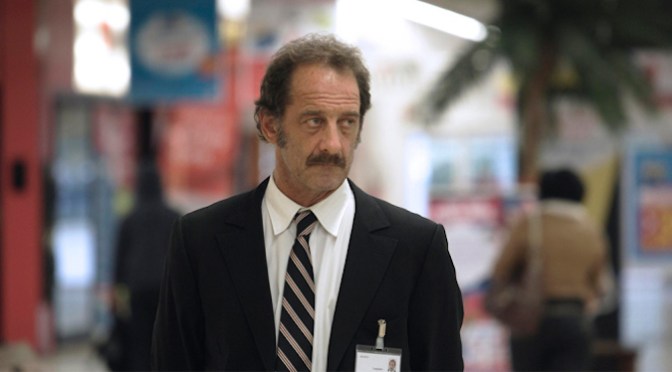
The Measure of a Man (2015)

A film like The Measure of a Man needs the right actor in the leading role, and Vincent Lindon is the right actor. He’s not commanding, but he’s dignified; he’s not emotive, but he’s emotional; he’s not a force of nature, but if he is then he’s a fault line waiting to quake. He’s always just about to boil, “simmering”, maybe, but then again there’s even less violence in his demeanor than there is in a pot of increasingly hot water. Lindon is simply comfortable, at ease and natural in a tie or a T-shirt, genuine as if he’s blissfully unaware of the camera in his face (and in Measure it’s really in his face).

On the other hand Lindon’s character, unemployed factory worker Thierry Taugourdeau, is decidedly uncomfortable. There are very few opportunities for Thierry to just loosely enjoy life in his own body in the manner of the actor portraying him; Thierry can’t afford that. He’s confronted with his financial realities during every waking moment, sometimes explicitly and sometimes during a scene of him dancing with his wife, and Measure presents Thierry during a time in his life when his employment is everything. He’s like a saggy old Augie March in a rotation of labor by necessity instead of by election; instead of working in jobs dictated by his pride, he takes what he can get and usually has to suppress that pride.

Continue reading The Measure of a Man (2015)

The Martian (2015)

Hands down, the best movie theater experience I’ve ever had.

Sci-fi royalty Ridley Scott’s’ latest space voyage did not disappoint.  The Martian — starring Matt Damon, Jessica Chastain, Kristen Wiig, Jeff Daniels, Michael Peña, Sean Bean, Kate Mara, Chiwetel Ejiofor, and Donald Glover (holy shit) — epitomizes the term “modern classic.”  It gets its two major themes of unrelenting determination and human bravery across gracefully and without any integrity-damaging clichés, an accomplishment that continuously eludes many filmmakers who embark upon such a journey. That’s the difference between this film and Independence Day, for me (that’s not to say that the latter doesn’t hold a special place in my heart).

I left the theater with the stupidest grin on my face. The film’s humor was the beautiful element that made it exceptional, not only in the simple sense of making the film more enjoyable, but also in the sense that it unquestionably aided Damon’s performance — otherwise, I doubt his sheer optimism would have been nearly as believable.  The humor lightened the mood for us and kept us believing that Mark Watney was going to do the impossible.  Far from falling into the category of comedic-relief-humor, The Martian might actually get nominated for Best Comedy or Musical at the Golden Globes next year.  When Watney practically blows himself up and goes I flying across the hab, I cried with laughter.  When Watney intentionally goes to town with expletives in an inter-planet online chat that is being streamed worldwide, I cried with laughter.

Continue reading The Martian (2015)

The Walk (2015)

The Walk is being compared to Gravity in a recent spate of fairly misleading TV spots, intense Inception-esque music set to critic quotes that swoop in to say things like DOES WHAT GRAVITY DID FOR SPACE! It’s clear what they’re trying to say: this is more an experience than a movie. It’s partially true, and certainly the most affecting parts of the film are those which purport to be more than film. Lots of movies try to push for that as a selling point, and the floating and swooping superlatives in the Walk trailers recall all of those other movies that are GUARANTEED TO BLOW. YOUR. MIND.

Robert Zemeckis handles the majority of the story of Phillippe Petit, the eccentric and restless French high-wire artist, with much the same eccentricity and restlessness as characterizes his subject. There’s voiceover narration hosted by a Statue of Liberty-bound Petit (get it? France!), there’s a black-and-white sequence, a few flashbacks, a few time lapses, a few time jumps. The Walk, like Petit’s mind, is all over the place. At times the quick pace is paradoxically dragging, but I suppose such is the case for Petit as well. He’s bored by ropes strung between lampposts and trees. He wants a true high wire. He wants to see New York, to see the towers. He wants to see mountains again, Gandalf, mountains.

Continue reading The Walk (2015)

O Brother, Where Art Thou? (2000)

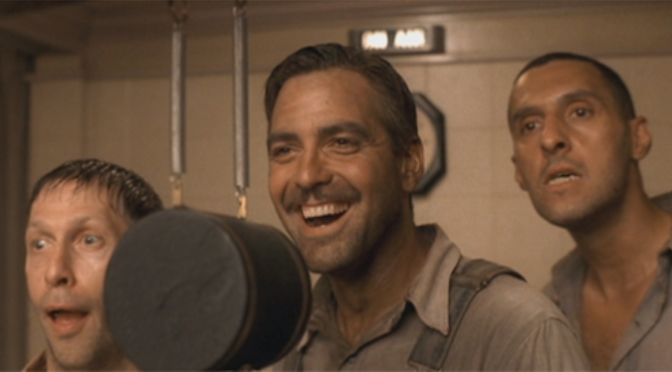
This year’s New York Film Festival played host to a 15th Anniversary screening of O Brother, Where Art Thou?, the Coens’ Dirty Thirties road movie, though it hardly seems like that much time has passed. I might have described O Brother differently — say, the Coens’ Dust Bowl love letter or the Coens’ Homer homage or the period highbrow escapee buddy whatever — except that the directing duo melted all of that babble away in the post-screening “discussion” of their writing process. “We just started with ‘three guys on the road'” said Joel; Ethan added, “then we tarted it up with Homer.” That was that. Next question. The Coens are experts at both of those things: interpretive film direction and film interpretation deflection.

But they were no less the storytellers on stage, despite their succinctness, and they were joined by O Brother stars George Clooney, John Turturro and Tim Blake Nelson as well as legendary cinematographer Roger Deakins. The latter was a pleasant surprise, and though the Coens have recently worked with the likes of Emmanuel Lubezki and Bruno Delbonnel it’s endlessly exciting that Deakins will return to the fold (as will Clooney) for the next Coen film Hail, Caesar!; if it’s at all the blend of O Brother and Barton Fink that it appears to be, then it can’t come soon enough.

Continue reading O Brother, Where Art Thou? (2000)

Narcos – Season 1

Narcos has a rookie season that moves like a final season. Netflix has been in the TV game for a while now, with their flagships House of Cards and Orange is the New Black both entering fourth seasons soon, and it’s rare that a Netflix series falls wide of the mark — Bloodline, Daredevil, and Sense8 all drew in high-powered acting and directing talent and were almost immediately renewed for second seasons. Narcos, with the pacing and and urgency of a well-established series and character arcs that would normally be stretched over the course of a lesser show, might outdo them all.

A large part of what sets this story apart from the pack is the fact of this story being a true one. Pablo Escobar has been portrayed several times by all the people you might expect — there’s Benicio Del Toro just last year in Paradise Lost, Javier Bardem next year in a new biopic, and then John Leguizamo (okay, so maybe not who you’d expect) in yet another biopic the following year — but the infamous Colombian drug lord has never been viewed under a microscope like this. It’s Wagner Moura who steps into Escobar’s patterned polos here in Narcos, and he’s up to the considerable task.

Continue reading Narcos – Season 1

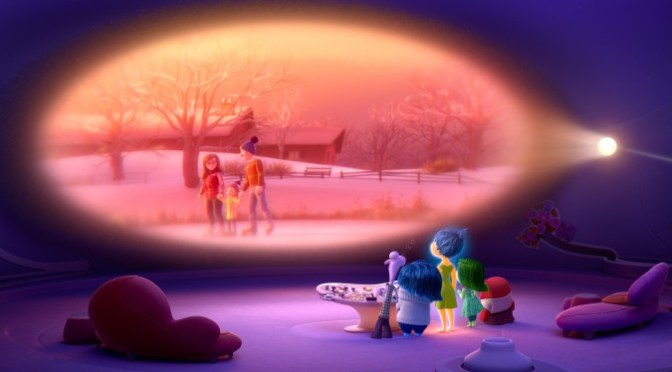
Inside Out (2015): Pixar Goes to Therapy

Our Take Two column offers second opinions and alternative angles on films and TV series reviewed elsewhere on Motion State. Head here for our original review of Inside Out.

The people have spoken. Original, well-written content is what they want, and they want it now! Down with all of these cliched remakes! I speak on everyone’s behalf when I say–what’s that? Ex-squeeze me? Jurassic World, of all movies, is breaking every box office record? Well then.

It’s hard to express how that makes me feel. I could scream and gag and cry and fall into a deep depression. And there’s no movie that can fix me. What’s that? Another off-screen interjection? I should look no further than Inside Out? So there’s hope after all… Continue reading Inside Out (2015): Pixar Goes to Therapy