Category Archives: Festival Series

Inside Out (2015)

Pixar’s most recent creation, Inside Out, is not a children’s movie as it is advertised to be. The animation and young protagonist, Riley (Kaitlyn Dias), may suggest that the movie is for the ten and under crowd, but it most certainly is a movie that is better suited for an older audience. Now, this is not just a long-winded attempt at justifying the fact that I sat in a theater crowded with six-year olds to see this movie; it is a credit to Pixar for their ability to disguise an emotionally complex and subtly humorous film as a children’s movie. They have wisely used this model several times over, which has led to their vast success. Inside Out, even more so than other Pixar films, is able to not only entertain kids, parents, and everyone in between (or just me in between), but also provide a powerful message about the power and role of emotions.

It is no coincidence that Inside Out is a movie entirely about emotions, mostly centered on Joy (Amy Poehler) and Sadness (Phyllis Smith) because throughout the movie, at least the older portion of the audience goes on a journey of emotion as well, mostly between joy and sadness. As the protagonist Riley tries to adjust to her new life after moving from the comfort of her Minnesota home to San Francisco, we see how she and her emotions (Joy, Sadness, Fear, Anger, and Disgust) handle the transition.

Continue reading Inside Out (2015)

Nightingale (2015)

I wanted to love Nightingale unconditionally. We’ve written about one-man-show films here before, from Locke to Buried to Redford‘s All Is Lost to Altman‘s Secret Honor, and Nightingale certainly stands with those true one-man-shows rather than with, say, Cast Away or Gravity or 127 Hours or any other single-character flick that actually has a small supporting cast. Nightingale has no supporting cast, no strange premise wherein the hero is trapped underground or trapped on the high seas or trapped in space. Nightingale‘s Peter Snowden is trapped in his mind, and that’s scarier than any of the aforementioned scenarios.

David Oyelowo is the single actor in question here, and to say he delivers a great performance would be a pathetic understatement. Oyelowo is an absolute force of nature from the first frame of Nightingale to the last. The storyline is unsettling, sure, and we’ll get to that in a minute, but shorn of that Oyelowo’s performance is unsettling in and of itself for the sheer velocity of it all. Not only are Peter’s highs and lows very very high and very very low, but they’re backed up into each other and jumbled up in such a way that Peter switches like a lightbulb from on to off, from calm to manic, from contemplative to downright inconsolable. It’s impressive, but before that it’s incredibly disturbing.

Continue reading Nightingale (2015)

Ex Machina (2015)

There’s this dude Nathan. He’s one of the few dudes onscreen in Ex Machina, the directorial debut of 28 Days Later and Sunshine scribe Alex Garland. Nathan is a walking paradox, even in the most perfunctory surface-level characterization of him as a hard-drinking frat boy who also happens to be a veritable technological genius. Caleb, his temporary intern of sorts, at one point compares him to Mozart — likely the first time a Mozart figure has ever spent so much time on abs and forearms. This straightforward incongruity in Nathan would only work with the right actor in his shoes, and Oscar Isaac is the right actor. A force in Inside Llewyn Davis and A Most Violent Year, Isaac is utterly convincing throughout Ex Machina. Nathan drains bottles of beer and vodka, yells at his maid, passes out drunk, wakes up to lift weights and beat his punching bag, and soon starts in on the beer and vodka again — and yet he’s always the smartest guy in the room by a longshot.

That somewhat superficial contradiction (or, for the purposes of a review of a film about artificial intelligence: that skin-deep, cosmetic, inorganic contradiction) is only the beginning of Nathan. Isaac is joined by Domhnall Gleeson as Caleb, the timid young coder brought to Nathan’s underground tech lair as ostensible winner of a contest to take part in a secret experiment (Isaac and Gleeson are also both in The Force Awakens later this year, which is doubly exciting after seeing Ex Machina). Together they deliberate Ava, Nathan’s advanced A.I. that not only walks exactly like a human and talks exactly like a human but thinks exactly like a human, too. What that means, exactly, is exactly what Ex Machina probes. Maybe. Spoilers follow.

Continue reading Ex Machina (2015)

It Happened One Night (1934)

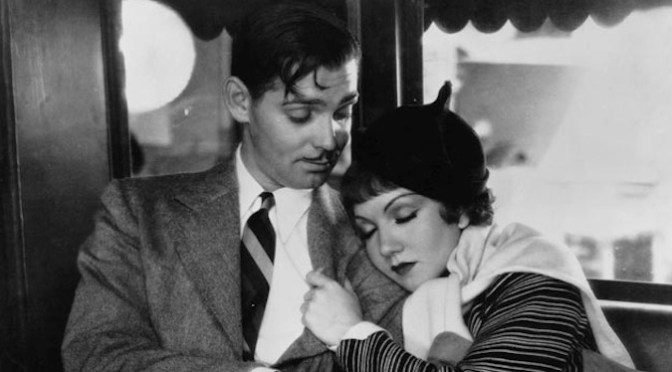
Boston’s Brattle Theatre screened a new restoration of the Frank Capra classic It Happened One Night this past weekend, fittingly coming on the eve of the 87th Academy Awards — Night was the first film to win Oscar’s Big Five, taking Best Picture, Director, Actor, Actress and Screenplay in the face of strong competition from the likes of The Thin Man. The restoration improved the quality of the original not by colorizing it or replacing the deleted scene where Clark Gable’s Peter discovers a magical portal to the planet Zaferonz (you didn’t hear about that?), but simply by touching up the considerable damage to the original print.

Scripts from this era of American film are always fascinating, mostly because they’re so different from today’s scripts. It Happened One Night falls only a handful of years after talkies came about, but the ensuing decade would typify a dedication to screenwriting that’s much rarer these days. It’s why I adore films like The Big Sleep, and it’s largely why It Happened One Night remains such an endearing version of a very familiar story.

Continue reading It Happened One Night (1934)

Leviathan (2014)

Leviathan is chilling. It’s many things, of course — it’s beautiful, stunningly shot by director Andrey Zvyagintsev and cinematographer Mikhail Krichman; it’s grand and sweeping, ceilingless in theme and character; it’s relevant, despite criticism by the Russian government regarding an “unpatriotic” message. But most of all Leviathan is hauntingly realistic, defiant of many of the plot developments one might expect from such a film. Nominated for Best Foreign Language Film at this year’s Oscars (and arguably the frontrunner alongside Ida), Leviathan is also Russia’s first appearance at the Academy Awards in nearly a decade.

The plot stems from a land dispute between a corrupt town mayor and a family living by the seashore. After having been harassed by the mayor’s men, the short-fused patriarch Kolia brings in his friend Dmitri, now a lawyer in Moscow, to help fight the takeover. Dmitri digs up some dirt on the mayor that he thinks he can use — but in this tiny Northern town it seems everyone is dirty. Kolia’s life begins to unravel as he watches helplessly, and before long it’s not just his home that lies in jeopardy but his job, his wife, his son, his freedom.

Continue reading Leviathan (2014)

The Theory of Everything (2014)

Eddie Redmayne becomes Stephen Hawking in a rare and exciting way in The Theory of Everything, giving a performance that extends far beyond simply mimicking Hawking’s look. He’s a young actor — currently 33 — but already has a sizable body of film work under his belt, in addition to a Tony Award and an Olivier Award for his work in the play Red alongside Alfred Molina. In short: it’s a good time to be Eddie Redmayne. His success in this role will doubtless launch him onto the international stage, and judging by his next role (a part in Jupiter Ascending, his first big-budget action film) he’s already there.

And yet it’s all he and co-star Felicity Jones can do to drag The Theory of Everything out of the tired, trodden mud in which the film itself is set. To claim outright that a certain biographical film is “boring” isn’t necessarily the equivalent of deeming the life of the subject to be similarly boring, but it’s close enough to warrant a perfunctory disclaimer: Hawking had a life that was anything but boring. Sure, everyone knows that math and science themselves are really incredibly boring — certainly no one is denying that. But Theory can’t even fall back on that, because there’s surprisingly little math or science in the film.

Continue reading The Theory of Everything (2014)

Birdman (2014)

Birdman is not your typical Alejandro Gonzalez Iñárritu film. Correction: Birdman is not your typical anyone film — which is part of what makes it so good. Iñárritu’s inventive cinematography combined with exceptional dialogue between intriguing, fantastically-acted characters make Birdman a masterpiece, and one that deserves all of the praise it is receiving in terms of Academy Award nominations.

The film follows Michael Keaton’s Riggan Thomson, a past-his-prime actor who was once famous for playing the titular superhero Birdman (Keaton himself knows a thing or two about formerly playing a superhero). Riggan’s past character haunts him throughout the film as he tries to become relevant as an actor outside of just the superhero role. He attempts to shake loose of Birdman by directing and starring in Raymond Carver’s play “What We Talk About When We Talk About Love”. Carver’s play provides an appropriate backdrop for Riggan’s attempt at a career revival. Carver, himself, is quoted to start the movie in what reveals a central theme of the movie: “And did you get what you wanted from this life, even so? I did. And what did you want? To call myself beloved, to feel myself beloved on the earth”.

Continue reading Birdman (2014)

American Sniper (2014)

Around the 30-minute mark of American Sniper there’s something that’s not quite a montage, not quite a self-contained series of events, not quite comfortable in that first half-hour of the film. Sniper Chris Kyle spots an insurgent in his scope and he takes him out. A few more lone insurrectionaries crop up, and Kyle fires again. Again. Again. It sounds like a montage, but director Clint Eastwood doesn’t let it play out as such. And it’s fairly quick, cutting from one shot to the next inside the space of a minute and a half. Still, though, there’s something brutal and cold and darkly affecting about this life-of-Kyle in 90 seconds, something that almost singlehandedly elevates American Sniper to the level of a modern classic war film.

I assumed that Sniper would be a lot like The Hurt Locker, judging from the trailers and a few reviews and my admittedly vague knowledge of Chris Kyle’s story. Sniper is a lot like Hurt Locker, to be sure, but it’s not exactly in the way I expected. The similarities, really, are resigned mostly to the aesthetic — and visually, they’re so similar that you might expect Kyle to peek through his scope and spot Will James strutting down the sandy street in his EOD blast suit.

Continue reading American Sniper (2014)

The Lavender Hill Mob (1951)

A career retrospective on Alec Guinness runs at the Museum of Fine Arts Boston this week, starting with the Ealing Comedy The Lavender Hill Mob. There are a lot of actors and actresses today who get credit for switching between drama and comedy, and it seems there are more and more dark-and-gritty roles being taken by comedians these days (see: Jonah Hill, Chris Pratt, Jesse Eisenberg, Adam Sandler). It’s worked the other way, too, which is why Tom Cruise shows up in Tropic Thunder and ends up being the best part.

Guinness was something else. This isn’t a dramatic actor trying comedy any more than his role in Bridge on the River Kwai is a comedic actor attempting drama — it’s just Alec Guinness, for lack of a more detailed explanation, completely at home in both arenas. Granted The Lavender Hill Mob isn’t a laughfest of super-zany proportions (Guinness nailed those too, though, with Kind Hearts and Coronets and The Ladykillers), but it’s a far cry from Kwai.

Continue reading The Lavender Hill Mob (1951)

Big Eyes (2014)

Big Eyes is about a fringe artist whose Gothic work about depressed, child-like characters becomes wildly popular, copied, and commercialized until it’s rendered a caricature of itself. And no, it’s not Tim Burton’s autobiography. It’s the bizarre true story of Margaret and Walter Keane and the fortune they made in the 1960s on paintings of children with, you guessed it, big eyes. Still, it’s not hard to analyze Burton’s attraction to this story. Each new movie “from the mind of Tim Burton” seems to parody his own aesthetic, turning it into a brand more than an auteur’s style. It would be far too easy  to say that Walter represents the big, money-hungry studios and Margaret is Tim, just victims of their own popularity.  But this is a movie that deserves to stand alone–and after Dark Shadows, I’m sure Burton wants it that way.

The audience might already be familiar with the weird 1970 court case in which Margaret sued Walter for slander while he stubbornly insisted that he was the original artist. But Big Eyes sheds light on the couple’s even weirder marriage. Margaret originated her iconic wide-eyed waifs when she was just a modest painter selling portraits on the street. But it was Walter who took credit for her work and turned them into a massively lucrative venture by selling cheap posters to the general uncultured public. The art world turned up their noses and scoffed, of course, but, as Walter passionately declares, the world is built on the lowest common denominator. Continue reading Big Eyes (2014)