

Julius Onah has a lot to say. He stepped onstage just before Luce, his third feature as director, screened as the Opening Night film at this year’s Independent Film Festival Boston. Typically a pre-movie appearance from an auteur amounts to a wave, a bow, a “thanks for coming out!” or, at worst, a visible hostage situation at the hands of a ruthless moderator. Onah, in the span of what seemed like less than a minute, reflected on Luce‘s premiere at Sundance and his hopes for the conversations the film will continue to spur; he referred to the movie theater as “his church”; he drew parallels from the film to his own life experience, having emigrated to the U.S. from Nigeria when he was ten; and he even snuck in a playful dig at IFFBoston, noting that he’d submitted several short films for consideration years ago, all of which were rejected.
His film is similarly assertive of numerous ideas without ever being overly verbose. Luce Edgar (Kelvin Harrison Jr.) is a star high school student in Arlington, Virginia who spent the first seven years of his life surrounded by the violence of war-torn Eritrea. His adoption by a white upper-class American couple (Naomi Watts and Tim Roth) meant a new start, though it also meant a long period of adjustment and self-reconciliation. When his stern (some would say “bitchy”) teacher Ms. Wilson (Octavia Spencer) reads an unsettling essay by Luce and finds illegal fireworks in his locker, the question arises as to whether that period of self-reconciliation is actually still underway. Is Luce the model young American everyone makes him out to be? Or is there a darker side within him, manifesting itself as a sociopathic danger to others?

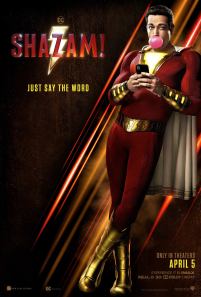 Is the DCEU still a thing? Conceived as the answer to Marvel’s unfathomably successful Cinematic Universe, DC’s interconnected supertales never quite coalesced the way they were intended to. You could point to any number of reasons for this derailment: a lack of a Kevin Feige-type visionary at the helm, or a violent shift in tone from one movie to the next, or poor casting in crucial roles, or the general cart-before-the-horse nature in which this series was rushed into existence. Those are all blameworthy when considering the ineffectiveness of a franchise. But because each individual film in the DCEU —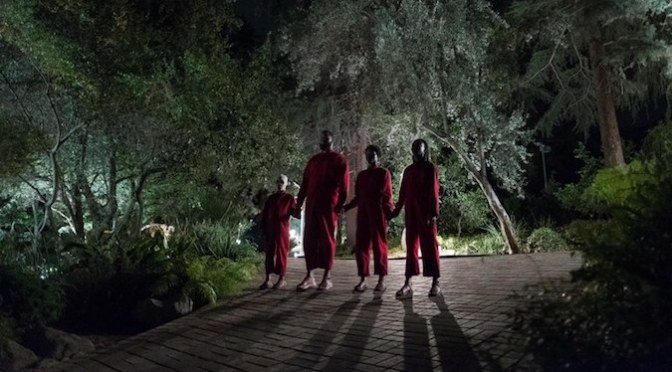
 Jordan Peele’s Us is nothing short of exceptionally entertaining horror. Starring Lupita Nyong’o and Winston Duke as the mother and father of a prototypical American family, Us joins a long tradition of doppelgänger horror while still emerging from that tradition into definitive modernity. Like Peele’s debut Get Out, the American Dream — as a white-picket-fence fantasy and as a dark reality — is crucial not only to the implicit themes of the film, but to the reason both films are scary in the first place. Yes, Us has a preponderance of classic horror moments, from jump-scares to home invasions to creepy coincidences foreshadowing a coming threat. But these tropes become entertaining again only in context of a strong underlying assertion that speaks to something in our everyday life, and while Us may not speak as explicitly as Get Out, the potency of the film is drawn from a similar source.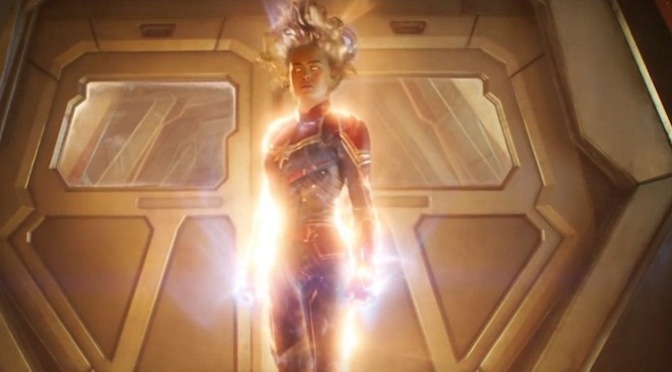
 In 2017 The Last Jedi ignited a culture war between lovers of Star Wars on the one side and…well, lovers of Star Wars on the other side. This war was ostensibly borne of debate over the film, praise versus criticism, and there certainly is a battlefront of this war that does engage in genuine discourse over Jedi. There’s another front, of course, comprised mostly of warriors fighting with a willing blindness to the merits or pitfalls of the film as a film; some people just despise Jedi for puerile personal reasons, some just defend it simply because it’s Star Wars. This is the Ultimate First World Problem, such hatred and ire thrown about over the seventh sequel to a space fantasy from 1977. But intentionally or not, a particular faction of “critics” revealed themselves during this war. We’ll call them the Shitboys, because they’re mostly boys and they mostly shit on everything.

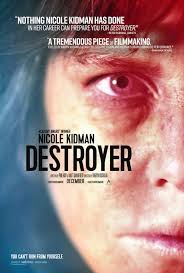 I was pretty darn excited by Destroyer just prior to watching Destroyer. The fact of a female-led, female-directed crime film with such noir grit would’ve been enticing enough. That female lead, of course, is Nicole Kidman, which always helps in the Excitement category. But frankly director Karyn Kusama was even more of a draw, coming off her last effort The Invitation. While not altogether a classic, Invitation stuck in the mind for its slow-burn tension and creepy performances. It was almost a suburban spin on a haunted house tale, Ice Storm meets Amityville Horror, accomplished with confidence by Kusama on a comparatively small budget of $1 million. Destroyer upped the ante, left the suburban mansion for the L.A. streets, but the fact that it was still an original thriller was mighty exciting.
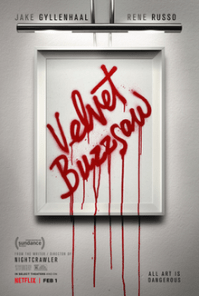 I went to the Tate Modern in London once. Modern art is easy to shit on, the philosophy of experimentation and willful disregard for tradition seeming to some haphazard, easy, cheap or just plain juvenile. That day at the Tate somebody had left a crumpled-up brochure on the ground, dead center of a pristine exhibit hall, and visitors would occasionally encircle it with hushed regard as they mistook it for art. It was the most surreal thing in a museum of exclusively surreal things, watching a piece of trash receive such vigilant appreciation.
 You’d certainly be forgiven for thinking Alita: Battle Angel to be a new movie by James Cameron. It gives off his scent in more ways than one, but primarily in the union of completely gangbusters special effects and a completely lackluster script. Cameron’s credited as a producer, though, not that the title of “producer” can actually ever have one single definition. Based on the manga series Battle Angel Alita, the film adaptation is in actuality directed by
 The superhero genre is not, in fact, a genre. Adapting comics to film has become a billion-dollar industry in the past decade, and the movies comprising that industry have certainly been typified by a familiar formula. Marvel movies are with few exceptions fun but mostly mindless. DC movies are with few exceptions Marvel movies with all the fun wrung out. Those exceptions usually end up being the best of the bunch, but the point is that the “superhero genre” — while technically an applicable term for things grouped by subject matter — is more a “superhero formula” applied across genres. There’s action-thriller, action-comedy, action-adventure, sci-fi action…heck, when’s someone gonna make a superhero rom-com or a superhero road trip flick? Or a super-workplace melodrama devoid of any action whatsoever?
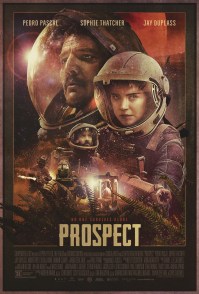 Detail is king in Prospect, the debut feature from writing/directing duo Christopher Caldwell and Zeek Earl. There’s little to latch onto in the opening minutes that could be called “familiar” outside the general setup: two human characters, father and daughter, in a ship floating through space. But the young girl is writing in an alien language, her father is administering a strange drug, and the process they both engage with to launch their pod down to the surface of a nearby planet is about as complicated as the entire mission in First Man. There’s a device that the father holds in place and continuously winds like it’s a jack-in-the-box, though its purpose is never actually articulated.
 Art ages. The second a book hits the shelf, a movie hits the cinema, a painting hits the exhibit or a song hits the radio, that art is in some ways locked into that time period forever. Maybe as time passes that art ages poorly and is sentenced to oblivion — like, say,
  Motion State Review