Category Archives: Film Review

Birdman (2014)

Birdman is not your typical Alejandro Gonzalez Iñárritu film. Correction: Birdman is not your typical anyone film — which is part of what makes it so good. Iñárritu’s inventive cinematography combined with exceptional dialogue between intriguing, fantastically-acted characters make Birdman a masterpiece, and one that deserves all of the praise it is receiving in terms of Academy Award nominations.

The film follows Michael Keaton’s Riggan Thomson, a past-his-prime actor who was once famous for playing the titular superhero Birdman (Keaton himself knows a thing or two about formerly playing a superhero). Riggan’s past character haunts him throughout the film as he tries to become relevant as an actor outside of just the superhero role. He attempts to shake loose of Birdman by directing and starring in Raymond Carver’s play “What We Talk About When We Talk About Love”. Carver’s play provides an appropriate backdrop for Riggan’s attempt at a career revival. Carver, himself, is quoted to start the movie in what reveals a central theme of the movie: “And did you get what you wanted from this life, even so? I did. And what did you want? To call myself beloved, to feel myself beloved on the earth”.

Continue reading Birdman (2014)

A Most Violent Year (2014)

A Most Violent Year is set in New York City in 1981, the most violent and murderous time in the history of the city. Oscar Isaac plays ambitious immigrant Abel Morales, manager of a successful oil enterprise, and Jessica Chastain plays his beautiful wife/accountant. On the eve of a major business deal, Abel must simultaneously contend with a federal investigation into his practice and a band of hijackers attacking his drivers.

Things fall apart fast for Abel, A Serious Man style, with pretty much everyone turning against him, and it’s in this set-up that A Most Violent Year seems like it’s going to be a pretty great gangster film. Abel is beaten down but never defeated, constantly levelheaded and rarely unprideful. In one scene he speaks to three new employees about business procedure, and though we know he should probably be frantically dealing with everything that’s happened to him in the past week we find him here instead, describing sales tactics with such gusto that Jordan Belfort would buy oil from him. In scenes like this Isaac’s Abel recalls Pacino’s Michael Corleone more fully than any character you care to name, stonefaced as he looks people directly in the eye, staunch in his beliefs.

Continue reading A Most Violent Year (2014)

1492: Conquest of Paradise (1992)

I think of Ridley Scott as a badass. Chalk it up to me being a little tyke when Gladiator and Black Hawk Down came out, or to his most famous films being the sleek and surefooted sci-fi flicks Alien and Blade Runner. I watched his most recent film Exodus: Gods and Kings, in which Moses is played by Batman, and the reaction was more or less the same: this dude just made the Bible badass. Let’s be clear in stating that Exodus is a pretty poor effort, and so I don’t mean “badass” as a full compliment. But that sleekness and that direct, immediate pacing holding a healthy amount of action is what I associate Scott with, and if nothing else Exodus certainly was a spectacle.

Then I watched 1492: Conquest of Paradise. Gérard Depardieu plays Christopher Columbus, discoverer of America, fighting to explore what he knows to exist past the European horizon. The film opens in 1490 or so, as Columbus gathers a head of steam for his royally-financed expedition — the always-superb Armand Assante plays the nobleman Sanchez, and Sigourney Weaver plays Queen Isabel. Columbus pushes for his dream. Sanchez and Co. conspire to gain from the ambition of the explorer, and there’s an overwhelming sense in this opening half-hour that — for lack of a better descriptor — shit is about to go down. Maybe Sanchez will plant a spy on the Santa Maria, or maybe he’ll do something even more dastardly.

Continue reading 1492: Conquest of Paradise (1992)

American Sniper (2014)

Around the 30-minute mark of American Sniper there’s something that’s not quite a montage, not quite a self-contained series of events, not quite comfortable in that first half-hour of the film. Sniper Chris Kyle spots an insurgent in his scope and he takes him out. A few more lone insurrectionaries crop up, and Kyle fires again. Again. Again. It sounds like a montage, but director Clint Eastwood doesn’t let it play out as such. And it’s fairly quick, cutting from one shot to the next inside the space of a minute and a half. Still, though, there’s something brutal and cold and darkly affecting about this life-of-Kyle in 90 seconds, something that almost singlehandedly elevates American Sniper to the level of a modern classic war film.

I assumed that Sniper would be a lot like The Hurt Locker, judging from the trailers and a few reviews and my admittedly vague knowledge of Chris Kyle’s story. Sniper is a lot like Hurt Locker, to be sure, but it’s not exactly in the way I expected. The similarities, really, are resigned mostly to the aesthetic — and visually, they’re so similar that you might expect Kyle to peek through his scope and spot Will James strutting down the sandy street in his EOD blast suit.

Continue reading American Sniper (2014)

Prisoners (2013)

I’m not typically a genre purist. I don’t believe an artist should be constrained to single genres, and I have a great admiration for movies that blur the lines to create something fresh. There are two very different, but very good movies in Prisoners that, in this case, don’t exactly result in synergy. The first is about two families dealing with the disappearance of their daughters. It’s haunting, gut-wrenching, and hyper-realistic. To me, this is the stuff of reality. The second is about the mysterious detective trying to catch the abductor. It’s creepy, riveting, and grotesque. This is the stuff of crime thrillers. Frankly, each one would be nearly perfect on its own. But together, in the form of Prisoners, they feel like a cheap blow below the belt.

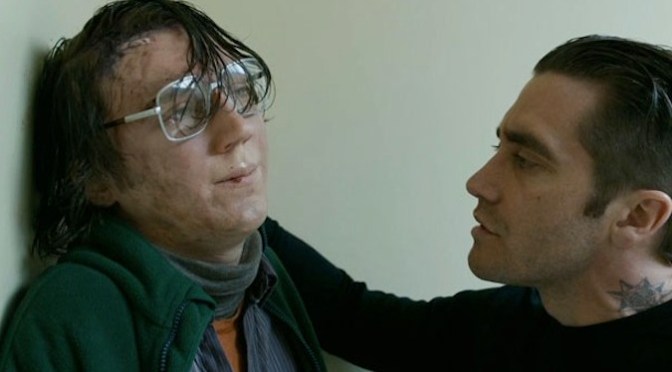
Anna’s parents, played by Hugh Jackman and Maria Bello, attend Thanksgiving dinner at Joy’s parents’, played by Terrence Howard and Viola Davis. When the two girls don’t return from playing outside, and it starts to rain, and a mysterious RV is spotted, the families go into panic mode. Days later, with the authorities on the case 24/7 and vigils being held for the missing girls, the families continue mourning and start resigning to the bad news that’s likely to come. But Keller Dover (Jackman) never really leaves panic mode. There was one suspect–the child-like, catatonic owner of the RV (Paul Dano)–but the cops had to let him go. So Keller does what any frustrated father who’s built like Wolverine would do and takes matters into his own hands. Next thing you know, he’s leading Terrence Howard into an abandoned apartment complex where the suspect is chained to a sink and badly beaten. Continue reading Prisoners (2013)

The Dark Knight Rises (2012)

As with our recent article on Batman Begins, this won’t exactly be a traditional “review” of The Dark Knight Rises so much as an examination of the comics that directly inspired the film, previous iterations of the character on the big screen, and the things that Christopher Nolan chose to pinch and blend together from the two of those in order to give us a recognizable version of Cinema Batman. Some of the most legendary moments in Nolan’s trilogy are those of true originality, but it’s good to remember every now and then that Bruce Wayne has been around a hell of a lot longer than Nolan and Co.

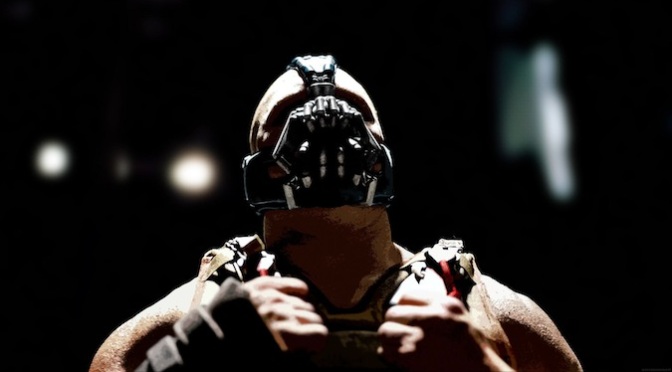
And if we’re talking comics that influenced Nolan’s last Batfilm, the only one really worth mentioning is Knightfall. Yes, there are a whole host of comic arcs that can claim to be influences for parts of Rises — the No Man’s Land arc sees Gotham cordoned off from the rest of the world; the four-part story The Cult has a villain operating from the sewers; Bane is the explicit right-hand man of Ra’s al Ghul in 1999’s Bane of the Demon; and Frank Miller’s seminal The Dark Knight Returns has a similar premise and conclusion to Nolan’s Rises, which we’ll come back to in a moment.

Continue reading The Dark Knight Rises (2012)

Dear Zachary: A Letter to a Son About His Father (2008)

Movies have the power to foster a true emotional experience in its viewers at times while at other times movies can bring characters or people, though deceased, back to life. The documentary Dear Zachary reminds all of its viewers of this potential by making us feel both a deep connection to the Bagby family—on which the movie focuses—and unadulterated emotion towards their tragic situation.

Filmmaker Kurt Kuenne follows the heartrending story of the murder of his friend Dr. Andrew Bagby as well as the aftermath of the senseless crime. The documentary takes on several different forms throughout, which is part of what makes it so powerful. Kuenne rightly glorifies the life of the deceased Bagby through interviews with all those people around the country whose lives he had touched in his all-too-short 28 year life.

Continue reading Dear Zachary: A Letter to a Son About His Father (2008)

Big Eyes (2014)

Big Eyes is about a fringe artist whose Gothic work about depressed, child-like characters becomes wildly popular, copied, and commercialized until it’s rendered a caricature of itself. And no, it’s not Tim Burton’s autobiography. It’s the bizarre true story of Margaret and Walter Keane and the fortune they made in the 1960s on paintings of children with, you guessed it, big eyes. Still, it’s not hard to analyze Burton’s attraction to this story. Each new movie “from the mind of Tim Burton” seems to parody his own aesthetic, turning it into a brand more than an auteur’s style. It would be far too easy  to say that Walter represents the big, money-hungry studios and Margaret is Tim, just victims of their own popularity.  But this is a movie that deserves to stand alone–and after Dark Shadows, I’m sure Burton wants it that way.

The audience might already be familiar with the weird 1970 court case in which Margaret sued Walter for slander while he stubbornly insisted that he was the original artist. But Big Eyes sheds light on the couple’s even weirder marriage. Margaret originated her iconic wide-eyed waifs when she was just a modest painter selling portraits on the street. But it was Walter who took credit for her work and turned them into a massively lucrative venture by selling cheap posters to the general uncultured public. The art world turned up their noses and scoffed, of course, but, as Walter passionately declares, the world is built on the lowest common denominator. Continue reading Big Eyes (2014)

Guardians of the Galaxy (2014)

Chris Pratt dominated 2014. From reprising his role as the lovable Andy Dwyer on the hit comedy Parks and Recreation to his starring roles in blockbuster smashes The LEGO Movie and Guardians of the Galaxy, which will garner the attention of this review, he seemed to be everywhere you looked. While I assert that Pratt was at his best in Guardians, his attempts at seriousness in various parts of the film felt a bit like he was trying too hard. But, his first scene in the film was absolutely brilliant, as he gets a little funky and sings into a space rat as though it were a microphone. This scene sets the stage for the tone of the remainder of the film: a collection of comical ridiculousness that you simply can’t take your eyes off of.

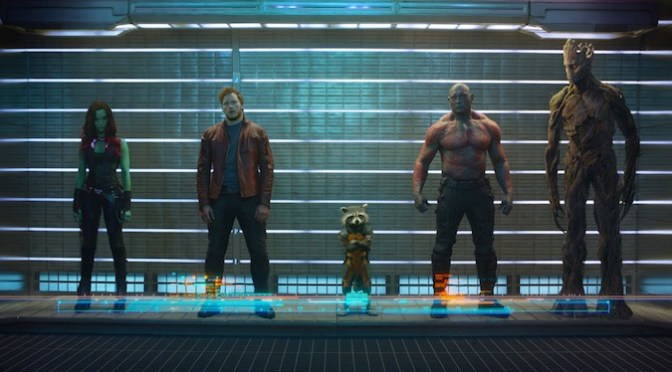
Guardians is a borderline Star Wars spoof, while at the same time paying all due respect to it. The genius of the film is found in the clever dialogue that evidences this point. One scene that comes to mind in particular is the one in which all the guardians decide to fight together against Ronan, all standing up to somehow state their dedication to the cause. Bradley Cooper’s hilarious Rocket comments, “Great. Now we’re all standing. A bunch of jackasses standing in a circle.” While the mocking of the cliché trope that is standing up to display emphasis is something I found to be tremendously clever, I also recognized the themes, such as devoting oneself to a just cause regardless of the dangers attached to doing so, that are so similar to those of the original Star Wars trilogy. Thus, Guardians is a sort of revitalized Star Wars reboot that stresses humor over drama but nevertheless paints a potent emotional portrait when it needs to, despite Pratt’s overacting at times. In addition, the film resolves itself in an incredibly familiar way. A band of outlaws come together to save the galaxy and are rewarded with impunity and heralded as heroes by the galactic authorities. Sounds a lot like A New Hope to me. To take it one step further, I honestly wouldn’t have been disappointed had this film instead been titled Star Wars: Episode VII – The Force Awakens.

Continue reading Guardians of the Galaxy (2014)

The Quick and the Dead (1995)

A quick glance at Sam Raimi’s filmography shows a greater preoccupation with iconography than with originality. He’s retread the old “cabin in the woods” and “superhero origin” tropes three times over (four if you count Darkman), yet, Robert Frost be damned, it has made all the difference. Through Evil Dead and Spider-Man, Raimi has evaded the title of “hack” to become both an auteur and blockbuster filmmaker, which is no easy feat when you’ve made Spider-Man 3. He manages to inject adrenaline and humor into genres that would die of exhaustion under any other director’s hand. As for The Quick and the Dead, the Western genre has only benefited from the Raimi treatment.

The Quick and the Dead reminds us of familiar Western figures straight away: the blind shoeshine, the bumbling barkeep, the merciless sheriff, the one-eyed ex-convict, and a flamboyant assortment of gunslingers. Of course it wouldn’t be a Western without the nameless hero, and fortunately we have Sharon Stone to give us an emotional anchor as The Lady amid a grotesque cast of caricatures. She arrives in town to exact revenge on the sheriff for the murder of her father, but gets roped into a quick draw dueling competition before she can do the deed. Continue reading The Quick and the Dead (1995)