Category Archives: TV Review

The Leftovers 1.6 – “Guest”

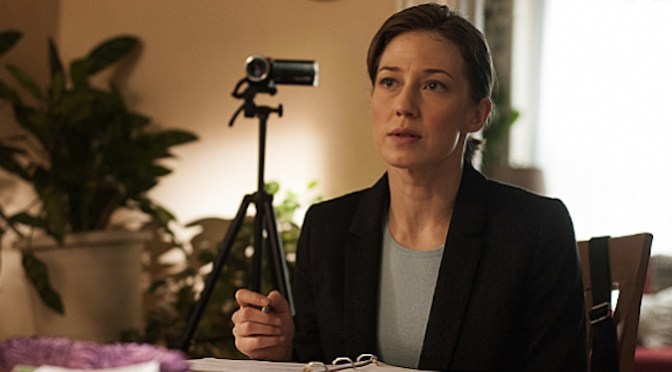
The first scene of “Guest” perfectly encapsulates the special kind of world we talked about in our review of the previous episode “Gladys“. Sure, the second scene steals the show: Nora leafs through a newspaper, makes an appointment with a prostitute advertised under the headline Nothing is Forbidden, invites the scantily-clad girl into her home, plants a pistol in her hand, dons a bulletproof vest, then demands the girl shoot her directly in the chest. Nora’s done this before, she assures the prostitute, although the last girl she got to shoot her “said she’d never do it again”. Thousands of dollars change hands, as do a great number of understandable health-related concerns. Tears fall. Eventually the gun goes off and Nora lurches backwards onto the blow-up air mattress. The hooker flees. After a long moment, Nora gasps a breath of fresh air.

Hell of a scene, no? Even if you aren’t sold on Nora’s self-help methods as a kind of New Grief — as if the old methods of grieving for lost loved ones no longer cut it — the intensity of the scene is still powerful. It builds moment by moment, starting as the prostitute steps over the threshold and holding an inhale as she darts back over it after the gunshot, finally exhaling at the same time Nora does. But a large part of the intensity of the scene might be attributed to the fact that this is the second scene of “Guest”, and the first is so deceptively twisted and unimaginably tragic that the gunshot scene almost becomes inevitable.


Continue reading The Leftovers 1.6 – “Guest”

Narcos – Season 1

Narcos has a rookie season that moves like a final season. Netflix has been in the TV game for a while now, with their flagships House of Cards and Orange is the New Black both entering fourth seasons soon, and it’s rare that a Netflix series falls wide of the mark — Bloodline, Daredevil, and Sense8 all drew in high-powered acting and directing talent and were almost immediately renewed for second seasons. Narcos, with the pacing and and urgency of a well-established series and character arcs that would normally be stretched over the course of a lesser show, might outdo them all.

A large part of what sets this story apart from the pack is the fact of this story being a true one. Pablo Escobar has been portrayed several times by all the people you might expect — there’s Benicio Del Toro just last year in Paradise Lost, Javier Bardem next year in a new biopic, and then John Leguizamo (okay, so maybe not who you’d expect) in yet another biopic the following year — but the infamous Colombian drug lord has never been viewed under a microscope like this. It’s Wagner Moura who steps into Escobar’s patterned polos here in Narcos, and he’s up to the considerable task.

Continue reading Narcos – Season 1

The Leftovers 1.5 – “Gladys”

To my mind, two things played a major role in spawning a resurgence in post-apocalyptic storytelling in the past decade. The first is Cormac McCarthy’s The Road, a bombshell of a novel from 2006 that depicted an ashen, desolate earth struggling to grasp the faintest glimmers of hope. It became a decent John Hillcoat film a few years later, but the craze spun off into more than just that: The Book of Eli, I Am Legend, Tom Cruise’s Oblivion, last year’s brilliant Snowpiercer, last year’s crappy Young Ones, that crappy now-cancelled NBC show Revolution, etc. etc. They’re not all directly borne of The Road, of course, but the genre itself certainly received a huge boost from McCarthy’s novel. That’s why the time was right to revisit Mad Max with Fury Road, and why the likes of Blade Runner is getting a new treatment as well. Heck, just this week there’s talk of Christopher Nolan being involved with the long-awaited Akira adaptation.

The second influential piece of post-apocalyptic storytelling is The Walking Dead, the massively popular AMC show that launched a thousand other zombie-related things and an official spinoff of its own (Fear the Walking Dead, which is pretty good if almost exactly what you’d expect). The thing that pushed TWD ahead of the pack was the format of a television series: movies and books are comparatively finite, but the long-term storytelling at hand in a TV series (or a comic book series, like the one TWD is based on) serves the genre in the perfect way. In both cases — Road and TWD — the aim was to create a new world out of the old one, to watch characters deal with the differences, to play witness to what fantastic and terrible things might arise after something alters life as we know it.

Continue reading The Leftovers 1.5 – “Gladys”

The Leftovers 1.4 – “B.J. and the A.C.”

Right down to the title of the show, The Leftovers isn’t necessarily one for subtlety. Any time something isn’t where it’s supposed to be, a parallel is drawn to the mysterious Departure that inexplicably claimed 2% of the world’s population. This is Drama, capital D, and these people have Problems, capital P, and sitting down to an hour of cap-D plus cap-P — especially “B.J. and the A.C.” — can end up being too much CAPS LOCK to handle if you’re not ready for it. But on one level The Leftovers sacrifices subtlety intentionally, I think, allowing for clarity instead. Supreme clarity, in fact, and one that should make nearly every other show on television envious.

Take the opening Breaking Bad-esque montage of “B.J. and the A.C.”:

Continue reading The Leftovers 1.4 – “B.J. and the A.C.”

The Leftovers 1.3 – “Two Boats and a Helicopter”

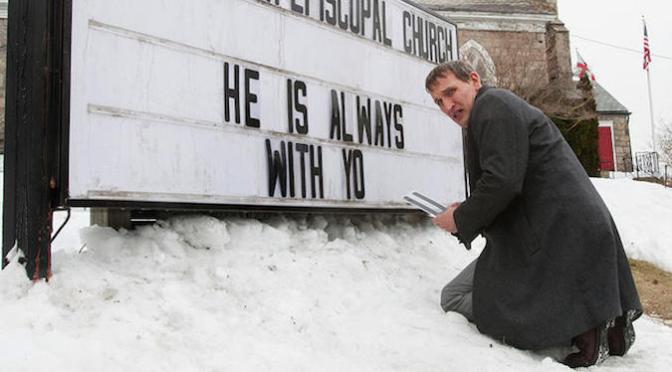
Alongside the sixth episode “Guest”, “Two Boats and a Helicopter” provides the most effective hour of character drama in the stellar first season of The Leftovers. The first episode to zoom in on a single character depicts the sad struggle of Reverend Matt Jamison, portrayed with suitable passion by Christopher Eccleston, in the wake of the mysterious Departure. The first and second hours showed glimpses of Matt, passing out flyers at a rally that damn the Departed rather than deify them. “It was not the Rapture!” maintains Matt. In “Two Boats and a Helicopter”, he reveals what he thinks the Departure actually was: a test.

And his sister Nora sums up one side of the episode with perfect succinctness: “if it was a test, I think you might be failing it.” Thus is his post-non-Rapture existence a continuous test of faith wherein Matt attempts to hold onto his beliefs in the face of that unthinkable and impossible event. Matt’s story keeps turning in on itself, offering hope in one instant and ripping it away just as quickly. It’s a cruel-seeming existence, one that forces Matt to eventually view the smallest of occurrences as a direct sign from God. After a certain point, the letdowns are more or less inevitable.

Continue reading The Leftovers 1.3 – “Two Boats and a Helicopter”

True Detective 2.8 – “Omega Station”

One might have hoped that the second season of True Detective would end up being something more than it appeared to be at the outset. Not just that the overall story would improve or that the episode-by-episode characterizations would gradually become more palatable — many hoped that the end of the sophomore outing would shine a light back on the beginning in such a way that a second viewing might be more rewarding than the first. This kind of retroactive structuring isn’t impossible, but it is pretty damn rare. The example I always use is Lost (yeah, I use Lost as a barometer for pretty much everything) which had an ending that might not have pleased everyone but managed to turn back and gracefully incorporate disparate elements from the first few seasons.

Did True Detective do that? The answer’s probably more No than Yes, and although the one major Yes is worth discussing the Nos just seem to pile atop one another immediately after watching the finale. Spoilers follow for “Omega Station”.

Continue reading True Detective 2.8 – “Omega Station”

True Detective 2.7 – “Black Maps and Motel Rooms”

One writer I enjoy reading and rereading is Don DeLillo, author of Underworld and White Noise — arguably his most famous works — and my personal favorite Libra. I rambled about him in relation to Birdman in this article. His relation to True Detective? Negligible, mostly, except for the fact that the sheer volume of characters in play during the second season of the HBO series has frequently recalled the densely-populated neighborhoods of DeLillo’s books. This dude packs characters into his stories, and if it gets out of control at times it’s still a very intentional and graspable phenomenon wherein the primary characters both stand out from the pack and blend into it. They get sort of out of control, these chessboards of intermingled personalities, and in the case of the 800+ page Underworld things get downright daunting; but it’s all controllable and palatable at the same time, somehow, in the way that all of the disparate colors in a kaleidoscope can still be explained as part of a single device made of cheap plastic.

True Detective is, I hope, more akin to that kind of a story than we’re able to grasp with the final episode (which will be an extended 90-minute finale) still to go. At the moment, one would be forgiven for wondering what in the heck it is we’re even rooting for here. Caspere’s killer? Maybe. That’s the event that kicked the season off, and it’s definitely still “unsolved”. But there are more loose threads in this season than there are loose threads on David Morse’s drug rug, so let’s get down to detecting some truth. Spoilers follow for the seventh episode “Black Maps and Motel Rooms”.

Continue reading True Detective 2.7 – “Black Maps and Motel Rooms”

True Detective 2.6 – “Church in Ruins”

Like this season’s third episode “Maybe Tomorrow“, “Church in Ruins” did something important: it peeked out, briefly and with clear purpose, and tried to put forth something that we’d never seen from the series before. This is essentially the equivalent of inching the shower curtain open just enough to reach your arm through to grab your towel before the cold air comes rushing in — again: brief, purposeful, a foray into something different characterized with intent on avoiding that something different. I could continue to over-convolute this line of thinking, but, hey, if you’re entertainments of the more Byzantine variety, I give you True Detective.

“Maybe Tomorrow” was packed with humor, and it was the type of humor that ‘Tec had never engaged in until that point. “Church in Ruins” was a milestone of sorts, too, but far more difficult to pin down. Yes, there are way more going-ons in Season 2 as compared with Season 1 — cadres of tough-looking supporting characters in slim-fit suits, piles of dead bodies with/without eyes, hooker parties, gambling addictions, custody battles, missing blue diamonds, etc. etc. etc. You’d be forgiven for rewatching an episode or two out of confusion. But, really, the confusion one might have felt after “Church in Ruins” likely had nothing to do with what just happened and more to do with the weird way in which it all went down.

Continue reading True Detective 2.6 – “Church in Ruins”

True Detective 2.5 – “Other Lives”

“Other Lives” wasn’t so much a reboot as a remake, not so much starting fresh as simply starting from the beginning all over again. Following the massive, civilian-offing Heat-esque shootout at the end of last week’s episode “Down Will Come“, all four of this season’s protagonists find themselves down a few rungs on the Ladder of Success. Worth noting, though, that only Ray Velcoro has an arc that’s really worth investing in — and only Ray seems to realize what the Ladder of Success actually is. When Frank Semyon states that he thought being poor was behind him in “Down Will Come”, Ray shakes his head: “That shit never leaves you,” Ray says, “no matter how much money you make.” The sentiment is carried through when Frank, offering Ray a job, encourages him by saying that “a little rage can go a long way.” Ray, of course, even though he knows the answer, asks the question out loud: “A long way to where?”

And even though he knows the answer, he takes Frank up on his offer in the weeks following the harrowing gun battle. It’s now been three months since the murder of Ben Caspere. Ray has straight-up quit the Vinci P.D., Ani was removed from the special investigation and demoted to the evidence closet in the basement during the Internal Affairs probe into her sexual misconduct, and Paul has taken a job at an insurance company that he hates. Frank has moved out of his palatial brood-pad into a more modest Glendale brood-pad, still struggling to clamber back up to the “peak” he felt he’d achieved just before Caspere died with Frank’s money in his pocket. And all in all we’re back where we were during the premiere episode “The Western Book of the Dead“, seemingly no closer to catching Caspere’s killer.

Continue reading True Detective 2.5 – “Other Lives”

True Detective 2.4 – “Down Will Come”

Aside from Flags of Our Fathers, “Down Will Come” featured more flags and/or fathers than you’re likely to see in a given hour of televised entertainment. The stars and stripes are littered throughout the Vinci P.D. precinct, various apartments, random billboards (and last week’s episode “Maybe Tomorrow“, which aired one day after the Fourth of July, even had an American Sniper billboard). One of the many, many (many, many, many) guys that Frank Semyon tries to squeeze for extra cash has a little lawn flag sticking out of the pencil holder on his desk. There’s more national imagery in “Down Will Come” than any episode of the second season so far, but at least it’s more subtle than earlier lines like We were working for America, sir, which just land with a leaden and damn-near unpatriotic thud.

But far more interesting are the father-son (or -daughter, in Ani’s case) dynamics packed into the fourth hour, which begins with Semyon and his wife griping over their lack of offspring. Jordan proposes adoption, Frank scoffs at the idea of raising someone else’s sinner child; Jordan insinuates she might not be able to have children after “the operation”, Frank suggests more tests; ultimately, Frank pushes the issue off because of all of the other stuff he has going down at warp-speed, kicked off by Caspere’s murder and the sudden dissolution of his once-stable empire. Frank’s the kind of guy who needs his empire to sprawl, he needs land, he needs people to know his name, he needs legacy that lasts and refuses to be satisfied until he has it in full. Ironic, then, that a guy obsessed with his own empire can’t figure out what every emperor before him has discovered: those one-off kings who had no offspring to carry on their names? Those guys who stood in as buffers between one massive dynasty and the next? History isn’t so kind to those guys.

Continue reading True Detective 2.4 – “Down Will Come”