Category Archives: TV Review

True Detective 2.3 – “Maybe Tomorrow”

A lot of the critical flak directed at the second season of True Detective has to do with the bottomless angst in which all of the main characters are mired. There’s certainly a lot of brooding, a lot of staring, a lot of heavy breathing. Nary a smile. The premiere dealt with child abuse, suicide and rampant prostitution (not to mention murder) and the second episode “Night Finds You” left a main character lying flat with a point-blank shotgun blast in his chest. Below is a picture of my family gathered to spend time together and enjoy this wholesome television — after that are spoilers for the third episode “Maybe Tomorrow”.

"Turn it up, son! I don't want you to miss any of the exposition in this scene at the fertility clinic!"
“Turn it up, son! I don’t want you to miss any of the exposition in this scene at the fertility clinic!”

Continue reading True Detective 2.3 – “Maybe Tomorrow”

True Detective 2.2 – “Night Finds You”

As we ventured in our review of last week’s pilot episode “The Western Book of the Dead“, the structure of the second season does indeed come into slightly sharper focus in the second hour “Night Finds You”. This installment echoed some of the weaker points of the previous one, including a whole lot of exposition and a whole lot of angsty brooding. And what’s up with the melancholy bar singer? How about a hosting a karaoke night instead? Or bring in Figrin D’an and the Modal Nodes, liven the place up a bit. Velcoro and Semyon could be use some groove. Spoilers follow for the second episode “Night Finds You”.

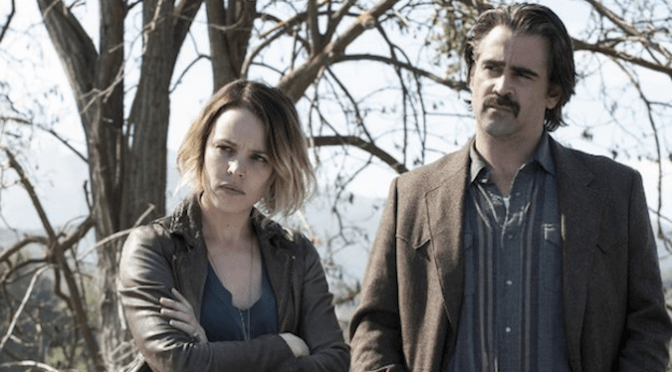
Aside from all of that, there were a handful of exciting things that occurred in the second hour. Some of these things were pure True Detective. I suppose I never quite realized how much of the first season took place in a moving vehicle, but it felt fitting to see Colin Farrell’s Ray Velcoro and Rachel McAdams’s Ani Bezzerides exchange trailer-worthy capsule philosophies as they traversed the post-industrial Vinci (His: “My strong suspicion is we get the world we deserve”; Hers: “I don’t distinguish between good and bad habits”). The starting point of their relationship is characterized by mistrust and conscious deception, as both are informed about the other during individual briefings at the start of the episode. Ani learns that Ray is rumored to be a bent cop, while Ray is more or less tasked with seeing that the investigation goes nowhere. The pair use the car ride to “get to know each other”, which in True Detective means testing the other for weak spots, for betrayals, and eventually for a point on which an alliance might be formed.

Continue reading True Detective 2.2 – “Night Finds You”

True Detective 2.1 – “The Western Book of the Dead”

Most everyone is comparing last night’s premiere of True Detective‘s second season with all of the highs of the first, which is both an inevitability (it’s True Detective, after all) and an exercise in futility. For the purposes of our Season 2 reviews we’ll be largely ignoring Matthew McConaughey’s Rust Cohle and Woody Harrelson’s Marty Hart (trying, anyway) although some comparisons do hold favorably with the current cast of characters. Our recent piece “A Man Without a Family” touched on the various family circles throughout the first season, and it’s clear in characters like Colin Farrell’s Ray Velcoro and Rachel McAdams’s Ani Bezzerides that some themes are inherent to the show regardless of which season we’re in.

“The Western Book of the Dead” was jam-packed with stuff, juggling a handful of protagonists and delving into flashbacks and allusions to mysterious pasts. Ray, a California cop in the Vinci Police Department, is introduced to us as the father of a young boy. The kid’s afraid of his classmates picking on him, but Ray seems tender and loving in his encouragements. “Be proud,” he says. When we discover that Velcoro’s kid is likely  product of the years-ago violent rape of his wife, our picture of Ray the Loving Father starts to disintegrate. By the end of the episode he’s ripped into his son, driven to the home of the kid that’s been bullying him, and beaten the father of that kid to hell while making the kid watch. The beauty in the fact of watching this scene on Father’s Day is not lost on me.

Continue reading True Detective 2.1 – “The Western Book of the Dead”

Sense8 – Season 1

Sense8 seems like the kind of show that began with the title, then developed an edgy concept to match/justify the title, then built a plot around the concept, then sort of accumulated characters to fill the whole thing out. That’s conjecture, of course, and of course there’s no “right” way to build a lasting story in the medium of television or otherwise. Lana and Andy Wachowski have been around the block, too, with the Matrix series, V for Vendetta, Cloud Atlas and their most recent film Jupiter Ascending among the numerous entries on their joint résumé. Their sci-fi movies are big, loud, and undeniably ambitious, and while the jury’s mostly still out on whether those movies are any good or not it’s certainly true that their concepts are highly original.

The concept of Sense8 is simultaneously the best thing about the series and the most frustrating. Eight people, spread across the world from San Francisco to Chicago to Mexico City to London to Berlin to Nairobi to Mumbai to Seoul, make a fascinating discovery about themselves: they are able to sense each other. Thoughts, feelings, secrets, emotions — regardless of the distance between them, these “Sensates” (get it?) share a bond that no one else can understand. They themselves don’t understand it for some time, and by the end of the first season there’s still a lot left to explore about the connection these eight people share.

Continue reading Sense8 – Season 1

True Detective 1.8 – “Form and Void”

This review appeared shortly after the initial premiere of True Detective in early 2014 — slight edits have been made since the original posting.

Everything leading up to last night’s conclusion to True Detective’s first season has been pretty stellar, setting the bar higher for the show as a whole than any other first season you care to name. The finale was so sought-after, in fact, that the HBO GO server overloaded and crashed due to such high demand, sending millions into despair over whether Rust and Marty would finally get their man. Last week’s episode “After You’ve Gone” served up a nice volley for the finale to knock down — and the eighth and final installment did just that. Needless to say, spoilers follow for the season one finale “Form and Void”.

Writer and showrunner Nic Pizzolatto dug himself into a hole in several ways with True Detective, foremostly by turning out a phenomenal, pitch-perfect pilot and a five-episode arc that brought with it the most intriguing hour “The Secret Fate of All Life”. I didn’t hear any major complaints after the first three episodes, and only when the fourth episode “Who Goes There” indulged in an action sequence did reviewers post fears about the show becoming “just another procedural”. Now, it seems, we have something of the reverse: “Form and Void” was inarguably, inescapably, and at times frustratingly revelation-free, instead providing a straightforward “resolution” where most fans pined for a major twist involving the unveiling of the Yellow King.

Continue reading True Detective 1.8 – “Form and Void”

True Detective 1.7 – “After You’ve Gone”

This review appeared shortly after the initial premiere of True Detective in early 2014 — slight edits have been made since the original posting.

Matthew McConaughey took home a well-deserved Oscar last night for his work in Dallas Buyers Club, beating out stiff competition in the likes of Christian Bale and Leonardo DiCaprio. While his acceptance speech was, as you would expect, very positive and un-Rustin Cohle, the usual drawling fatalism we’ve come to expect from Sunday Night McConaughey was going down on another channel. True Detective followed the slow-paced “Haunted Houses” with an even slower penultimate episode, and yet it still provided enough story progression that waiting a week to find out what the finale has up its sleeve will be torturous. Spoilers follow for the seventh episode “After You’ve Gone”.

At the end of “Haunted Houses” Cohle and Hart met in 2012 for the first time, having not seen each other for a decade and both looking a little worse for wear. Speculations as to what their ultimate meeting would entail were fueled by the shot of Hart checking his loaded gun, guesses ranging from standoff to a revelation that Cohle or Hart or both or whoever is indeed The Yellow King.

Continue reading True Detective 1.7 – “After You’ve Gone”

True Detective 1.6 – “Haunted Houses”

This review appeared shortly after the initial premiere of True Detective in early 2014 — slight edits have been made since the original posting.

The status quo changes yet again three-fourths of the way through the first season of True Detective, with the sixth episode providing a relatively muted but still provoking turnaround from last week’s guns-blazing action (“The Secret Fate of All Life“). This is the episode that fills in some gaps and gets us from Point A to Point B — so far, Point A has been a hell of a ride, and the final two episodes of the season will hopefully clear the bar that’s been set so very high. Spoilers follow for the sixth episode “Haunted Houses”.

The rift between Hart and Cohle is explored in full, and we delve into the 2002 events that would serve to alienate the two for the next decade. Michelle Monaghan finally gets some time to shine as Maggie when Hart’s ex-wife (in 2012) is brought in for questioning before Detectives Gilbough and Papania, and much of the episode stems from her recollections. Aside from her mere presence in the interrogation room, “Haunted Houses” offers up a fairly predictable feast of leftovers from earlier in the show — Hart reacts violently to everything and somehow gets laid by an attractive woman without even trying while Cohle does police work by himself, drinks by himself, and gets laid by an attractive woman without even trying (okay, that was new). The revelations were predictable mostly in the sense that they were inevitable, and any fears that True Detective is slipping into rote procedural territory can be swept aside — “Haunted Houses” was straightforward, yes, but it managed to clear the stage for the final two episodes.

Continue reading True Detective 1.6 – “Haunted Houses”

True Detective 1.5 – “The Secret Fate of All Life”

This review appeared shortly after the initial premiere of True Detective in early 2014 — slight edits have been made since the original posting.

Anyone who has been watching HBO’s True Detective knows that there’s something not quite right about Detective Rust Cohle. Matthew McConaughey has one of the roles of his life here, and he conveys the darkness inside Rust with brilliant ambiguity — is he a deceitful lawman or a meticulous killer? The fourth episode of the series “Who Goes There” marked the first indication of real evidence of something sinister within Cohle, although viewers have suspected as much since the pilot episode. Sunday night’s episode began, finally, to blow the question wide open — full spoilers follow for the fifth episode “The Secret Fate of All Life”.

“Who Goes There” finished with a tracking shot that quickly took the internet by storm over the past week, and the following episode picked up more or less where that shot left off. Hart and Cohle use the latter’s Iron Crusaders connection to hunt down Reggie Ledoux, meth chemist and prime suspect in the Dora Lange murder, and we finally reach the swamp-set shootout that both men allude to frequently in their case testimonials in 2012. Detectives Gilbough and Papania ask Hart and Cohle to recount this event for what must be the thousandth time since it happened 17 years ago, and Hart confirms that every time he’s told the story he’s told it the same, because “it only went down the one way.”

Continue reading True Detective 1.5 – “The Secret Fate of All Life”

True Detective 1.4 – “Who Goes There”

This review appeared shortly after the initial premiere of True Detective in early 2014 — slight edits have been made since the original posting.

After a two-week hiatus, True Detective roared back last night with one of the most intense episodes of television you’re likely to find. Major developments in the Dora Lange case in 1995 and a twist in the recounting of that case in 2012 were highlights — but an unbroken, heart-in-your-throat tracking shot of the eruption of a street battle brought the HBO series to a whole new level. Spoilers follow for the fourth episode “Who Goes There”.

When we left Cohle and Hart two weeks ago (read the review here), the fourth hour seemed set up for greatness. A gun battle alluded to during the interviews of 2012, along with the arrival of one Reggie Ledoux, promised both action and developments in the Dora Lange case. Both were needed, as the Lange case had been stewing at a low boil for a few weeks and the closest we’d come to an action sequence was a brief tussle between Cohle and Hart in the locker room. And we did indeed receive both — but what we got wasn’t at all what was expected.

Continue reading True Detective 1.4 – “Who Goes There”

The Red Road 2.6 – “Shadow Walker”

Aaron Guzikowski said he was going to break Jason Momoa in the second season of The Red Road, and in the finale “Shadow Walker” we get a glimpse at what the writer might have meant by that. Momoa’s Kopus spent much of the first season manipulating the people around him in such a way that Walter White would have been proud, but season two showed a few cracks in the otherwise stoic armor. The final hour blew those cracks open and ended up being a solid end to a shaky and uneven season.

And that title — “Shadow Walker” — gets to the heart of Kopus’s character (and Harold’s character, too) and relates beautifully to the title of the show. In my limited understanding of Native American spirituality, the “red road” is the right path, the good path, the road to redemption. Whether we’re talking about the taut first season cat-and-mouse game between Kopus and Harold or the flagging, multifaceted plots of the second, it’s always been clear that this shifting morality is at the heart of the show. Both main characters walk the red road to varying degrees, as does Junior, as does Jean, as does every other character in the show. Kopus and Harold are the most interesting (in theory) because they’re foils: Harold is the police captain and family man who gets to where he is by lying, Kopus is the ex-convict who just might be starting to see the light.

Continue reading The Red Road 2.6 – “Shadow Walker”