Film & TV News: October 20

News

  • The final trailer for Star Wars: The Force Awakens dropped last night (below). There are a lot of other news items to get to, so we won’t dwell on this single point.
  • The trailer for the new J.J. Abrams flick also went up (below), and it looks pretty good!
  • Disney just released a special sneak peek at a new Marvel movie or something, seemingly a crossover between Guardians of the Galaxy and Blade Runner, with Harrison Ford and everything. See below.

Continue reading Film & TV News: October 20

The Leftovers 2.3 – “Off Ramp”

The episodic nature of a show like The Leftovers could be its downfall. Take Tommy and Laurie Garvey, the only two familiar faces in “Off Ramp”, and consider that a) we’ve seen a lot of their respective stories, from backstories to experiences at the moment of the Sudden Departure to their lives in the aftermath, and then consider b) that the episodes featuring them almost always seem like weaker entries. Why? Lost-style episodes on single characters aren’t inherently weak, and in fact “Two Boats and a Helicopter” (about Matt Jamison) and “Guest” (about his sister Nora) were two of the best episodes of the first season of Leftovers.

But Lost still had its dreaded Sun episodes, or its Shannon/Boone episodes, or a f*cking Rose & Bernard episode right in the middle of a major action arc, and that last example gets to the heart of the problem: some great characters just slow the action down. Tommy and Laurie always kind of did that in the first season, involved with their little cults of various ilks and mindsets, and we always had to cut away to get to them. Cutting away, of course, implies that the stuff we actually care about will be waiting when we get back. It’s not that Tommy or Laurie walked on screen and sucked the life out of the show, but even in their best moments the structure was such that you’d still be waiting to cut back.

Continue reading The Leftovers 2.3 – “Off Ramp”

Beasts of No Nation (2015)

Beasts of No Nation lives in the space between realism and allegory. Uzodinma Iweala’s original novel approaches that space but seems far less concerned with it, narrated entirely by the young central character, Agu, in his simplistic present-tense dialect. A child soldier in West Africa, Agu’s journey in the novel is one of survival. His family is killed, and to avoid being killed himself he accepts an offer to join the army of the Commandant, a rebel warlord. At first he declares “I am not wanting to fight”; eventually, though, Agu is killing with knives and guns, willfully attacking “enemies”, tearing through his war-stricken country at the whim and call of the Commandant.

Everything about the novel is heartbreaking, but nothing more so than the sense that Agu is too young to realize that his journey across his country is also a descent into hell. The first-person narration is one that nonetheless conveys the bare minimum about Agu’s own thoughts and feelings about his actions, and yet at times it conveys more than enough. “I am liking it” — this is what Agu says about the sound of his knife hitting a woman’s head, about the splashing blood. It’s brutal in how direct it all is, in its impossibility and in its plausibility. Iweala never has to name the West African country or convince us that someone like Agu really exists; Agu very definitely does.

Continue reading Beasts of No Nation (2015)

Lawrence of Arabia (1962): Sand, Shadow, Fire, Fable

Our Take Two column offers second opinions and alternative angles on films and TV series reviewed elsewhere on Motion State. Head here for our Face Off between Lawrence of Arabia and Queen of the Desert.

David Lean’s T. E. Lawrence film is a visual adventure boasting some of the most impressive and ingenious staging you’ll ever see. One might be tempted to test Steven Soderbergh’s theory on the removal of sound and color from Raiders of the Lost Ark, an exercise meant to highlight how well Spielberg’s film is staged and framed, although sitting through a soundless black-and-white version of the nearly four-hour Lawrence of Arabia seems an especially colossal task. So, instead, we’ll examine here a few of the visual cues that drive Lawrence the film and inform Lawrence the character, and in so doing might uncover what Lean’s epic has to say about the explorer’s fabled legacy.

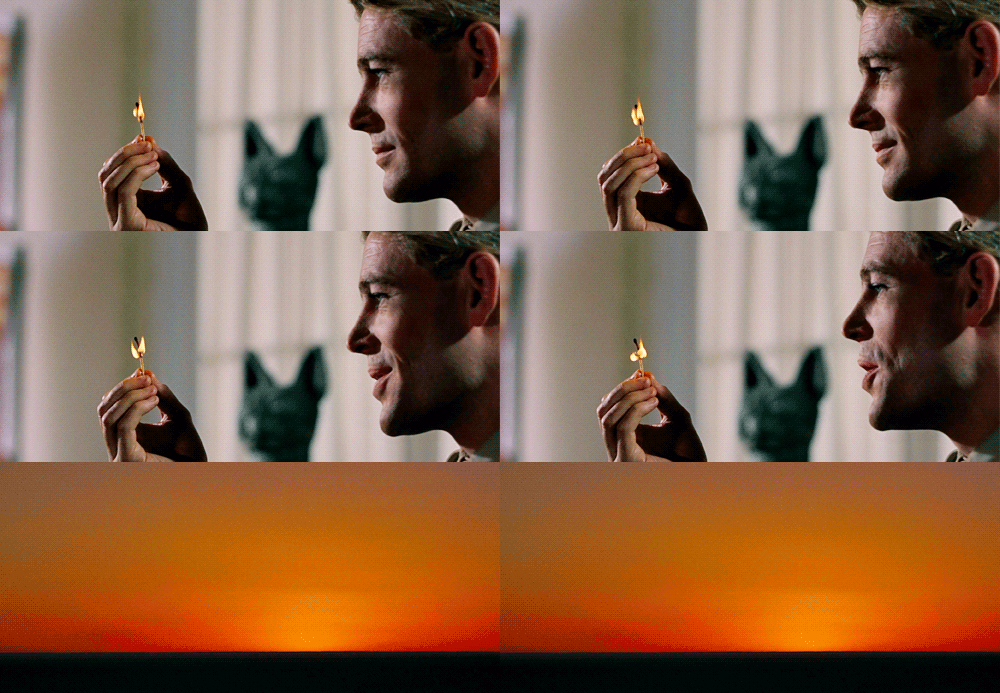
One would be remiss to announce a discussion of the visuals of Lawrence of Arabia without beginning at the most famous smash cut of the film, one of the most famous smash cuts of any film:

Lawrence of Arabia (1962)

This is how Lawrence gets to Arabia. Due respect to the Old-West-to-South-America-via-NYC montage of Butch Cassidy and the Sundance Kid, but in Lawrence the journey to Arabia is not as significant as the journey in Arabia; but Lean’s matching of the two images does more than save time. There’s an ever-so-slight grin that Lawrence gives just before he extinguishes the match, enough to suggest a truth that he knows and we do not. Fire is one of the primary visual symbols of the film, and in retrospect the correlation between Lawrence’s ego and the story told by that single cut is highly revealing.

Continue reading Lawrence of Arabia (1962): Sand, Shadow, Fire, Fable

The Leftovers 2.2 – “A Matter of Geography”

Let’s state up front that “Axis Mundi” is a hell of a season premiere. It’s utterly disorienting in the best way possible, fresh and yet eerily familiar, pushing The Leftovers into uncharted territory. If the premiere boldly goes where no Leftovers has gone before, then “A Matter of Geography” is the return to Earth, the necessary where-are-they-now refresher that connects the seasons in a narrative sense.

It’s not anywhere near as strong as “Axis Mundi”, but “Geography” is still a highly emotional hour. There’s a niggling sense that the cliffhanger at the end of “Mundi” won’t be revisited for a few more weeks, as “Geography” takes us back to Mapleton and next week’s episode looks to be dealing with the New York town as well, reconnecting with Laurie and Tom Garvey. But there’s more than enough in “Geography” to touch on in the lead-up to that final scene, which mirrors the final scene from the premiere but adds a completely new dimension to it.

Continue reading The Leftovers 2.2 – “A Matter of Geography”

Steve Jobs (2015)

97% of Steve Jobs is nearly perfect. Much like the products borne of the man’s unparalleled creative vision, everything in his latest biographical film is optimized, streamlined, rounded when the edge should be rounded, sharp when the edge should be sharp, forward-thinking, life-changing, and pitched to be perfect. The performances are subtle and explosive, depending on which character you’re dealing with. The drama is heavy-duty; the comedy is excitingly witty. The pacing of the whole film is breathless. And the writing — whew, the writing — Aaron Sorkin has probably never been this good or done this much with a film script. This is ostensibly The Social Network 2.0, a story about a genius/jerk who defined the times for the rest of us, except Steve Jobs has a richer character in the driver’s seat.

And in comparing the two, that leftover 3% only becomes all the more glaring. The structure of the film is unique, built over three days in history: the launch of the Macintosh in 1984, the launch of the NeXT computer in 1988, and the launch of the iMac in 1998. The aforementioned breathlessness of the film is derived from setting each episode immediately before these launches, as that’s probably the most stressful and nerve-wracking collection of hours in any product launcher’s life. No different in Steve Jobs. Jobs needs everything to be perfect, every address to start exactly on time, every personal grievance from his staff and family (of which there are many, and between which the words staff and family mean less and less) to be voiced and dealt with. “It seems like five minutes before every launch, people go to a bar and get drunk and decide to air their grievances,” says Jobs.

Continue reading Steve Jobs (2015)

Film & TV News: October 13

News

  • Both the New York Film Festival and the New York Comic Con concluded this weekend. From the former, I’d like to give a sarcastic shout-out to the idiot who talks through the Closing Night premiere and is inevitably seated right next to me; from the latter, I’d like to give an actual shout-out to the girl dressed as Harley Quinn that I saw zipping through Grand Central. Nice mallet.
  • Quentin Tarantino is cutting two versions of The Hateful Eight (rather than, you know, eight versions), one for 70mm and one for the rest of the peons to check out in digital. I really cannot for the life of me think of a good reason for this, other than because he’s Tarantino.
  • Jeff Goldblum, Bryan Cranston, Bob Balaban and Edward Norton will be voicing a pack of dogs for Wes Anderson’s next stop-motion animation film. Even if you’re not a huge Wes fan, that’s a pretty top-tier voice cast.

Continue reading Film & TV News: October 13

The Leftovers 2.1 – “Axis Mundi”

If 2% of the world’s population — call it roughly 140 million people — suddenly vanished one day, the world would change, right? Everything would be different, right? Religion would be shaken for some, as we saw last season on The Leftovers in the third episode “Two Boats and a Helicopter“. Grief, as a concept, would take on a new complexity as in “Guest“. Heck, even the ATF would necessarily expand to become the Bureau of Alcohol, Tobacco, Firearms, Explosives and Cults (obviously). Three years after the Sudden Departure, Carrie Coon’s Nora Durst lives her life (again, in “Guest”) in what appears to be a normal way: she goes to the grocery store and takes the trash out. But Leftovers unveils something underneath those trips to the grocery store and to the trash barrel, betrays a world changed but changed only beneath the business-as-usual facade.

I expect as much to be the case with Jarden, Texas, a town that miraculously was unaffected by the Departure. All 9,261 citizens of the town were “spared”, turning Jarden into a mecca for those believing it to be the only safe haven on the planet. It’s now billed as Miracle National Park, and tourists flock by the thousands to breathe the air of the place that God saved. The change of location from Mapleton, NY, works on several levels, providing more than fresh faces and fresh challenges. The sparing of Jarden is no more explicable than the Departure everywhere else, and thus we get a fresh take on the world of The Leftovers as well, one where the whole business of “not knowing” is framed as a positive thing instead of a tragic thing. In Mapleton everyone asked what happened, and we talked about how Leftovers will never actually answer that question. Here, in Jarden, whoever asks what happened is met with a chorus of justifications from God saved us to stop asking and just be thankful.

Continue reading The Leftovers 2.1 – “Axis Mundi”

Miles Ahead (2015)

The 53rd New York Film Festival came to a close Saturday night with the world premiere of Miles Ahead, Don Cheadle’s longtime passion project about the late great Miles Davis. An actor of Cheadle’s caliber attached so fully to a single film might be a rarity, and in this case it’s the lead role, the directing, and the writing that all fall in the man’s wheelhouse…and he co-produced and wrote original music for the film. And he was in Avengers: Age of Ultron just a few months back.

Interestingly, the similarities between the vigilante War Machine and the musician Miles Davis make it evident what Cheadle saw in both charac…just kidding. Miles Ahead is the best thing Cheadle’s done since Hotel Rwanda, or at the very least the most substantial role since then, and thus an overdue reminder that Cheadle is a fantastically likable leading man. He’s likable even when he’s playing Davis at his lowest point, a five-year creative drought fueled by cocaine and loneliness that makes up the majority of Miles Ahead, and through all the stubbornness and figurative horn-tooting (sorry) Cheadle still conveys the fact that Davis was overflowing with passion for his art. It’s fitting that the actor, who took eight years to craft Miles, matches the musician in passion for his own art.

Continue reading Miles Ahead (2015)

The Measure of a Man (2015)

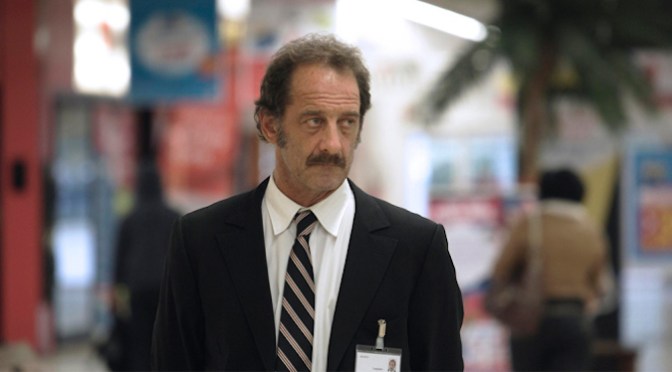
A film like The Measure of a Man needs the right actor in the leading role, and Vincent Lindon is the right actor. He’s not commanding, but he’s dignified; he’s not emotive, but he’s emotional; he’s not a force of nature, but if he is then he’s a fault line waiting to quake. He’s always just about to boil, “simmering”, maybe, but then again there’s even less violence in his demeanor than there is in a pot of increasingly hot water. Lindon is simply comfortable, at ease and natural in a tie or a T-shirt, genuine as if he’s blissfully unaware of the camera in his face (and in Measure it’s really in his face).

On the other hand Lindon’s character, unemployed factory worker Thierry Taugourdeau, is decidedly uncomfortable. There are very few opportunities for Thierry to just loosely enjoy life in his own body in the manner of the actor portraying him; Thierry can’t afford that. He’s confronted with his financial realities during every waking moment, sometimes explicitly and sometimes during a scene of him dancing with his wife, and Measure presents Thierry during a time in his life when his employment is everything. He’s like a saggy old Augie March in a rotation of labor by necessity instead of by election; instead of working in jobs dictated by his pride, he takes what he can get and usually has to suppress that pride.

Continue reading The Measure of a Man (2015)