The Leftovers 1.3 – “Two Boats and a Helicopter”

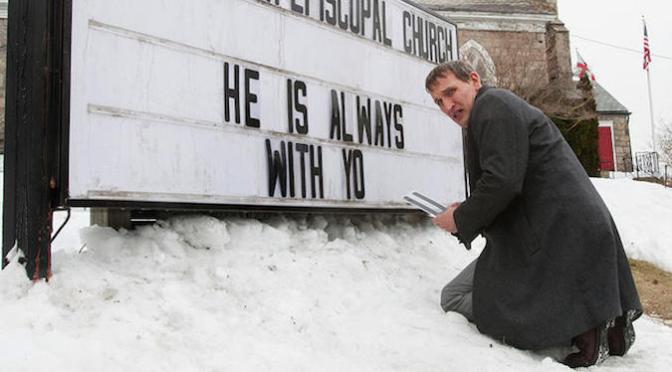
Alongside the sixth episode “Guest”, “Two Boats and a Helicopter” provides the most effective hour of character drama in the stellar first season of The Leftovers. The first episode to zoom in on a single character depicts the sad struggle of Reverend Matt Jamison, portrayed with suitable passion by Christopher Eccleston, in the wake of the mysterious Departure. The first and second hours showed glimpses of Matt, passing out flyers at a rally that damn the Departed rather than deify them. “It was not the Rapture!” maintains Matt. In “Two Boats and a Helicopter”, he reveals what he thinks the Departure actually was: a test.

And his sister Nora sums up one side of the episode with perfect succinctness: “if it was a test, I think you might be failing it.” Thus is his post-non-Rapture existence a continuous test of faith wherein Matt attempts to hold onto his beliefs in the face of that unthinkable and impossible event. Matt’s story keeps turning in on itself, offering hope in one instant and ripping it away just as quickly. It’s a cruel-seeming existence, one that forces Matt to eventually view the smallest of occurrences as a direct sign from God. After a certain point, the letdowns are more or less inevitable.

Continue reading The Leftovers 1.3 – “Two Boats and a Helicopter”
White God (2014)

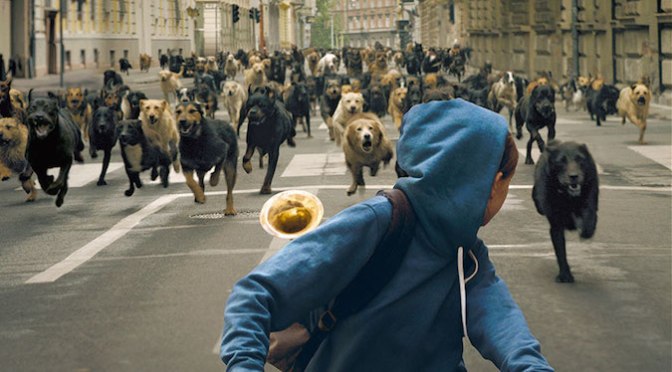
One of the most egregious snubs in the history of the Academy of Motion Picture Arts and Sciences concerns last year’s Best Actor trophy, and no, it has nothing to do with Leonardo DiCaprio. Eddie Redmayne walked away with the Oscar for his turn as Stephen Hawking in The Theory of Everything, and indeed his performance was groundbreaking and heartfelt. But it pales in comparison to the tour de force delivered by Body, the Hungarian star of Kornél Mundruczó’s White God, in his role as the tortured, tragic, life-loving, revenge-seeking, slobber-mouthed Hagen. Due respect to Redmayne, but Body’s performance is simply one of the most emotional and drool-covered performances in years.

As a young actor Body was met with obstacle after obstacle as he tried to make ends meet while pursuing his craft. He auditioned for some of the most iconic roles of our time and even received a callback for The Beast from The Sandlot, but the dude who played Mr. Mertle claimed Body was “impossible to work with” and cited the Hungarian-English language barrier as a primary qualm. He was an extra in Air Bud: Seventh Inning Fetch but soon disowned the film and distanced himself from the creative vision of the entire Air Bud series. Body struggled to be taken seriously as an actor, forced to take work in Iams commercials and as a busboy of sorts in the alley behind an L.A. hotspot.

Continue reading White God (2014)

The Man with the Golden Gun (1974)

After dragging Sean Connery back one last time for Diamonds Are Forever, the hunt was on for a new Bond that would be so kind as to stick around for more than one movie. That meant the first movie starring this new Bond would have to be really good; instead, it was Live and Let Die. No more Connery to be found here, sadly, but also no more world domination plots or supervillain nutjobs — just drug trafficking and regular nutjobs. Live and Let Die is weird, sure, but it’s not good weird. The film is too weak and Roger Moore is too clueless for any of the weirdness to cut through the muck. But the follow-up The Man with the Golden Gun is weird, is good weird, and may in fact be the best weird you’re going to find in the entire Bond franchise.

The film was more or less pronounced Dead On Arrival. As Moore’s second outing, The Man with the Golden Gun continued to fail to live up to any of the Connery Bond films. You name it, the critics decried it: weak plot with low stakes; weak dialogue; weak delivery of that dialogue, particularly from Moore’s Bond; weak Bond girl Mary Goodnight; stupid, unimaginative gadgets like a flying car; stupid, unimaginative inclusion of that fat sheriff from Live and Let Die; and, most damning of all, the simple and nearly indescribable fact that something about this doesn’t feel like a Bond movie. “Maybe enough’s enough,” wrote one critic, which is a funny thing to read with Spectre, the 24th film in the series, being released this year. Nowadays we know that it doesn’t matter how terrible Bond gets, or how many films in a row are stinkers, or how many miscast actors are handed the license to kill. There will always be another Bond flick, another ten, until the time comes to cast an invading alien as 007 (coming to zombie-infested theaters everywhere).

Continue reading The Man with the Golden Gun (1974)

Saturday Night and Sunday Morning (1960)

Did you know that Albert Finney was young once? Weird, right? He occupies such the Old British Guy post nowadays that his Young British Guy seems like a completely different actor. Time, of course, has a bit to do with that, as Finney’s had a long career full of great roles (Murder on the Orient Express), not-so-great roles (Looker) and, at present, increasingly smaller roles than he deserves (Skyfall). But it’s not just the passage of time that makes a return to Saturday Night and Sunday Morning, a film I first saw in college, a bit of a jarring experience. That’s because the difference isn’t so much Old British Guy vs. Young British Guy at all — it’s Old, Lovely British Guy vs. Young, Dickhead British Guy.

Come on, you say, that’s simplifying it a bit too much. It certainly is. Finney’s Arthur Seaton, the prototypical angry young man at the center of Saturday Night and Sunday Morning, in fact has more than a few responses to such “insults” that approach perfection here. His entire social stance is a refutation of the notion that you or I or Doreen (Arthur’s girlfriend) or Brenda (Arthur’s other girlfriend) or anyone else would presume to know the first thing about him. A bit from his famous soliloquy:

Mam called me barmy when I told her I fell off a gasometer for a bet. But I’m not barmy — I’m a fighting pit-prop that wants a pint of beer, that’s me…but if any knowing bastard says that’s me I’ll tell them I’m a dynamite dealer waiting to blow the factory to kingdom come. I’m me and nobody else. Whatever people say I am, that’s what I’m not. Because they don’t know a bloody thing about me.

Continue reading Saturday Night and Sunday Morning (1960)

Film & TV News: August 26

News

  • Lots of production at the Rumor Mill this week, including the possibility of Mad Max‘s George Miller taking on directing duty for a future Superman film; there’s the possibility of Jon Hamm playing the villainous Negan in The Walking Dead; and there’s the strange possibility of Star Wars: Rogue One utilizing a CGI version of Peter Cushing’s Grand Moff Tarkin. Likely? Unlikely? Awesome? Weird? Both?
  • The New York Film Festival slate is shaping up well this year, including as a bit of a surprise Paul Thomas Anderson’s Junjun, a short documentary about Radiohead guitarist and There Will Be Blood composer Jonny Greenwood.
  • Christian Bale will reportedly play Enzo Ferrari for Public Enemies director Michael Mann, continuing the ill-advised trend of Not Being Batman Anymore.
  • Motion State turns 1 this week! A special thanks to all of our contributors and readers.

Continue reading Film & TV News: August 26

Thunderbolt and Lightfoot (1974)

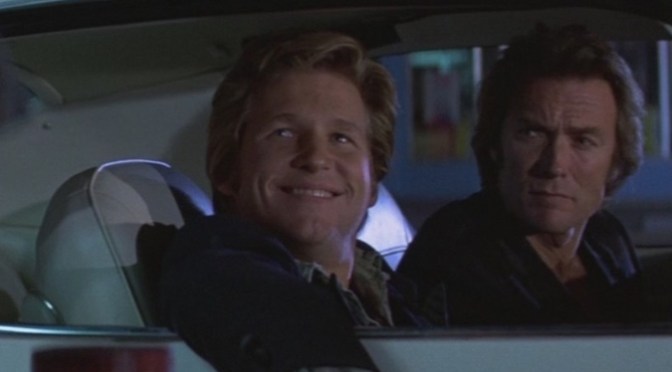
Progress — that’s what Thunderbolt and Lightfoot is about. The buddy dramedy is about more than that, of course, from women-chasing to bank-robbing to cross-dressing. Five years after Butch Cassidy and the Sundance Kid, Clint Eastwood’s stoic Thunderbolt and Jeff Bridges’ anything-but-stoic Lightfoot came closer to capturing the same verve and tragedy of American rebelliousness than most films in the ensuing forty years. It’s part road flick, part heist flick, part character study. In the simplest sense Thunderbolt and Lightfoot is a drive-in movie, complete with laughs and adventure and car chases and a few explosions for good measure; in a more complex light Michael Cimino’s directorial debut yearns for the American Dream, for satisfaction greater than that offered by everyday life, for an accomplishment, for progress.

The comparison with George Roy Hill’s Butch Cassidy isn’t borne entirely of the fact that the protagonists are a pair of BFF criminals, and Lightfoot even takes direct issue with that label — “criminals” — before the final credits roll. Butch and Sundance are battling against the death of the West they love, the West in which they thrive. Bigger guns, bigger armies, bigger bank vaults — the world’s changing whether they like it or not. Still, it’s their own perception of the world that really matters, especially in Butch’s case. “I’ve got vision,” he tells the Kid, “and the rest of the world needs bifocals.”

Continue reading Thunderbolt and Lightfoot (1974)

Straight Outta Compton (2015)

I think it is fair to assume almost every college student under the age of 21 has belted (or at least disgruntledly murmured) the words “Fuck Tha Police.” Straight Outta Compton puts the phrase in a more important context, believe it or not (what’s more important that one’s passionate lust for underage drinking, right?). Starring O’Shea Jackson, Jr. (Ice Cube-incarnate) and a band of eerily-similar-looking-to-the-real-life-people-they-portray and actually quite gifted actors, Straight Outta Compton tells the story of the famously infamous revolutionary rap group N.W.A.

The first hour/hour-thirty of the film immerses the audience in the world of late ’80s Compton, California. It’s a rough world, of course, filled with drugs and violence, but it is not necessarily filled with bad people. This is an unfair world, where the people put in charge of protecting those who live in it, are, in fact, a significant source of pain and distress. The misguided thoughts and actions of many members of the Los Angeles Police Department led directly to a sense of great tension and justified rebellion.

Continue reading Straight Outta Compton (2015)

Rising Sun (1993)

1993 is very likely the pinnacle of Crichton-ness: Jurassic Park shot the writer to a level of stardom he’d only grazed with the likes of The Andromeda Strain and Westworld, and filmmakers scoured his existing properties for an opportunity to catapult themselves into Spielberg-level notoriety. This needed to happen fast, before anyone else jumped on a Crichton adaptation, but there were essentially only three of his novels that hadn’t yet been adapted. One was Congo, which featured super-smart gorillas, so that wasn’t much of an option (until it was, years later); second was Sphere, a really weird subterranean “imagination adventure” that couldn’t possibly be adapted (until…well, you know); and the third was Rising Sun, a relatively low-key murder mystery masquerading as a cultural economic diatribe (or is it a diatribe masquerading as a murder mystery?) that seemed to provide a perfect mix of commentary and storytelling. For quick kicks, the choice was an obvious one.

And as tends to happen with projects undertaken for such reasons, Rising Sun sadly marks the downward trend in Crichton adaptations sloping sharply away from Jurassic Park. Probably anything would fail to measure up to Park, but the tale of clashes that is Rising Sun failed thoroughly in every arena (except the box office — it rode Park‘s wave to a pretty good domestic haul). TGSC, baby. TGSC.

Continue reading Rising Sun (1993)

The Man from U.N.C.L.E. (2015)

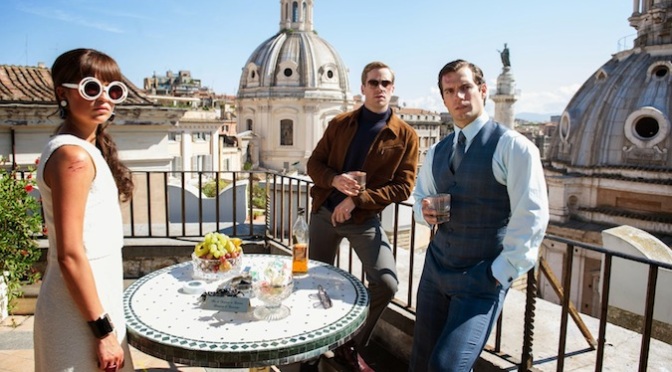
It’s fairly easy to spot a Guy Ritchie flick, and in his most recent movie The Man from U.N.C.L.E. a few of his trademark flourishes find their best use yet. Henry Cavill and Armie Hammer fill the suits first worn by Robert Vaughn and David McCallum in the ’60s television show and globetrot around the Mediterranean attempting to out-spy one another. There are three or four plots going on at once — one’s a crusade to stop a maniacal heiress from obtaining a nuclear weapon, one’s a love story, one’s a hopeful reunification of father and daughter —and so Ritchie’s penchant for hand-holding and retreading ground we’ve already covered is actually quite useful at times.

Mostly, though, the moderately bogged-down plot is just kind of there; the style, the mood, the unending suaveness of the two leads — that’s really what counts in Ritchie’s Man from U.N.C.L.E. There are some slick sequences that don’t make you forget the plot but make you simply not care about it, sequences that lose you, purposefully and gleefully, in the zippy catchiness of it all. There are some slow bits and, again, the retreading of information gets tedious as it does in other habitual instances throughout Ritchie’s filmography. But mostly this movie is all about the flow, and even if the scene-by-scene progression isn’t flawless the pacing within the scenes themselves is fantastic.

Continue reading The Man from U.N.C.L.E. (2015)

Face Off: The Voices (2014) and Kingsman: The Secret Service (2014)

Motion State Face Offs pit two films, franchises, or television series against each another for no reason other than because we can.

There are ostensibly only a small handful of things that The Voices and Kingsman: The Secret Service have in common. Both are 2014 releases with a satirical vibe that sometimes plays as downright cartoony. Both are Rated-R violent. Both played on a recent transatlantic flight that I took. They’re both movies, too, and both star actors and actresses and have titles made up of letters. The fact that Voices and Kingsman both exist is their greatest commonality, although it’s not necessarily something you’re particularly happy about once you realize that all of these other really good movies — hey, they exist too.

And therein lies the actual thread linking Voices to Kingsman. The former stars Ryan Reynolds as a meek little manchild with an odd little habit of talking to his pets. He hears their voices in his head, and he and his cat and his dog have some rollicking conversations. Oh, yeah, and he also has a penchant for killing people and chopping them up, too. Kingsman is a spy flick that might be a spy spoof, following a young lad named Eggsy as he’s initiated into a secret service of super-suave sleeper scouts. Taron Egerton plays Eggsy, but the show is stolen by his mentor figure Galahad, played by Colin Firth. In both cases we have pretty solid cast at hand. And in both cases nearly every single one of them is slumming it.

Continue reading Face Off: The Voices (2014) and Kingsman: The Secret Service (2014)