Daredevil – Season 1

If anyone has shown a dedication to the long game in big-budget storytelling lately, it’s Marvel. The latest addition to the ever-expanding Cinematic Universe is the Netflix series Daredevil, chronicling the early days of lawyer Matt Murdock and his crimefighting alter-ego. In many ways Daredevil is the best thing to happen to the MCU in a long time. Not only is it far superior to Marvel’s other television ventures Agents of S.H.I.E.L.D. and Agent Carter, but it often packs more of a punch — physically and emotionally — than the majority of the MCU films. The lack of cable television limitations or MPAA ratings means the show can be as dark as it needs to be. Most importantly, though, Daredevil shies away from the typical overblown grandiosity of many MCU ventures and opts instead for a very human drama.

It’s still a hero vs. villain thing we’re dealing with here, of course, but Daredevil is at its strongest when it plays away from that (striking the super– prefix from both hero and villain). Murdock gets his ass handed to him on a regular basis, Wilson Fisk is diabolical and yet relatable, and the street-level politics of the show are far more interesting than the end-of-the-universe Avengers stories. This is true of the comics, too, and as with live-action Daredevil it took a while to get the character right. There are a whole host of comic book influences for the Netflix series — primarily the Frank Miller tales The Man Without Fear and Born Again —which we’ll dive into now. Ye be warned: spoilers abound.
Continue reading Daredevil – Season 1

Assault on Precinct 13 (1976)

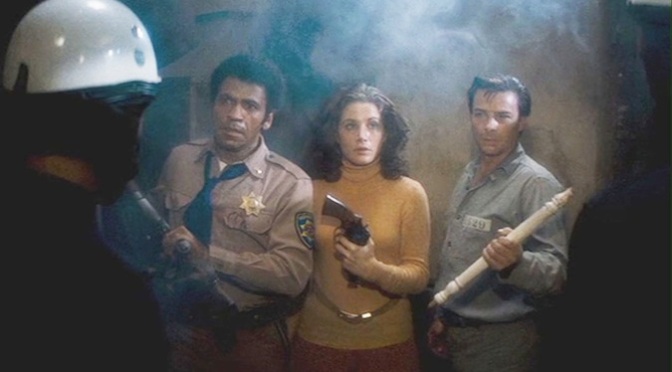
There’s a building on a quiet alley in a rundown part of the city that’s almost abandoned, draped in shadow and disrepair. Inside the building is a collection of individuals from vastly different walks of life. There is a supervising lieutenant freshly assigned to the job. There is a grief-stricken father in the throes of shock after discovering his murdered daughter. There are two dainty secretaries wearing sweaters (one orange, one yellow). There are three hardened criminals, one of whom is sick with a possible virus. Each of the people inside the building is an individual with an individual story. Outside is different. Outside is a creeping evil, a legion of hunters that is nonetheless a single faceless and motiveless mass, no individual stories to be found. The hunt is all.

…sounds like a horror movie, right? Like the kind John Carpenter might make? Even beyond Carpenter, this is not at all an unfamiliar formula for fright-fests — strangers unite against mysterious evil — serving as the entire premise of movies like Cube and Saw. The idea that something lurking out there will inevitably attack each stranger regardless of their differences is an inherently scary notion. And even though Assault on Precinct 13 isn’t necessarily a horror movie, it’s at its most effective when it operates like one.

Continue reading Assault on Precinct 13 (1976)

Better Call Saul 1.10 – “Marco”

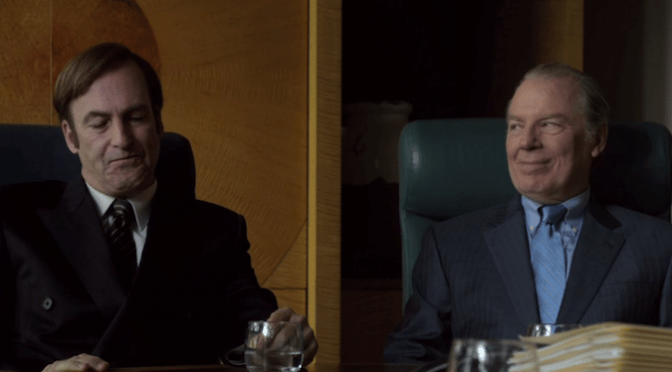
It’s been a week since the conclusion of the first season of Better Call Saul. “Pimento“, far and away the best single episode of the season (although I loved “Hero“), made sure Jimmy’s world was flipped upside down as we headed into the finale hour. Relationships that once meant the world to our morally-challenged lawyer are now seen in a different light, and people Jimmy once thought to be the scum of the earth are suddenly something else entirely.

It’s fitting, then, that “Marco” gives a name and a history to Jimmy’s one-time best friend Marco. In “Hero” we saw a glimpse of Slippin’ Jimmy’s adeptness in the short con game, and if he’s The Sting‘s Johnny Hooker then Marco is his Luther Coleman. After the events of “Pimento” Jimmy returned to his old stomping grounds and found Marco exactly where he left him, asleep at a bar in the middle of the afternoon, scraping by on a crappy job and a handful of half-assed scams.

Continue reading Better Call Saul 1.10 – “Marco”

Film & TV News: April 13

News

  • Stephen King’s The Dark Tower is getting “fast-tracked” — whatever that means nowadays — at Sony Pictures. The fantasy series has long been rumored for a film adaptation and had Ron Howard attached as director at one point, but now it sounds like it might actually get made.
  • As his latest film Furious 7 continues box office domination, director James Wan is now rumored for DC’s Aquaman film. According to a consortium of critics known as Me, if the DC Cinematic Universe has a more cohesive storyline then they should be able to stray in tone and mood from Zack Snyder’s pout-fests without seeming out-of-place. The more unique the directorial vision, the better.
  • The complete Star Wars saga is now available for the first time in Digital HD, just in time to watch all six movies a dozen more times before The Force Awakens comes out.

Continue reading Film & TV News: April 13

The Red Road 2.2 – “Graves”

A relatively quiet second episode of The Red Road‘s sophomore year provided a little more clarity with regards to the direction the show might take after a cracking first season. The impetus for much of the going-ons here is the murder of Mac, elder chief of the Lenape chapter of the Ramapo Mountains, which we saw at the end of the the second season opener “Gifts“. As suspected, Phillip Kopus is now the front-and-center suspect in Mac’s demise.

A recent interview with Jason Momoa touched on the “breaking” of the Kopus from the first season; Aaron Guzikowski, creator of Red Road and scribe behind Denis Villeneuve’s Prisoners, certainly seems to be heading in that direction with “Graves”. It’s interesting that Kopus more or less shuns the traditional trappings of his Lenape ancestry and yet seems to find himself cornered by it throughout the opening episodes of the second season. That disregard for the tribe led to Mac’s abandonment of him, which in turn presents a motive for people to attach to Kopus when Mac turns up dead. Even though the mountains have their own tribal police force, the method of attack on Kopus is the same as it has ever been, with a “half-assed lynch mob” (in Kopus’s disdainful estimation) beating him and covering him with tar.

Continue reading The Red Road 2.2 – “Graves”

Skyfall (2012)

For such a successful franchise of movies, there is no denying that of the 23 James Bond installments, a handful of the movies are nothing special on their own. That is to say, strip away the Bond allure and you’re left with a lot of movies that probably resemble a 2014 Kevin Costner film (3 Days to Kill, Jack Ryan: Shadow Recruit… you get the picture). But the most recent entry Skyfall certainly does not fit into this category of Bond movies. In many ways, Sam Mendes’ first Bond movie is not a typical Bond film; making it not just a great James Bond movie, but a great movie in general.

Mendes gives the viewer this sense early when Q says to Bond — but really to the audience as a sort of aside — “what did you expect, an exploding pen?” It’s Mendes way of saying, “what did you expect, a typical Bond movie?” In the case of Q, what he gives Bond — a fingerprint encoded gun — is even better. And in the case of Mendes, what he gives the viewer is also far better.

Continue reading Skyfall (2012)

Casino Royale (2006)

Of the three Daniel Craig Bond films, two have been received with applause from audiences and critics alike. One of the two is Casino Royale, Craig’s debut as 007. Royale has changed the game as far Bond films go. No more (completely) preposterous gadgets or (literally) impossible feats are featured in this film. No more corny lines and no more maniacal, manacle-wearing, super-genius super-villains. Martin Campbell’s Casino Royale is rooted in reality. Of course, there is some stuff that might seem somewhat far-fetched, but you just don’t have yourself a Bond film without at least a splash of absurdity.

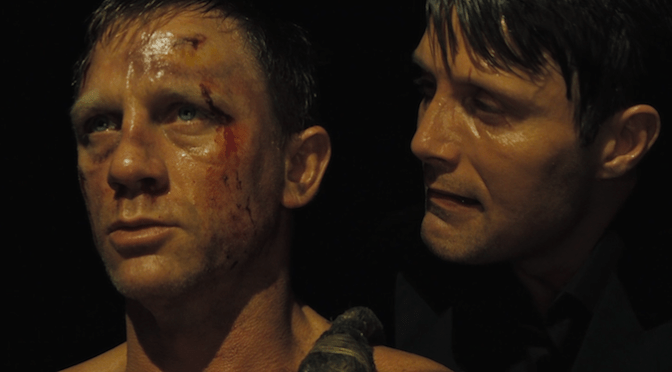
Daniel Craig is stupendous in this film. He fully embodies the perhaps overly confident, womanizing alcoholic who, at the same time, wears a badge of courage and integrity at (almost) all times. Craig portrays the smoothest Bond I have ever seen. I know what you’re thinking…probably screaming, actually. Connery will always be Bond, no one is saying otherwise. At the same time, Craig, in my most humble opinion, one ups him in the “I’m the coolest dude on planet Earth” department. It’s everything from the way he carries himself to the timing and delivery of his lines (every one of which hits perfectly). What is most notable, though, is the dark side that Craig brings to the timeless character. His orphanage is addressed in the film, the emotion behind his first kill is evident, and Bond drinks with a purpose throughout Royale. Craig makes it all work so well, from the stern look in his eyes as he races through the Miami Airport to the sarcastic smirks he makes at Le Chiffre (Mads Mikkelsen) from across the poker table.

Continue reading Casino Royale (2006)

The Hudsucker Proxy (1994)

The Coen Brothers’ filmography seems to alternate between “beloved” and “pretty much unknown.” For every Fargo and Big Lebowski there’s a Man Who Wasn’t There and A Serious Man. Nonetheless, it’s this writer’s opinion that each one of their movies is carefully crafted to near-perfection. (Okay, the jury’s still out on Ladykillers and Intolerable Cruelty. ) Of course, if I hold all their movies in such high esteem, what’s the point of a review? Well, because first of all I want you to know that The Hudsucker Proxy exists. And secondly because it deserves as much analysis as any of their other films.

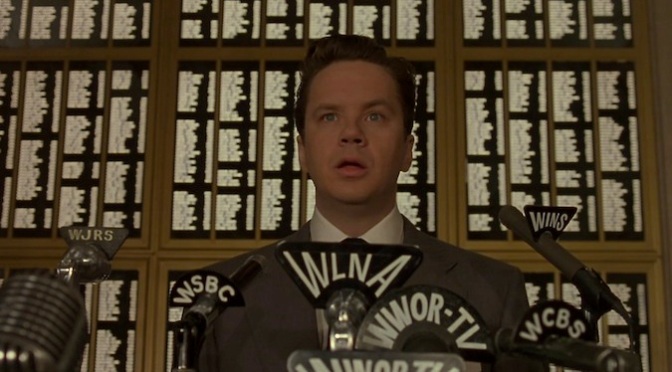
In a hyper-Art Deco 1930s Manhattan, Waring Hudsucker (Charles Durning), president of Hudsucker Industries, has flung himself off the top floor of the downtown headquarters. With company stocks about to go public, the board of directors, led by Sydney J. Mussburger (Paul Newman), plots to depress stock prices by hiring an incompetent president as a scapegoat and then buying back the company. That incompetent proxy turns out to be oblivious business student Norville Barnes (Tim Robbins). But that’s only the beginning of the Coens’ madcap screwball parody that satirizes every rung of the workforce ladder, from the mailroom grunt to the head honcho. Continue reading The Hudsucker Proxy (1994)

Better Call Saul 1.9 – “Pimento”

Sometimes we don’t get to dive into each individual episode of Better Call Saul as deeply as we’d like. We have busy lives! Important things to do! Climb that mountain! Finish that novel! Make that bed! Drink that beer! Eat those chips! If there’s anything to knock routine by the wayside and demand our full attention, though, it’s Saul‘s ninth hour “Pimento”, the penultimate episode of the first season. The mountain and the novel and the unmade bed will have to wait (the beer and chips are right here, because multitasking); in this review we aim to pick apart the incredibly dense “Pimento” and put it all back together again.

First up: some self-congratulatory horn-tooting for kinda sorta predicting the big reveal of “Pimento” in our review of the previous episode “RICO“. We’ll save our discussion of that until after the jump for the sake of spoilers, but for now let it be sufficient to state that our reputation precedes us, that we have no equal on this earth, that the tales and songs fall utterly short of our enormity. Gaze upon our magnificence. We are fire. We are death.

Continue reading Better Call Saul 1.9 – “Pimento”

Westworld (1973)

Though known primarily for his novels, Michael Crichton made a name for himself in Hollywood not only through popular adaptations of his novels such as Jurassic Park and The Andromeda Strain but also by directing films himself for more than a decade. Westworld was both Crichton’s feature directorial debut (barring the ABC made-for-TV film Pursuit) and one of his earliest original screenplays. Plagued with production woes from the start, Westworld is largely renowned today as a major landmark in science-fiction cinema and an important advancement in film technology.

As David A. Price writes in this New Yorker piece, computer-generated imagery is commonplace at the movies these days. Star Wars gets a lot of the credit for sparking the technological revolution in Hollywood (although there have been a few technological advances since then), and it’s certainly true that the effects team behind that space saga deserves most of the commendation in which they bask. But if the question is where did all of this start?Star Wars and Avatar and every other CGI-laden movie of the past thirty years — then the answer is almost certainly Westworld.

Continue reading Westworld (1973)